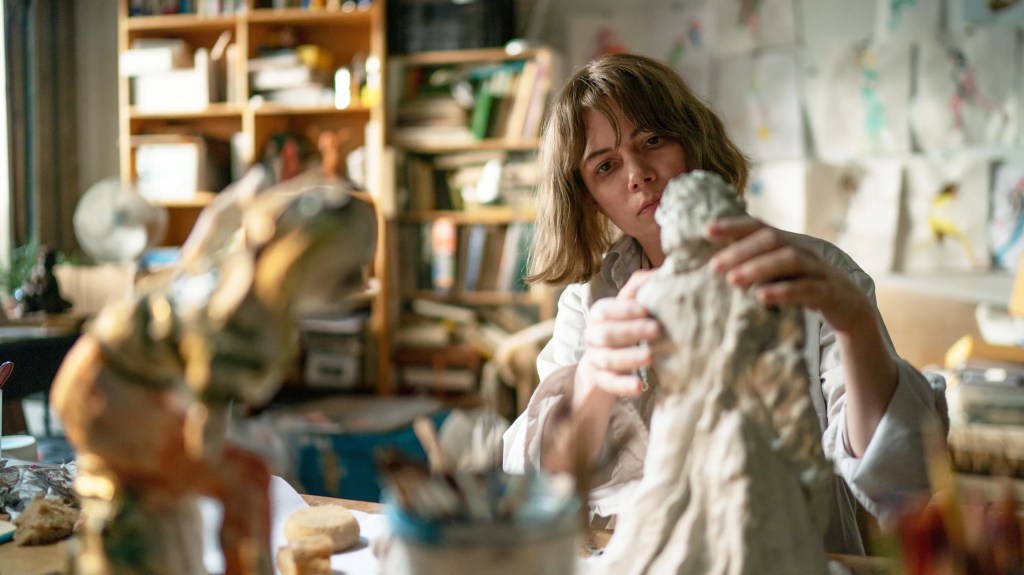
It’s therapeutic watching Michelle Williams gently tender her sculptures, or any artist in the film for that matter. What a joy it is to observe people work. The film opens with design sketches, ends with a finished gallery, and is filled with interstitial sequences of individuals working on their niche art pieces within communal spaces. In a way, this is Kelly Richardt crafting artifacts within an artifact by caring for every minute detail in this artistic community. By the end, the audience has experienced an entire artistic cycle. It celebrates the communal joy of art through the personal perspective of Lizzy.
Films often present excelling or suffering artists, that’s why there are dozens of Van Gogh biopics out there, as he is the trademark of both. The idiosyncrasy of Showing Up lies in its portrayal of a middling artist. Lizzy is not scraping the bottom of her pockets to keep her dreams alive, nor is she on the rise or achieving any significant success. The film is essentially probing into the pure joy and tension of an art milieu through wry, humanist lenses. Michelle Williams is subtly brilliant here. Deep glances of jealousy, resentment, and desperation for connection all delineate a deeply caring introvert with an angsty facade. Her eyes light up when she sees her father talking about her work, she apologizes to the sculpture when she has to redo its arm, she hates the pigeon for interrupting her work but still takes it to a vet. Her social tendencies are off-putting ostensibly, but Reichardt is too much a master of natural dialogues to allow Lizzy to become one-dimensional. A memorable sequence is when she enters the national looking for a place to shower, where she sees Jo’s art piece. The scene cuts to a close-up of her face, we see her eyes glowing up. Inside those tiring eyes, there is always something burning to create. What makes this film connectable is its understanding of Lizzy’s motivations without ridiculing or sensationalizing them.
A more personal aspect I found so endearing is Lizzy’s need to connect with people. It’s done in such a subtle way that speaks dearly to me as a fellow introvert. It’s an odd paradox where I minimize my interaction with people but yearn for those connections when I’m down. When Lizzy hears Jo and Eric giggly enter the neighbouring house at night, her loneliness shines in her eyes. The camera then pans to the right where she tends to the pigeon. The pigeon to me is not simply a metaphor for broken wings and healing. In fact nothing in Lizzy’s life is healed nor is she by any means freed by the end of the film. She will always have trouble opening up to her colleagues, she will probably have another nervous breakdown when her next sculpture doesn’t come out well, her family is still weirdly dysfunctional, and who knows if something come up to delay Jo from fixing the water heater. The pigeon to me signifies nuisance we grew found of. Our lives are packed with spontaneous intrusions. Like Lizzy, these nuisance made me grumpy, but as I adjust to their existence I grew attachment. Somewhat similar to Lizzy’s father finding companion in the squatters taking advantage of him. They are essences of daily lives and art as their spontaneity is inseparable with our creative freedom. The clipped wing pigeon and the burnt sculpture are analogues indexical by fray turned accidental beauty – baring the resemblance between art and life. It all resolves in everyone showing up (hehe) to the show at the end. They all have their quirks, narcissism, and may came out of the oven imperfect, but they are part of a community anyways. As the bird flies free in the end the camera cleverly shifts perspective from Lizzy’s to the bird’s. As Lizzy and Jo slowly walks away for cigarettes, it’s the end of a creative cycle and a gleeful signature of “and life goes on”. This film is such a delicate capture of shared creativity with quiet philosophy of “art is life”.



 Cinema Travelogue
Leave a comment