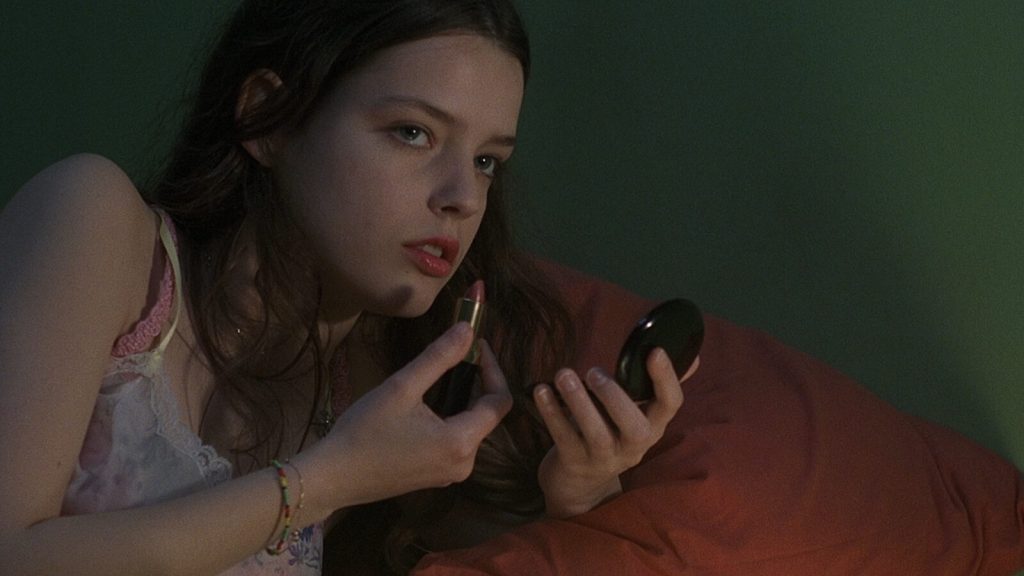
In Fat Girl, Breillat employs a naturalistic approach to telling the abrasive coming-of-age journey of two sisters. Her observation style strikes a fine balance between sordid provocation and stone-cold surveillance. The best example is the bedroom long takes of the 15-year-old Elena being lured, peer-pressured and sweet-talked into having sex with a much older Italian college student, Fernando, despite her reservations. The camera is kept at medium distance; it zooms and pans gently as if it’s too timid to intrude. The desensationalized images knowingly prevent indulgence of derivable pleasure, but they simultaneously reject cloying judgements or concrete statements on the perverse groping we are witnessing. There are no exclamation marks to condemn Fernando’s verbal trickery and lies and tell the viewers, “This is bad.” all we’re given is the gradual devour of the girl’s innocence, which avoids gentrification and only signifies how common and dangerous these experiences are in real life.
The younger sister, Anais, the titular fat girl sharing Elena’s bedroom, listens in and surreptitiously observes her sister’s sexual encounter. The film shifts from directly observing the sex scenes to close-ups of Anais’s face and leaves the ongoing sex in the blurry background. The camera captures her initially curious and excited by the burgeoning possibility of sex, covering her face with her hands but opening a crack between her fingers to still see the action; but later, she devastatingly sobs as if she’s the one bearing the burden of Elena’s stolen innocence.
The two girls’ relationship is symbiotic. Elena can only leave their vacation home and meet boys if she takes Anais with her. On their walks, the two would often engage in conversations about the idea of sex and losing virginity. Both their bitterness and affection for each other are well delineated and capture an unusually dark essence between siblings that is rare in film. They seem to be written in dichotomy. Physically, they are nothing alike. Elena is aware and takes pride in her physical beauty; in contrast, Anais is always seen eating or getting food, which Breillat claims to be a form of defence mechanism that shields her from the violence of men. Their conversations are often shot in front of and blocked by mirrors, which may symbolize they are the same person watched through a fractured glass.
Elena and Anais both have a precocious understanding of their place within the social conventions of beauty, but they’re nevertheless lost and scared when they are confronted with the darkest sides of the patriarchal society. Even worse, the adults seem to be portrayed as callous and materialistic and pay no attention to their children’s emotions except to shame them for their behaviours. When everything collapsed in a surprising apocalyptic ending, I felt a beguiling sense of relief as if the wall that suppresses both girls had collapsed or at least shaken a little bit. This is a film that’s never ashamed of any scenarios it shows to the audience, even the characters themselves.
This is a film I admire more than I love. The film after those two sex scenes dragged a lot for me. The problem is sort of mitigated in retrospect. A notable choice that builds up the ending is the presence of trucks around the family trio’s drive home, perhaps a symbol of the ubiquitous masculinity they can’t escape. I kind of needed the world to be more expansive for its thesis to fully work. Given Breillat also works as a novelist, the film’s vibes remind me of some bleak novellas I read during high school. Excited for Last Summer.



 Cinema Travelogue
Leave a comment