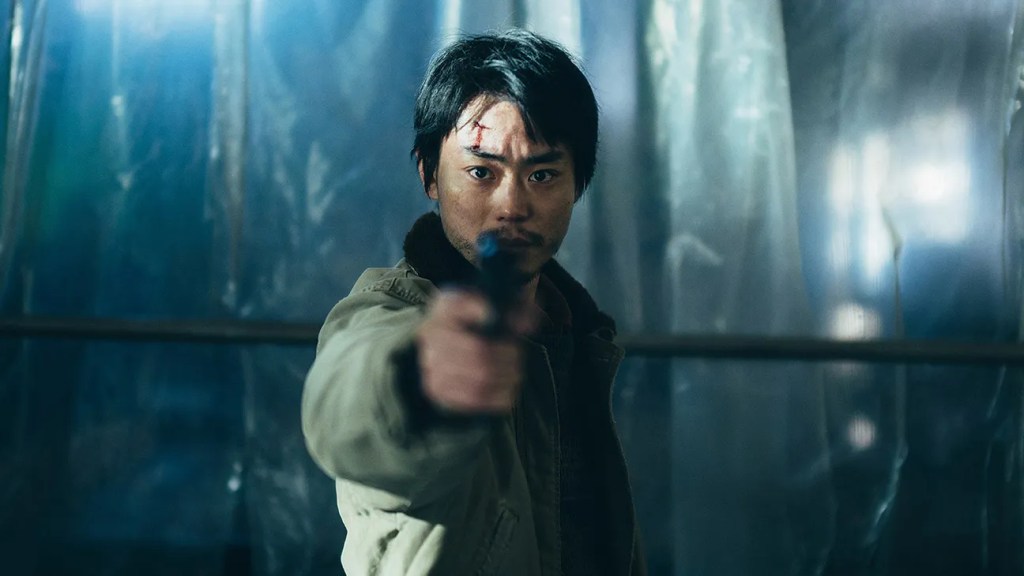
“I know a lot of people here love my film Cure, this film is not much like that,” said Kiyoshi Kurosawa before TIFF’s premiere of his newest feature, Cloud. He’s speaking the truth, the film is nothing like that hypnotic masterpiece, but not in any pejorative sense. In fact, 1997 seems so peripatetic from the perspective of this film’s aesthetics. While Brady Corbets is busy flying The Brutalist’s 300 pounds of film stocks from Venice to Toronto, Kurosawa made a film in digital with almost no smudges within its frames. When the camera pans too quickly, its featherweight movement offers the frames such a rushed blur – looking somewhat identical to when I shoot videos on my iPhone – it creates a form of hallucination on its own. But the conspicuous digital flatness is not to be mistaken for an inept director; instead, it’s the forefront tool to illustrate the type of desensitized, fabricated internet space that the main character resides in.
Ryosuke, aliasing as “Ratel” in the cyber world, makes a living out of reselling goods on the Internet. It’s a tricky business – one day, you’re the king of the world for foreseeing and capitalizing on the trend of consumerism; another day, you might be the loser who owns a garage full of fake bags nobody wants. It’s also not a very moralizing business. We first witnessed him callously lowballing the prices of electric equipment from an older couple and reselling them at double the price online. Played by an intimidatingly removed Masaki Suda (also the voice of the heron from The Boy and the Heron), the first time we see Ryosuke is during his most business savvy during the entire film. Crammed in his small apartment, he stares firmly and eagerly at his laptop screen, confined in a small storage room, the camera pans from the laptop screen to boxes of packaged and labelled goods to Ryosuke’s face, then intercuts between the screen and Ryosuke looking at the screen to work up the tension; his eyes gradually fill with excitement and sparkling signs of life as all eight of his resale posts strike a deal within the first five minutes. He’s on the top of the world tonight.
Such release of dopamine should be no strange feelings to anyone who has even a remotely parasitical relationship with the internet – friends commenting, fire emojis under your Instagram post, getting likes on Letterboxd, or even counting down the clock, waiting for 10 a.m. EST TIFF ticket sales window to open on Ticketmaster – this distinct and instinctual capture of life behind screens through a single sequence proves Kurosawa’s astute understanding of our current world. What’s more disturbing is that this would be the only time such satisfaction arises and the only thing Ryosuke is living out of.
There are other people in the scrappy hustler’s life. His girlfriend, whose material obsession grows incrementally across the film, his friend/foe fellow scalper, his boss at his current boring job who sees him as a prospective second in command, and several other colourfully, strangely delineated characters. To spoil how these characters would converge later in the film would be a disgrace. Kurosawa is never content with settling the film’s tempo. The Internet is an endless well, full of creatures who’ve inhabited a dark corner for too long. What does Ryosuke want? Make more money, make more sales, and be richer than anybody else alone. The film emerges as a potent observation of the endless pit the Internet has carved within us. Obsessiveness and passiveness show equal hands-on Ryosuke’s countenance. Despite the sporadic use of horror elements, it creeps up on you in the end rapidly, deliriously, and assuringly.
If there’s anything in Kurosawa’s films that beckons people to keep expecting him to return to his J-horror roots, it is that he’s so good of a horror director that he can’t help but pour its formal elements into his work, even not fully committed to the genre. Shadows lurking in the background, lingering shots of the back of Ryosuke’s head, thunderous blasts of gunshots on stone-cold iron. But these elements never quite cram up like his supernatural horrors, they burst immediately in an offbeat manner as if he’s teasing you for expecting such buildup in the first place, like hysterics that plague Ryosuke’s conscience. The adept use of horror vocabulary subverts, but never undermines the atmosphere of the film. Cloud is closer to a comedic horror a la Beau is Afraid. It has a masochist tendency that is never highlighted or explained even to the end. Ryosuke is living his worst life, the only version of his life, like all of his sins have materialized and every instantaneous pleasure or relief is stripped away. Murphy’s law applies, have you heard of Chekhov’s espresso machine?
The tonal whiplash during the second and third acts hold me back slightly, but also, as usual, I can’t think of anything else I would like the film to be. The fact that Kurosawa is willing to evolve and incorporate new genres and never lose control deserves a tremendous deal of respect. Not to mention how true the film rings when I am at a film festival where tickets for Anora and Megalopolis are being resold at hundreds and hundreds of dollars, kind of ironic, right? The ending also strikes me with how much of a trenchant and hysterical satire this serves on a lot of the world-domineering CEOs right now.
Like many other masterworks from Kurosawa, Cloud is a film full of narrative and formal pivots that offset your expectations yet tease you to continue watching, to look even closer. Like its digital surfaces, it shifts apart from any contour of traditional narrative, eluding the main character’s rise and fall relationship with his business, only to arrive at a boundless space with no reverberations of answers. Let’s all have a blast, while we continue cruising into the abyss.



 Cinema Travelogue
Leave a comment