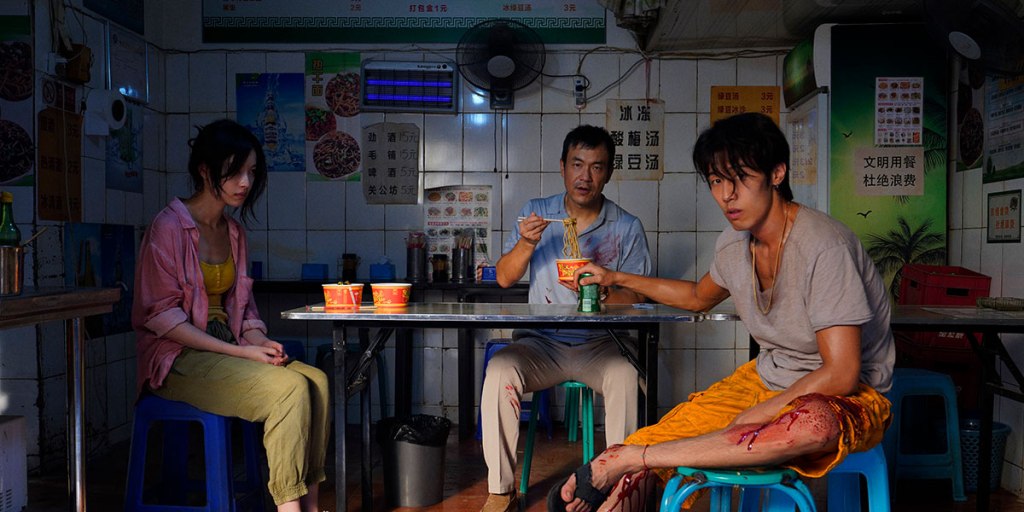
The moment fireworks fully reach the sky and explode is the moment they begin to fade. The two lovebirds in Bound in Heaven, Xia You and Xu Zitai, choose to embrace their lives as if every second is that brightest moment and forego the rest. In a film that hopelessly believes the illusive power of love can stampede everything in its way, our two main characters scream and ruminate and monologue about heaven and dying in each other’s arms. In fact, their fire burns so brightly that whatever else it tries to say or portray just evaporates in thin air.
Adapted from a Chinese novel with the same name, the story begins with a business mingling inside a high-up, ornate apartment in Shanghai. Xia You (Ni Ni), after showing a slight aversion to her fiancée (a macabre cameo from Liao Fan) for giving away front-row tickets to a Faye Wong concert, suffers another round of intense physical abuse from him. This is nothing new for this accomplished businesswoman, whose calm semblance before the pernicious violence only signifies the tragic cycle she’s trapped within. The promise of life seems to be dwindling down for her. Is this going to be the rest of her life when she marries? This is why the cool streetbound scalper Xu Zitai, whose terminal illness is still unknown to Xia, might seem like a breath of fresh air when she sneaks out to buy a new concert ticket for her favourite idol. Played by a transformative Zhou You, Xu exudes a raw, untamed energy that can set the world on fire. Despite knowing about his illness for a while, he prefers to live in the moment – something Xia craves in her life. As the traffic light around the corner of their encounter turns green, a tale of romance begins.
The first thing that Bound in Heaven succeeds at establishing is the formidable physicality between the two ridiculously hot people. Zhou You embodies a movie-star coolness; when he first appears – long curly hair almost covering his hair, hormones bursting out of his sweaty T-shirt – there is an instant gravitation towards his presence. His physical beauty is matched by Ni Ni playing Xia. There is a repeating visual motif of her thighs, we see them swinging in an empty alley when the two decide to go wild on the streets; they contain the power for a guy to overlook the abyss and live despite the worst of the worst. After Xu promises Xia a seat to see Faye Wong, we follow a sequence of Xu dragging Xia through the back of the concert stadium, only to reach a vacant room with a narrowly rectangular, dusty clerestory and finally lifting her leg above his shoulder in a clandestinely sexual position – her thigh touches firmly against his faces. These simultaneously wry and intimate moments cramp the physical attraction up to the temperature of a supernova. Needless to say, the two bodies clashed that night.
The fire steaming from this pure physical attraction serves as the foundation and impetus of this incrementally wild couple. As fate would allow, the two reunite in Wuhan a year later. Xia is on a business trip, and Xu is now running a small breakfast shop. The chemistry is still there, and as they spend more time with each other travelling to Xu’s bucolic hometown, they can’t simply be fuck buddies anymore. Director Huo Xin nimbly avoids a lot of heavy-handed moments when she introduces herself and gradually sees the two fall in love. We organically witness and understand the moment these two depressed souls seek out each other’s comfort. From the city at midnight filled with nothing but street lamps to the magic hour sunset, every scene these two spend together is set against the gorgeous backdrops of nature and the city landscape. The fornication makes instinctual sense, and Huo still remembers to remind us of their personal plights in a subdued fashion. There are only two elephants in the room, two ticking time bombs actually, Xia’s fiancé and Xu’s illness. How the film resolves or works around these two issues is now secondary to the fact that these two are brazenly heading on a pre-doomed path – a downward spiral of crime and fleeing.
If only the film’s interiority can be conveyed as well as its external elegance. Bound in Heaven runs into a common plight of keywords rambling when the two decide to proceed with their lifelong bounds. The film depicts the two’s connection in an undetailed and pompous fashion that makes it difficult to imagine what would these two even talk about away from the screen. During a key bounding scene that involves a very literal metaphor, the outward bursts of emotions seem more similar to young adult fiction adjacent cringe than a carefully thought-out emotional progression. It’s easy to tell both have a myriad of devastations running through their minds, but the way the film goes about them comes to a halt in front of its breathtaking visuals. Like Xia said so herself, “I like to be with you, I don’t even know why”. Neither does the film.
There is still a lot of pleasure and catharsis to be had with a film that plunges so straight-headedly into its metaphors with florid visual panache while understanding the geography of each location, even with the hollowness pulling its authenticity back. As a first-time director, Huo Xin excels at allowing individual moments to shine. Everything about the film is luminous – the river the two swim in, the Cableway ride accompanied by fireworks, and the rambunctious streets – colour-graded to match the end-of-the-world urgency of this relationship.
But to its effect, it becomes all the more glaring that the film foregoes any commentary about its own conditions. The two lovers contain indelible chemistry when they share the screen, but flat as individual characters. We see the untrusting attitude from Xu towards the medical and pharmaceutical industry in China, Xia You’s willing transition from white-collar into a package delivery man, and there’s also the depiction of domestic violence that Huo decided to insert into the narrative during the process of adaptation. Yet the film offers extremely limited insight on these subjects as if these events are occurring within a social vacuum, or one can say, the Chinese censor got them. The repetition of its motifs, whether the Faye Wong concert or ropes that bound them together or even the dazzling fireworks, grows tiresome. It leads to a sappy progression of this relationship where you see the conclusion 30 minutes before it ends.
To its credit, perhaps we’ve always known the ending since the beginning, and when that ending strikes, just as the two promise themselves, it contains a euphoric and elegiac metaphor that I can’t help but get swooned. If only there was something more that measures up to the film’s ostensible beauty.



 Cinema Travelogue
Leave a comment