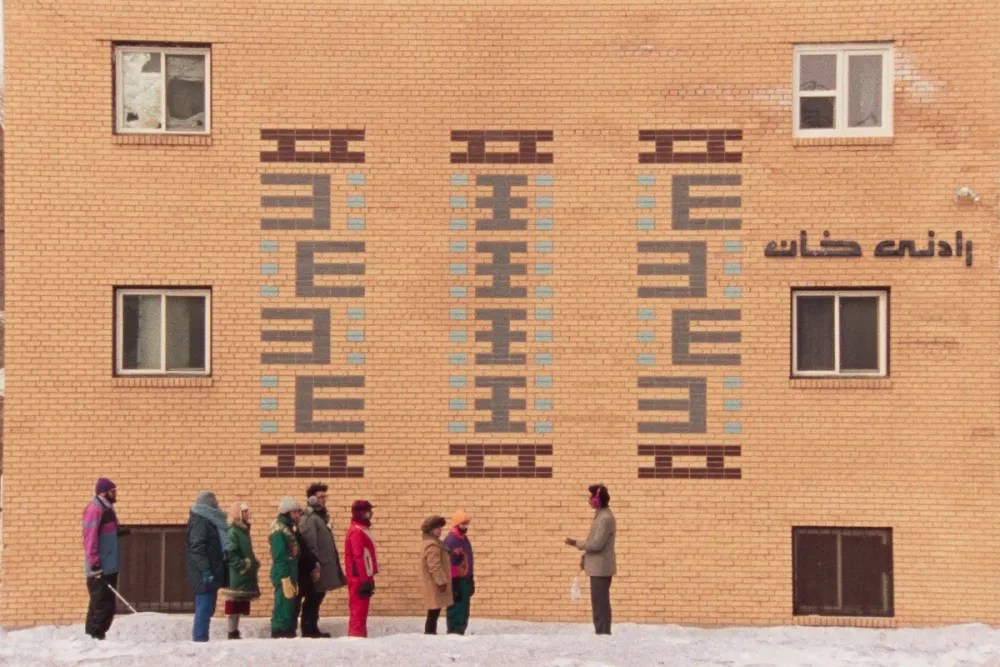
In Universal Language, Matthew Rankin introduces an offbeat, alternative version of his hometown, Winnipeg, where Iranians are the main inhabitants, and Farsi and French are the official languages. It’s very delightful to see a film that weaves the formal idiosyncrasies of Kiarostami, Tati, and Wes Anderson into something that feels genuinely fresh. Perhaps this is Rankin’s way of crafting his ultimate cinematic dollhouse. Earlier in his filmmaking career, he travelled to Iran to seek and learn from his favourite directors, consequently leaving his hometown, Winnipeg, behind. Although he did not succeed at his quest, it still feels very personal that he makes a Winnipeg-based film almost entirely in Farsi, not to cosplay the city as Tehran, but to bring his influences back to his hometown – a cinematic homecoming, if you will.
The opening scene is entirely an homage to Kiarostami’s Where’s My Friend’s House? In the opening of that Iranian masterpiece, a tensely constructed classroom scene establishes the dogmatic system that our young heroine will have to navigate. Universal Language reimagines the same scene with Tati’s compartmentalized spaces, externalizing the confined classroom space with a grander scope of brutalist buildings and snow-paved roads while substituting the intensely disciplined teacher with a slapstick goofball that poses more of a hilariously hopeless sigh towards his students than any hints of verbal or physical risks. This is a deft reference that not only makes clear the film’s inspirations but also announces the disparities.
A multi-faceted ensemble piece, Universal Language originates as an innocuous tale of children looking out for each other. When their classmate gets scolded for arriving at class late due to his loss of a pair of glasses, two sisters seek to trace down the turkey that stole their classmate’s glasses, in addition to finding tools to chisel a block of ice that contains a large bill. Again, this is a bizarre twist on Kiarostami’s thematic ideas of social responsibilities until it flips its game entirely and transmutes into a cathartic tale of homecoming, where Rankin plays a character with the same name who returns to Winnipeg after finishing his government duties in Montreal.
Universal Language operates as a diorama of intricately designed comedy of manners mixed with deadpan visual gags of stodginess. Rankin delivers jokes by the second, even adding gags into the subtitles. One can simply bask in how well he plans out the geometric composition of every scene and turns banal locations into sights of intrigue. The most consistently effective joke is how simultaneously eccentric and banal the city, the government, and the people can be. It may become repetitive and facile as the film goes on, but Rankin finds nuanced rhythmic patterns to keep the hilarity flowing. There’s a story arc where Rankin follows a tour that showcases the city’s most unexciting sites. It’s obvious these objects carry hefty personal meanings to Rankins; as the tour guide explains, “I like to show people things I care about”. Like a child fervently showing off his favourite toys, The confluence of personal memories and desire to undermine your hometown comes out more organic than the rest.
Unlike Tati’s kaleidoscopic world of miniatures, Rankin rebrands Winnipeg’s brutalist, brown and beige architectures as regional idiosyncrasies. The familiarity of the architecture with real government buildings and their austere office spaces is amusing. Farsi signs on shops that substitute Western with Persian culture. A minute gag that I found amusing is the replacement product for a “double-double” at Tim Hortons. But there is a trade-off with a film that mainly aims to intrigue its audience visually – the characters become muted figures within larger sets – in turn, the Persian culture does not carry as much purpose and potency as it could have. As the interwoven narrative aims to surprise, the individual arcs are murky by the end.
Its pitfall also lies in its unspecific setting of time. Without a sight of cellphones or technologies, the place serves more as an apparatus for the filmmaker to mourn the signage of lost time in an idealized place that never once existed. For a personal letter, one would’ve expected the film to crawl deeper below its layer of quirkiness.
As the film goes on, one can wonder whether the film is mostly just a showcase of quirks and a personal nostalgia trip. Without spoils, the film seemingly reenters the parodic realm of its cinematic inspirations; but the constant running gags now become at odds with the deeper sense of surrealism it’s trying to provoke. Perhaps it’s too cruel to criticize a work of scintillating imagination for how out of place it sometimes feels, but for a film that develops into a tale of personal affection and community, it’s reasonable to ask for more coherence. Universal Language is a deliriously fun movie to experience, but as a love letter to a space and community of forgotten people, its ardour seems to run too broad and referential.


 Cinema Travelogue
Leave a comment