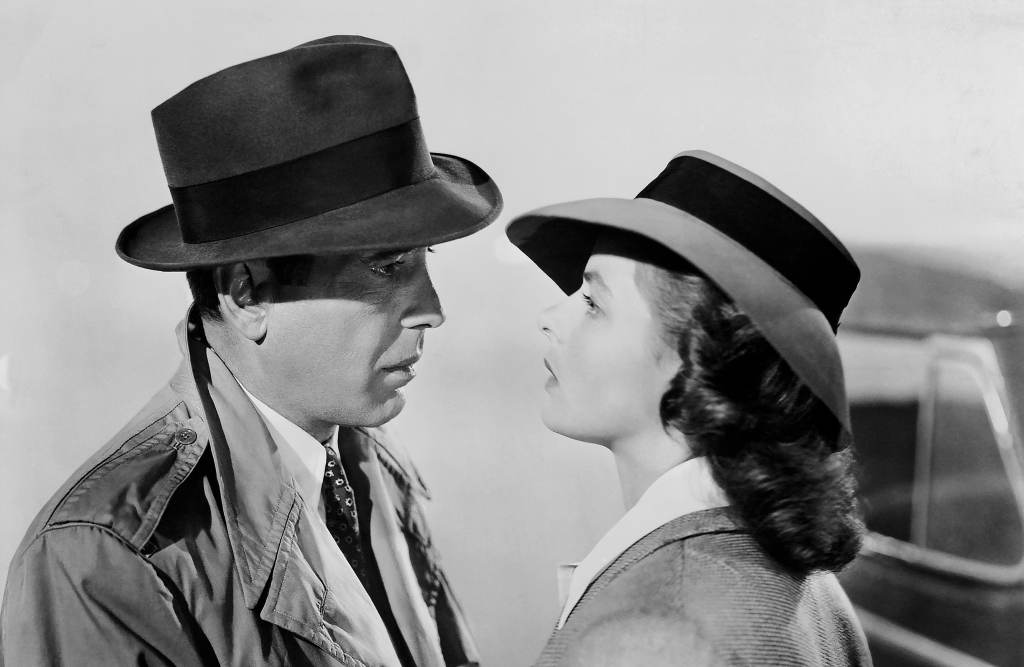
This last Wednesday, the Princess Cinema at downtown Waterloo screened Casablanca for its 39th birthday. This is an annual tradition for the landmark arthouse cinema, as it showed this film on 16mm on the day of its inauguration in 1985. What is most noteworthy, the ticket price is purposefully kept the same as 39 years ago. With that price, you can imagine how the theatre filled up with people of various ages and backgrounds rushing in to witness a film from over 80 years ago. It’s certainly the busiest movie across Waterloo all year. But Casablanca is not just any film, its reputation does not any further lamentation. Premiering moderate success with audiences and critics, it achieved the pinnacle of Hollywood recognition at the 16th Academy Awards in 1943, garnering three awards including the prestigious Best Picture out of eight nominations. Ever since its reputation has only been rising and even into the conversation of the greatest film ever.
The film is lovable because its pleasures are so recognizable and accomplished. Narratively, people have referred to Casablanca as a hundred cliches sharing a party together. Truly, it’s a classic story of a love triangle smashed onto the backdrop of the immediate timing of the US entering WWII; the lightning signals noticeable tracings of noir elements; and the script, done by a team of four writers, contains trademarks of memorable dialogues and quick-witted exchanges, mostly delivered by the leading man Humphrey Bogart. Surely, the film did not gain notoriety for its originality, but for its savvy mashing of all these storytelling elements.
The film opens with a map overlapping with documentary-like footage of mass migration, the voiceover describes the state of WWII at large and the essence of why the film is set in Casablanca. The titular city is the last stop towards Lisbon, the last chance war refugees can flee Europe and run towards the land of hope, America. The radio reports a man is on the run for murdering two German couriers for the film’s McGuffin, two transit passes that would allow their processors to depart Casablanca. In an expeditiously assembled montage, we quickly grasp the stakes at hand, troops bombard the city looking for the murderer – a man shot by Nazi police for escaping during a routine paper check; diamond necklaces and bracelets no longer carry worth as too many riches are trying to sell; a woman sees the arrival of a Nazi plane mistakenly exclaims, “Perhaps tomorrow we’ll be on the plane” – Casablanca is not yet occupied by Nazis, but the danger is imminent, the clock is ticking.
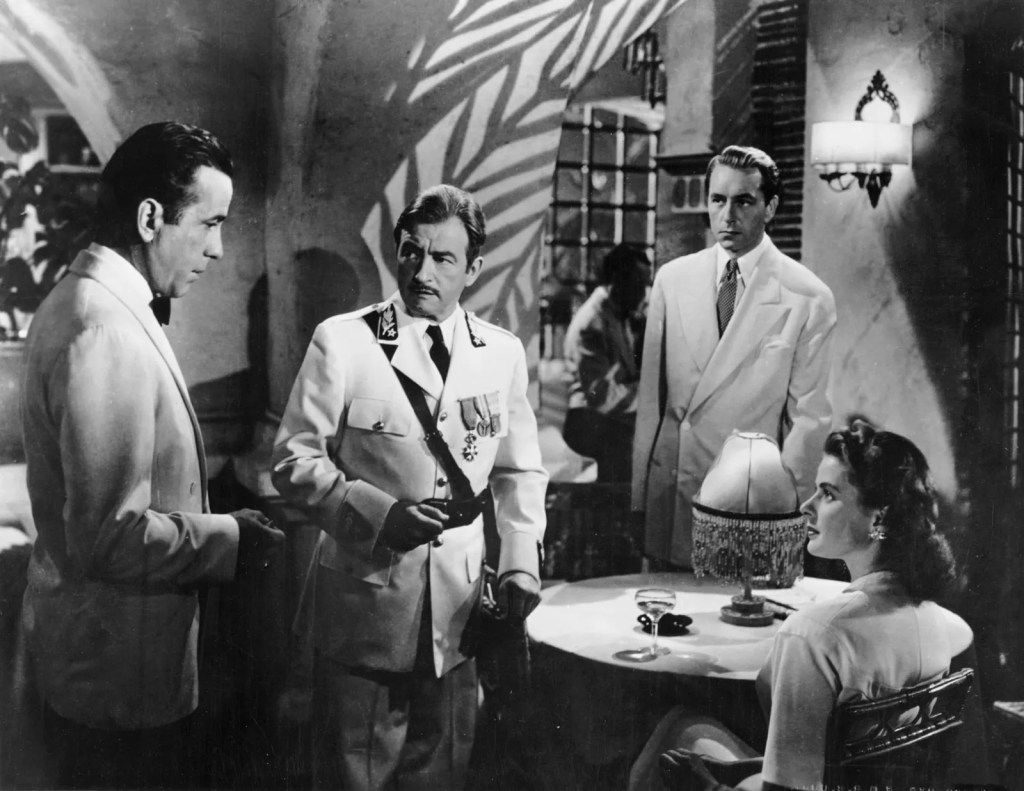
If there’s one aspect, one trademark that ensures the film’s status as a Hollywood classic, serving as its greatest tools, is the two lead actors. Amidst the arid desert and desperate people, Humphrey Bogart plays an ostensibly cold-hearted saloon owner Rick Blaine at the titular location, who is described by the Nazi officer Renault as “carrying a face of cynicism with a heart of a sentimentalist”. Wearing a facade of cynicism and claiming his neutrality, there is a deep sense of anguish percolating beneath Bogart’s mien, ready to burst through his eyes every time he sees injustice and pities, every time his empathy can’t contain itself anymore. Opposing Bogart is the divine Ingrid Bergman, whose presence instantly gravitates the screen with memories and regrets swirling in her eyes. She and Rick had a sparkling affair in Paris years prior, and their romance was abruptly terminated once the Nazi army infiltrates the city. Through their love song, “As Time Goes By,” and the longing in both performers’ eyes, we are constantly reminded of the persisting spark. The film gives Bergman slightly fewer dimensions, but she owns and acutely expresses every moment of affliction, where she juggles between love and responsibility of supporting her husband and a cause. The third wheel of the story is Ilsa’s lawful partner, the righteous Victor Laszlo, played by Paul Henreid. His head is always held high, and the scar on top of his right eye insinuates a darker past with experiences of escaping a concentration camp. It’s a tricky performance as Henreid has to sell a man who wholeheartedly believes in his cause while helplessly in love with his wife and tacitly understands the relationship between her and Rick. The film surely loves their faces – constantly pushing in, cutting from a close-up to an even closer close-up, and lighting Bergman’s face with millions of scintillating diamonds – it’s very difficult to not be swept up by the classic love-triangle story of longing when they are the ones helming the screen.
Many observe Rick to be a stand-in for America during a crucial period during WWII, where the neutral war profiteer is forced to pick sides due to the infliction of personal affairs. When the two transit passes serendipitously end up in Rick’s hands, he now has to make the choice between giving away the passes to Ilsa and Laszlo for them to escape thus allowing the rebel forces against Nazism to continue on but losing his beloved probably forever; or use the passes to escape Casablanca with Ilsa on their own, certifying his egocentric neutrality. In this case, Rick’s internal conflict is not that apt of an allegory for America at large and Ilsa’s objectives look to be a little too wobbly by the end of the film (even that is part of her character), but the film clearly follows the lineage of themes in Hollywood film where the personal has to go against the greater goods.
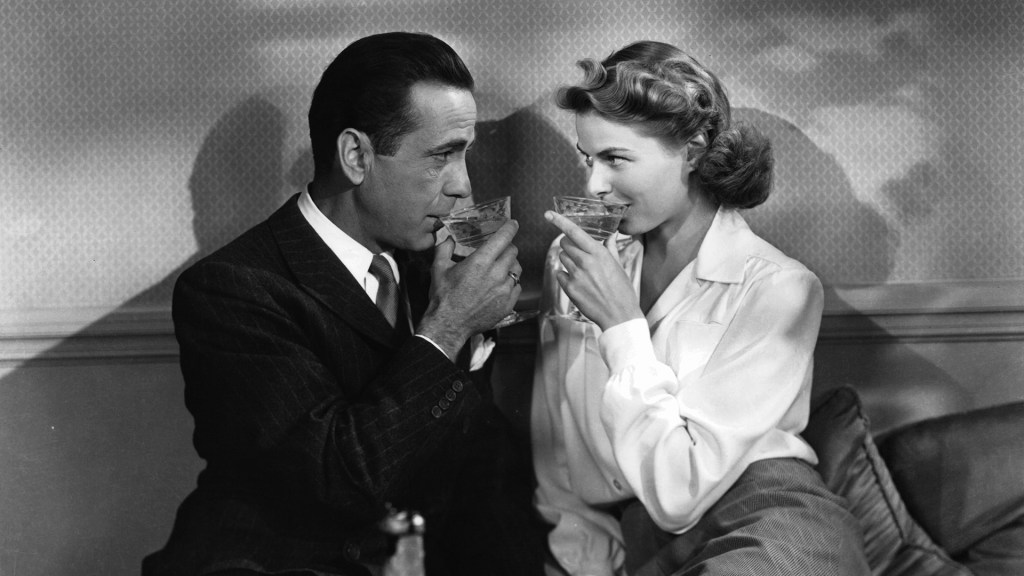
Casablanca is by every means a classic example of Old Hollywood filmmaking where director Michael Curtiz economically employs filmmaking techniques to sufficiently tell a story. There are countless examples outlined by myriad film scholars about how well everything is pieced together. On this watch, some of its subtle visual ideas stood out to me – the spotlight inside Rick’s ornate saloon while the pianist Sam is performing in contrast with the similar spotlight outdoors that represents the omnipresent surveillance by the Nazi troops; the dissolved cut that flashes back to Paris matches with the moment Rick’s eyes getting blurry, tearing up, listening to “As Time Goes By”; the noir-ish shadow of window blinds flashing onto Ilsa’s face – all contributes to a film with such confidence in its own mode while juggling so many.
There is a distance inevitably left by the film with its production values. Its polishness constantly reminds you that it is indeed a Hollywood production. Perhaps it is also self-aggrandizing for America to landmark itself as the place of hopes and dreams while cosplaying a completely foreign country in plight. But it’s undeniable the film has successfully delivered its levitating message by allowing Curtiz’s Hollywood touches to fully flourish. One can marvel at Christian Petzold’s 2018 masterpiece Transit, utilizing its contemporaneous settings and ghost story to depict the bleak and unsettling reality of a war refugee while still valuing Casablanca’s achievement of extracting a catchy, love-triangle story to provide worthy, uplifting optimism. This is what Hollywood is good at, and this time, they have done so through dedicated craft and well-earned emotional beats.
Casablanca also has a very strong sense of musicality, most notably through the motif theme song between Bogart and Bergman’s characters. Initiating as a melody played within the film, it later becomes part of the film’s score to accentuate the characters’ emotional development. During the film’s most moving sequence, where it grants a sense of solidarity towards the freedom fighters, the crowd collectively galvanized by Laszlo sings “La Marseillaise” over the Nazi anthem. Reportedly, the tears of Madeleine Lebeau, who fled Europe with her Jewish husband as war refugees in real life, are authentic. The drop of tears is essential for the scene to work, and it speaks to how timely the making of the movie was.

There are a couple of narrative weak spots, and it’s noticeable the script was written synonymously alongside the shoot. Every time a character draws a gun, it’s hard to take them seriously; the film’s plot does not advance as much as it meanders around a handful of locations, and the escape plan the film sets out for itself more or less feels convenient. But Casablanca is entertaining enough, the editing tight enough, the dialogue witty, fast-paced, and dynamic enough, and the actors gratifying enough to not allow its moralism to dominate the narrative. It’s very easy to imagine why this has the most revival screenings in cinema history – it’s a movie of hope and authentic humanity – isn’t that what all want sometimes?




 Cinema Travelogue
Leave a comment