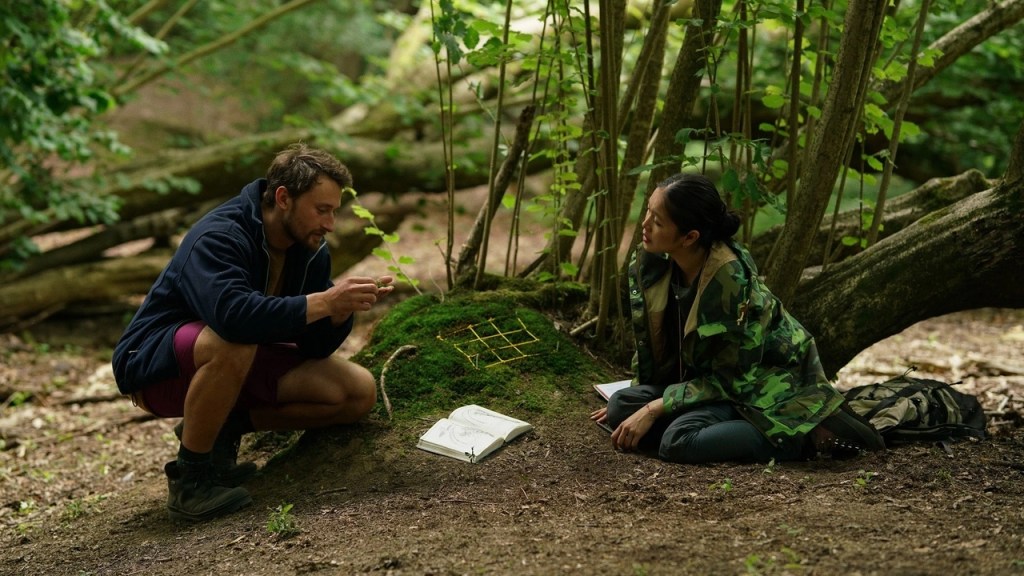
It is now or never that we should discuss Bas Devos’s scintillating fourth feature Here, since, in a couple of months, the internet conversation and discourse surrounding a movie with this particular title will be solely dedicated to a certain Robert Zemeckis joint. Joke aside, this delicately minor work that debuted on the Criterion Channel last Friday is one of the best films of the year so far. Quietly, it weaves abstract ontological themes into its distinctive scope that a lot of grander projects don’t even come close to doing. In a forebodingly quiet fashion, it encapsulates the presence of time and place through contained yet ever-expansive individual moments. Here is a unique film that does not aim to be the sum of its parts by having every single one of its parts be equivalent to its sum.
The term “here” often comes with the question of “where?” Geographically speaking, Devos’s project takes place in Brussels, Belgium. The film’s first image is the camera gazing at the construction site of a high-rise building through canopies – a formal introduction to a city where its anthropogenic evolution is catching up with its natural beauties. The following sequence probes into workers within this site as they finish off remaining work, share a final meal, and take the bus ride home before heading off to a 4-month break. Stefan (Stefan Gota), one of the workers on this site, plans to return to Romania to visit his mother after the weekend. The remainder of the film is a series of encounters and conversations Stefan has before he departs the city.
Here premiered at the foregone Encounter section at Berlinale in 2023. It is a very apt section for the film to debut in, as its charms revolve around the communal joy of meeting people. The people Stefan shares a moment with are blue-collar like him – a hotel attendant, his nurse sister, and car shop staff. These visits are often bereft of prior contexts; most characters appear in one scene and never reappear, but their vivid presence is sustained by Devos’s sheer visual intricacy and curiosity of observing bodies occupying mundane spaces. When visiting these people, Stefan would bring a plastic container of homemade veggie soup, a symbol of sharing. “Let’s eat the soup.” People are grateful for Stefan’s offering, and they would share this cuisine.
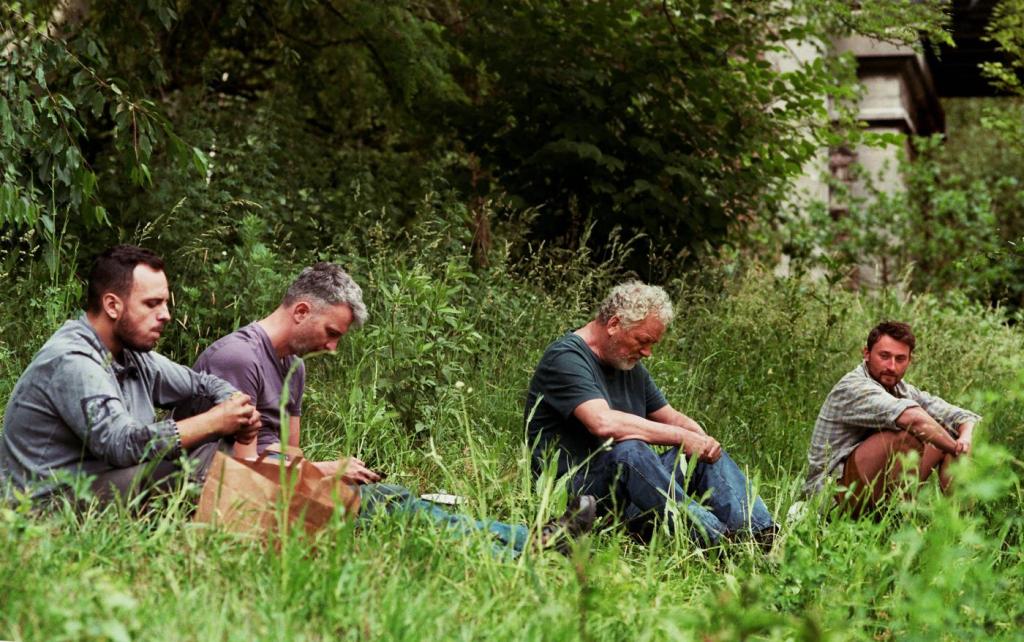
The people Stefan meets along the way are characterized by their compelling stories and humanistic acts. Here is a work of solidarity, not conveyed through sappy, over-the-top drama or broad-stroke statements but simple, detailed gestures and words from people. Devos initiates scenes of conversation with simple methods: a wide shot observing the group of people in union; then, when the moment is right, he cuts to a close-up of the people speaking, then to the listener, back and forth. These scenes are purposefully simplistic, not made to dominate, but they grant authenticity to the subjects in frame. When Stefan goes to a car shop to check on his car, he brings his soup and shares an outdoor picnic with the owner, Mihai and his employees. An immigrant like Stefan, Mihai delivers a remarkably poignant monologue of memory and dream, describing his experience of having an open-heart surgery with full-body anesthesia. He remembers an illusion of being surrounded by dozens of people he knows during his recovery in bed, all gathering in his room. The story attributes to the warmth of companionship while hinting at the dysphoria of the distance between people and the practical impossibility of such a gathering. At the end of this conversation, Mihai plans to host a similar get-together and invites Stefan when he returns; Stefan agrees, but who knows about the future? Through words and, more importantly, captures of precise moments of personal interactions, Here potently conveys that the idea of a community is the ways of sharing, engaging, and participating.
While watching the film, the euphoric weariness washed over me. In recent years, I needed to move between cities every four months – interchanging between work and school – there is often a week or so of time when I am occupied by neither, free to do whatever I want. The city I’ve lived in for so long suddenly feels new to me, the places I frequent all obtain a fresh look, as if I’ve only just raised my head and begun to see. But there’s also a downbeat feeling, a sense of loss and restlessness that mourns my soon-to-come departure; Stefan’s journey precisely captures this sort of reluctance, meandering, and lassitude.
There’s also an incredible lucidness associated with Bas Devos’s work. Stefan often falls asleep and wakes up at strange hours. “I am awake,” he once whispered to himself when he woke up as if he needed a reminder of his own existence. Some of these moments are captured during magic hours. This choice does not play in the register of magical realism films like All of Us Strangers; it’s pertinent to the thematic truth of Devos’s project. Magic hours occur between day and night, two concrete temporal blocks. Stefan is at a period of his life where he’s moving between two places. Despite being in the city for a while, Stefan no longer moves between two nodes – work and home – Brussels feels brand new. This weekend is an open window and maybe a last haul. The film questions one’s point of existence when they divest their occupation. In a city full of outsiders, perpetually reinventing itself, especially when he is an integral part of this reinvention, is Stefan suddenly a bygone tourist now? In this case, the magic hours resemble a oneiric state of stasis.
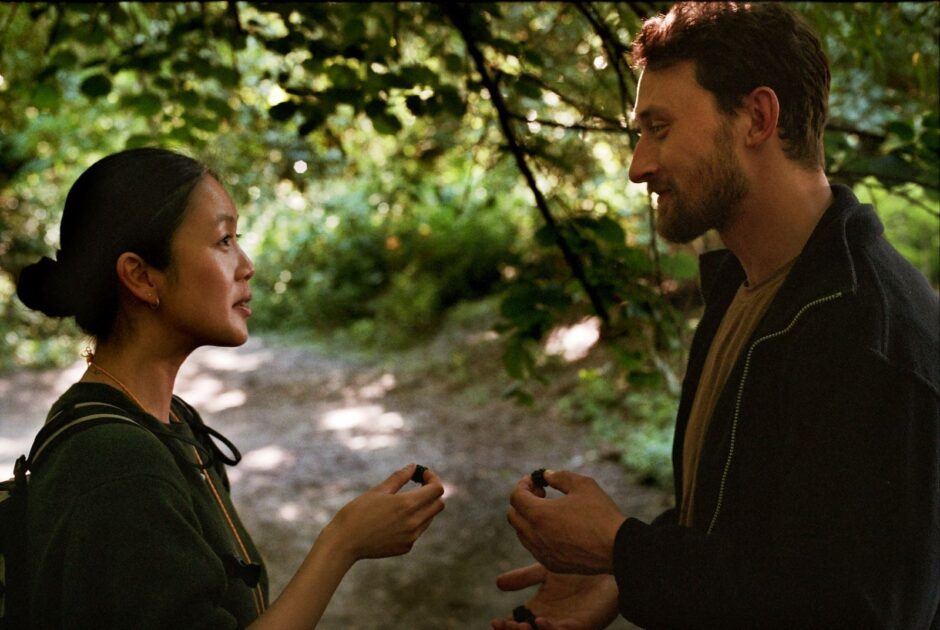
Out of everyone Stefan comes across, Shuxiu (played by Liyo Gong, who is primarily an editor), a doctoral student of Moss, carries the most narrative weight. We first come in contact with her through a voice-over montage of natural ambience where she describes an experience of her waking up and forgetting the names of every object surrounding her – an estranged dreaminess that matches Stefan’s insomnia. Her narration in Mandarin carries a feeling of foreignness that transmutes the natural scenery playing throughout her narration. How do you identify this leaf falling in front of you? What’s your relationship with it? How do you process the visual conception? The film provokes these questions yet never allows them to subsume the moment, like how our eyes and brains are two essential, disparate components of our existence.
Through Shuxiu, the idea of “here” applies to the cordial attentiveness someone carries for their profession, like Hirayama in Wim Wenders’s Perfect Days and Paterson in Jim Jarmusch’s Paterson. For Shuxiu, her work is filled with diligence, curiosity, precision, and imagination. She quietly tends to her microscope in the lab, patiently straying in the forest trail collecting moss samples; her smile exudes insurmountable passion when she listens to her students presenting their made-up ideas of mutated plants. Outside of her scholarly work, she helps at her aunt’s noodle shop, where she and Stefan first met on a rainy afternoon. In a sumptuous-looking shot of a noodle shop in the rain, only second to Chungking Express, the magical feeling of love speaks for itself.
As the film’s poster suggests, Here contains a story of burgeoning affection. The film’s focus on the relationship is similarly concerned with the ideas of companionship and sharing, with a deft twist on your typical meet-cute scenario and also insinuation of metaphysical connection through its editing choices. The two serendipitously rendezvoused on a forest trail where Shuxiu collects her moss samples. Congruent with the remaining film and the forest’s lush surroundings, Levos portrays the enveloping romance with an organic quietness, holding the camera attentively towards the two silently traversing across the forest, seeking varied species of moss and Shuxiu sporadically sharing her knowledge with Stefan. The glaring sunshine is almost hallucinating, modulating each scene between an acute awareness and spiritual removal towards the natural setting. Through pertinent designs of sound and framing, emphasizing the sound of buzzing bees and mutual body parts, particularly hands and legs, it delineates a clandestine physical connection unseen throughout Stefan’s previous encounters. I deeply felt both characters’ physical presence at the end of this trip, where every tiny action feels magnified.
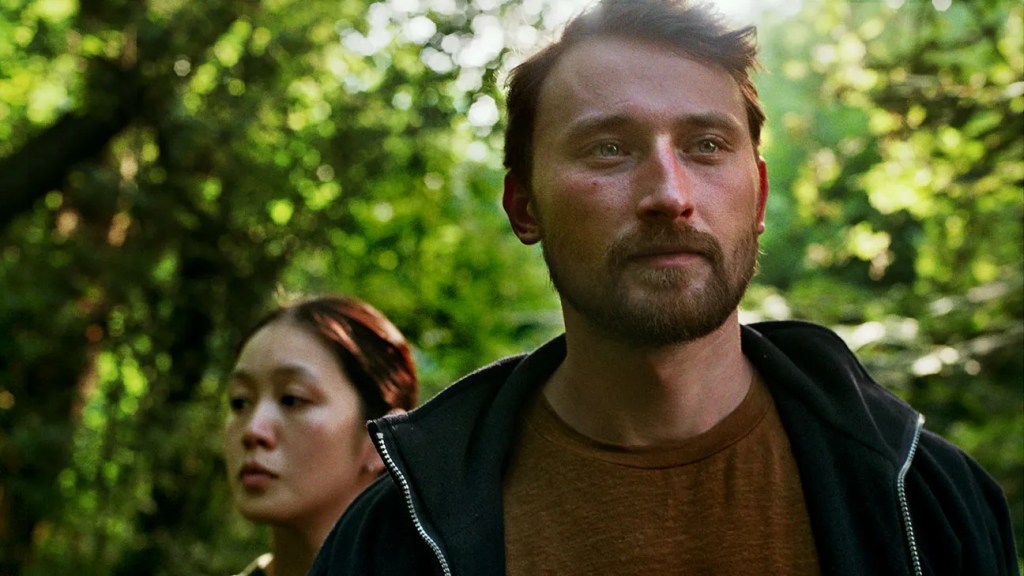
According to Shuxiu, moss is the very first plant to grow on land, yet most people aren’t aware of its existence. Devos’s lens not only introduces the microscopic existence of these organisms; he also transfers his observation style to the way he films humans and choreographs the film. Precise and pristine, cinematographer Grimm Vandekerckhove shoots the film with an ethereal calmness, always perceptive to the movement of the wind, the rain, and the leaves. A single cell block of moss can contain an entire world, and every little moment carries equal weight. The sound design is attuned to every gentle gesture the characters are making and every minute shift of weather or shadow shaking in the background. Similar to a plastic slide that Shuxiu observes through the microscope, the 4:3 aspect ratio allows the objects onscreen – the humans, the trees, the trains – to freely melodize in preconceived spaces, leading to an exuberant hyper-specificity that matches with the idea of living in the moment.
Here is a triumphant and gentle portrait of human connection for its fluent understanding of the meaning of occupying a space in someone’s memory or heart. For all the nameless things in this world, there exists a virtue to be actively present, to pay attention and appreciate the minute details of daily life, like streetlamps turning on every evening. What describes our active state of being, the abstract idea within Here, is not only the accrual of every lived experience but the combination of every component that shaped the exact moment we are occupying now. Everything is in the present, in front of you; all you need to do is observe and listen.



 Cinema Travelogue
Leave a comment