The old guns are coming all out these couple of years. Out of all the cinematic grandmasters who can still conjure themselves to make new films, just this year, we saw the release or festival premieres of Victor Erice’s Close Your Eyes, Godard’s Scénarios, David Cronenberg’s The Shrouds, and Paul Schrader’s Oh, Canada. I missed the opportunity to see Godard’s final short film at TIFF this year, but I did manage to catch the remaining three and found varied enjoyment out of them. What strikes me is how these works are all hugely autobiographical; not only are their main characters basically stand-ins for their makers but also how they are all stylistically subdued reflections on the form of cinema these directors have contributed to for decades and how they march forward. In short, these films stem their filmmaker’s rumination on contained present times with deep roots tracing back to their usual thematic interests. (The brilliant Will Sloan has an excellent post regarding the Late Styles films coming out recently, here)
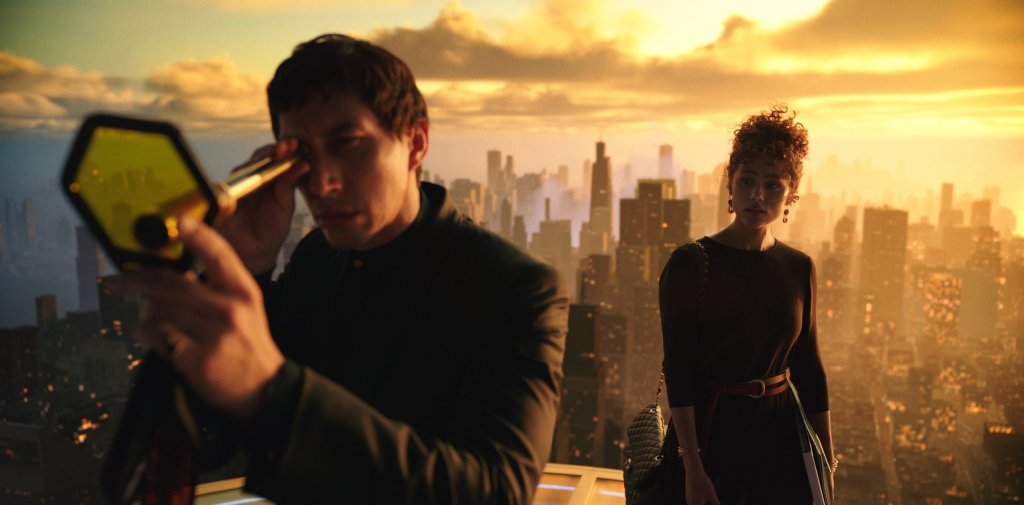
This leads to a completely different type of late film from a renowned filmmaker, the one I’m focusing on here, Megalopolis by Francis Ford Coppola. To be fair, the film still contains autobiographical elements. Adam Driver is most definitely the stand-in for Francis Ford Coppola himself, and a conspiracy subplot regarding his character’s deceased wife strikes as Coppola’s reflected grief towards his recently passed wife, Eleanor Coppola. But the most glaring difference is how this is not a discussion of the present at all, or at least it has fetched so out of reach that we can only see feeble traces of our current world in this film. Megalopolis is Francis Ford Coppola’s call to action, a maximalist piece of optimism for a better world. He’s not content with commenting and discussing the time we live in; his passion and vision lie within his optimism and megalomaniac ambitions deep beneath the vineyard he sold to fund this project. However, the ways he goes about it prove to be more a hubristic scattershot of ideas than an earnest plead.
The grandiosity of the project manages to entertainingly drag me along for about 30 minutes before a sudden realization that it’s tagged onto a plot that’s both narrowly imagined and poorly emphasized. The story essentially revolves around Adam Driver’s ambitious, talented Cesar, after winning the Nobel Prize for inventing a new type of metal named megalon, desiring to build a utopia named Megalopolis in the city of New Rome (we call it New York in the real world) for the future. The city’s mayor, Cesar’s rival, Cicero (Giancarlo Esposito), opposes and tries to obstruct this plan while his daughter (Nathalie Emmanuel) and Cesar find mutual affection with each other. There are a million subplots concerning nazism, corporate overthrown, bereavement, a virginal pop star, etc.. The film cannot find any backbone for Coppola to stick its grand plan onto.
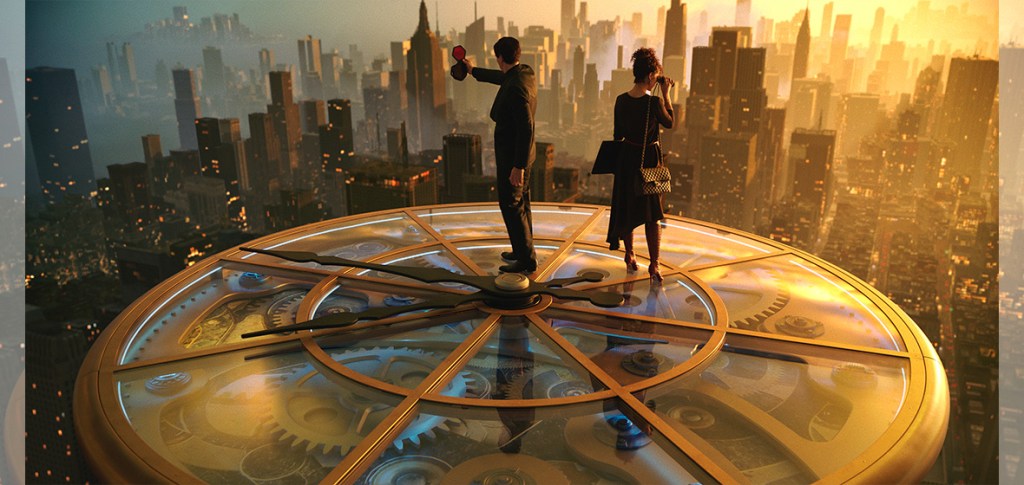
Through years of imagining, the product seems to have already slipped away from his fingers. In Richard Brody’s positive review of Megalopolis, he writes, “Cinematically, ‘Megalopolis’ is a skyscraper of cards. It’s not a chain of dominoes set up to fall with gaudy precision but a mighty contrivance magnificently envisioned yet insubstantially joined, as fragile as it is wondrous. It wouldn’t withstand a push; it would just collapse in a disastrous, unrecognizable heap. So don’t push, as only a malicious child would do.” As bravura and intricate as that may sound, Megalopolis strikes me less as a skyscraper of precariously stacked cards than a ghoul of over-processed and undercooked parts glued together by its deep-pocketed maestro, resembling Elizabeth Sparkles at the end of The Substance. The philosophical interests are kind of present, but heavily deformed by their obfuscations. Precision has nothing to do with the film’s structure. Case in point, close to the middle of its runtime, there is a significant calamity event – either mirroring 9/11 or serving as Biblical allusion – that supposedly alters the world of its conceptual New Rome. So why does the film never mention or hint about its arrival beforehand? Why does this important moment last shorter than a dead-end Taylor Swift subplot? Is Coppola trying to say something about its ephemerality? Or is that just one of the ideas being crammed into this film?
The amount of cinematic references and in-text citations proves this has been existing within someone’s mind for decades. For instance, when Julia reads a piece of news with Hitchcock in its title, the film proceeds to show a vibrant, Vertigo-like sequence of Julia stalking Cesar through a dark neighbourhood, with gargantuan green marble statues crashing down, across a flower shop, into a bedroom where Cesar tends to his already deceased wife. The sequence in isolation proves Coppola still has it as a visual stylist, but when thrown into an ocean of unmodulated, laborious references, it becomes baffling to decipher if there’s any intention behind it in the first place. There are also repeated references to Night of the Hunter and The Red Shoes deeply embedded within schizophrenic montages. Is Coppola trying to parse out his relationships with these masterpieces, or is he trying to say, “Look at what they used to make and like the Statue of Liberty, now they’re all just crumbling down!” It’s as if someone trying to rewrite the entire Bible and mixing in hundreds of other books in one meandering run-on sentence, it just doesn’t work.
Its ideas span multiple decades but are inapplicable to any of them. The florid, sometimes garish imaginations do not buttress its central belief, instead adding more digression. Sincerity and optimism are great; they should be appreciated, and there are a lot of moments that signal Coppola’s fervour towards this project – the winery money certainly shows. The giant silhouette shadows projected onto the skyscrapers look cool as fuck. Cesar’s ability to stop time and how his love with Julia contributes to this ability displays a type of vulnerability the rest of the film lacks. In general, how much does that fervour stick to the characters, the story, the setting? The milieu of New Rome does not expand as the film progresses. In the place of ground truth are hallucinating montages with the people of the city acting as ornaments against broad-stroke and overly referential politics. The subplot including Shia LeBeouf’s plan to reinstall nazism onto the people who have been forced out of their homes due to the construction of Megalopolis, strikes as awkward as a commentary on Trump as you can imagine. If the goal is ultimately the people, why only make a film about illusive ideas? Why not make a film about the people? By constraining the story with a small group of exaggerated key figures, the film does not seem to care about its subjects as much as it thinks.
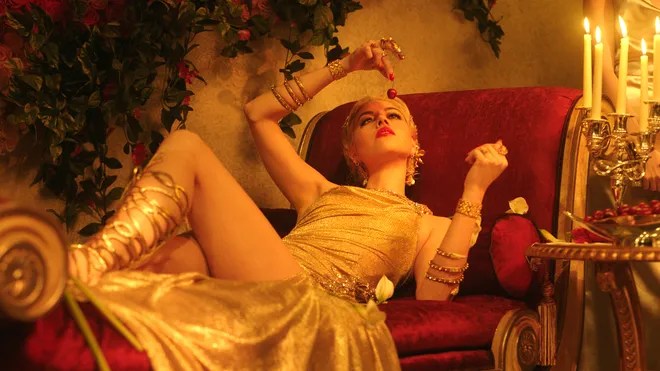
The actors are respectable. Veteran performers (Fishburn, Voight, Esposito) provided gravitas towards their scenes even if their lines were constantly trying to escape them; Adam Driver and Aubrey Plaza were certainly trying stuff (“Go back to the CluUUuub”); Nathalie Emmanuel was doing her best; Shia LeBeouf exists. Yet the film got lost within its mix of giddy high society camp (unsure if intentional or not) and an inert family drama that can be found on daytime TV. It’s not superficial enough, nor is it dramatically nuanced enough. No matter how much Adam Driver monologues about starting a conversation, Megalopolis remains about “the vision of FFC” instead of allowing that vision to be democratized with people. Sadly, I doubt this film will achieve what its fourth-wall-breaking conceit seized to achieve. Its incoherent nature arguably invites nuanced dissections and discussion of its political ideas, yet it also has ages-old, overused lines such as “We want to destroy him, now you just made him a martyr.” The result is closer to a parodic, hyperbolic society in the likes of John Wick, except unfocused, unfunny, and unentertaining. Despite how hard Coppola preaches, he is building a utopia with no foundations. I felt nothing in the end.



 Cinema Travelogue
Leave a comment