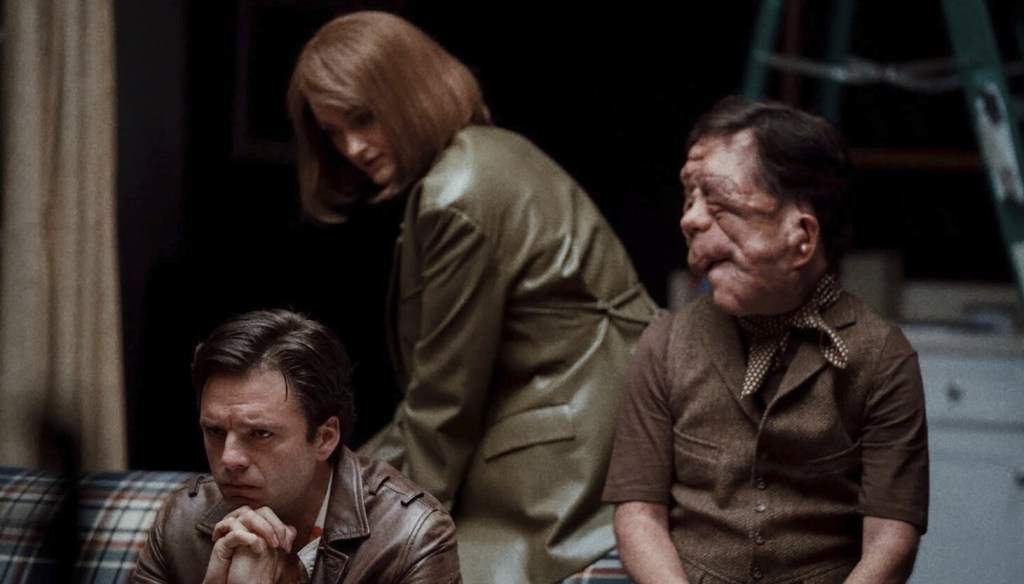
Can someone truly become a different person? This is the central question Aaron Schimberg’s A Different Man poses throughout its runtime. Often times hysterical and often times chilling, the movie tracks the quasi-fantastical journey of Edward, a man with neurofibromatosis, played by an initially unrecognizable Sebastian Stan, who accepts an experimental drug that may cure his deformities out of the shear burden of embarrassment and discomfort of living under his natural skin.
The opening scene features Edward torpidly banging his head on a white office wall, seemingly infiltrated by frustration, only for the movie to defy expectations and zoom out to show the set of a commercial. This is the first of many where the film deftly upsets the audience’s expectations. Edward is, in fact, miserable in life – an unsuccessful actor who has to fight for meagre roles assigned to his type. Schimberg quickly dives into his inner world, shy, timid, and seemingly antagonized by everyone on the subway home. Through a rather shaky handheld style that constantly moves and pans, Edward’s perspective is captured with a fiddling sense of isolation, like he is too petrified to look around because someone might look back and see him. Renting in a dim apartment, his social awkwardness and transient existence impede his living conditions. There is a giant spot of leakage on the roof of his living room. Perhaps too shy or too quiet to ask the landlord, that hole continues to expand with mysterious objects falling out from time to time.
The dripping black hole on Edward’s ceiling matches his existence, taciturn and dim in spirit. Perhaps to balance his inwardness, Ingrid moves in next door, a Polish playwright new to the New York scene. The Worst Person in the World‘s Renate Reinsve plays her with an outwardly carefree spirit that takes an interest in Edwards. He often sees Ingrid bringing home guys when he peeks through the peephole of his front door. Perhaps just as a neighbourly gesture or some genuine affection, the two spend time with each other, but their communications are always hindered by Edward’s awkward demeanour and fear of physical contact.

A Different Man operates within a suppressed atmosphere, where Edward can never truly be comfortable in his skin. The key contributing factor is its leading man Sebastian Stan. Winning the Silver Bear for Best Actor at the Berlin International Film Festival earlier this year, he manages to simultaneously sustain a weary awkwardness while taking performance liberty through his minute gestures. His Edward is always hunching, staring away from people, standing at an uncomfortable distance away from others, and responding to people timidly; his voice meanders without an ounce of confidence and assurance. Edward’s social anxiety is also punctuated by the script through external factors. It is exaggerated by his continuously defeating social interactions with everyone around him, almost teetering to the point of a cruel social experiment. The editing skimps between day and night, incorporating abrupt cuts and sudden zoom-ins to create a dreamlike atmosphere.
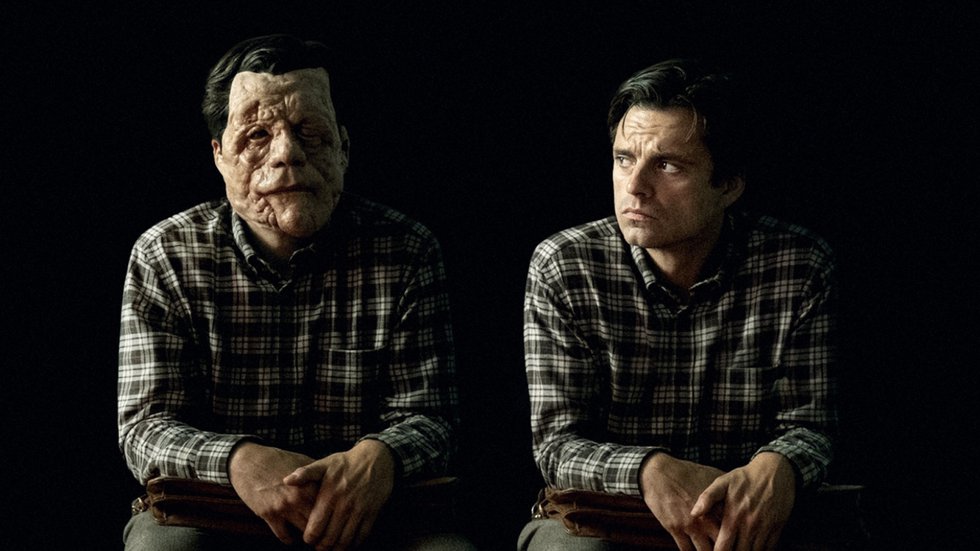
Not a spoiler, as there are plenty of films left, the experimental drug worked. With squishy body horror of skin and flesh, orchestrated by a jazzy score from composer Umberto Smerilli, the film delivers an eerie sequence where Edward literally peels his face off and is reborn into a Sebastian Stan-looking man. It is easy to thematically link A Different Man with another film currently playing in theatres, Coralie Fargeat’s body-horror industry satire The Substance. Both feature a fading actor who seeks an unusual way, in both cases, an experimental drug that magically appears in their lives through a doctor visit, to remediate their inner insecurities about their looks. In addition, both assume completely new identities when they successfully transform. Here, Edward assumes the name Guy and claims his former self dead.
While The Substance takes a much more straightforward and aggressive plunge into its main character, Elizabeth Sparkle’s quest to regain her youth, taking extremely unsubtle methods to exclaim the horror and absurdity of beauty standards and perseverance of youth, A Different Man is more methodical and pertinent to Edward’s perpetual insecurity. Even as handsome as Sebastian Stan, Edward does not instantly transform into Prince Charming. There is a persisting malaise in Edward’s voice and physicality, where he would fit perfectly in the contingent of Charlie Kaufman’s impotent, socially awkward men who live in a world intricately catered to their misery.
Instead of The Substance using body horror tropes to underline the absurdity of Elizabeth’s situation, A Different Man takes a different but prevalent trope in recent A24 releases like Beau is Afraid and Dream Scenario, a ubiquitous machine of masochism against its main character’s insecurities. Evidently, Schimberg’s script sets up a mirror in front of Edward to confront and inflict upon every bit of his insecurities. That enters in the form of Oswald, also a neurofibromatosis patient, except cheerful, confident, and devoid of any concerns or insecurity. Played by Schimberg’s frequent collaborator Adam Pearson, his cockney gentleman’s persona pops off even before he appears onscreen. Pearson’s brilliant performance reminds me of Steven Yuen from Lee Chang-dong’s Burning, free-spirited to chilling degrees. Greeting everyone with an open arm, Oswald’s scintillating presence is reminiscent of every confident, well-off, successful man. He can sing, act, and juggle. The film’s narrative and emotional gambit is how it preconditions its audience with Edward’s lonely, miserable presence in the first half to merge the audience with Edward’s perspective. Through Sebastian Stan’s confused and consternated face, one continually looked for flaws or any dark secrets in Oswald. How is he never ashamed of his face? How does he summon this pizzazz when talking to women? Why is he so gifted at everything? Can I be just like that if I had a little more courage? These questions linger and accumulate in Edward’s mind; every step the film takes is to undermine his existence.
There is also a clever meta-commentary centring around an off-Broadway play written by Ingrid about Edward, a Beauty and the Beast type of story. Its rehearsal process predicts all the dubious questions one might ask about the project itself. The ethics of casting a handsome actor to play someone like Edward or even creating art that exploits someone’s physical illness, the act of a Hollywood actor wanting to depict the experience of a deformed person, and Ingrid’s kinky attachment to the previous version of Edward. The murkiness of identity is a prevalent idea throughout the second half. Edward, now Guy, still keeps a prototype of his former face, which he wears as a mask when he forms Ingrid’s play. All of these ideas are delineated in a rather lucid and hysterical fashion, mostly focusing on Guy questioning his own identity and values until a minor twist that puts the entire film into question.
Through Edward’s perspective, Schimberg seems to suggest the only way to truly find contentment and fulfillment is to work inside-out instead of indulging in outside perception. He constructs a Twilight Zone masochist machine that conveys this idea to the audience through Edward’s impermanent, defeating existence. It’s piercing when it satirizes relatable social situations, but with diminishing returns when it insists on sending Edward down this downward spiral of loneliness. The exercise eventually becomes anemic and cartoonish towards the end. Through its intentionally opaque structure, it ignores plenty of personal details, namely, Edward’s convalescence period after his transformation is completely skipped over. The goal presumably is to imbue the story with an elusive fable-like quality and find bleak comedy in Edward’s misery. Consequently, its narrative becomes less and less significant through these choices, and there are ultimately only the three actors that manage to hold the screen. In a chilling send-off courtesy to Sebastian Stan, I am unsure if I am leaving the film with anything but some pessimistic ideas and desires to start an Oscar campaign for both Stan and Pearson.




 Cinema Travelogue
Leave a comment