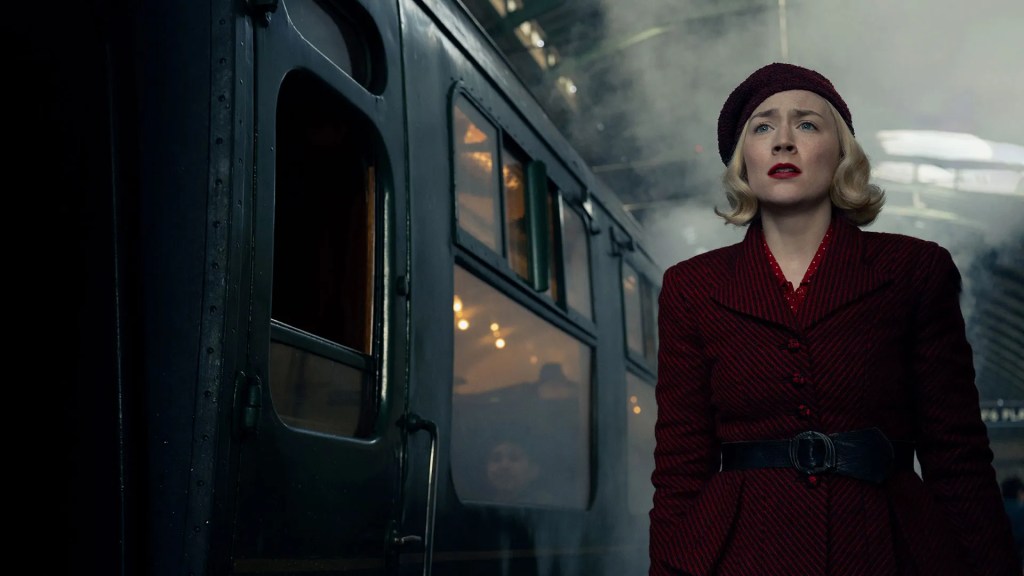
The newest Oscar bait wannabe, Steve McQueen’s Blitz is a social panorama about lives lived outside the battlefields – weapon factory workers, scavengers, underground socialist movement – following a biracial kid, George (Elliot Heffernan), on a tenuous journey to reunite with his mom (Saoirse Ronan). The movie has a good starting point, McQueen has more interest in the racial tension that fuelled the war and segregating Nazi ideologies (very fitting considering what happened this week) than the typical video game-esque indulgence of bloodshed in All Quiet and 1917. There are still many CGI sequences of bombs and large set pieces with thousands of extras hopelessly seeking refuge in the streets of London, but McQueen lends the film’s dramatic focus mainly to the people George and Rita encounter throughout their path of reunion.
During Elliot’s Oliver Twist-esque journey, he encounters boys the same age hiding within the same train cabin, an African police officer whose dignity and diligence allow him to embrace his black identity, and a large flood in a subway station where he confronts the pedestrian horror of war face-to-face. The main emotional staple is a staidly excellent Saoirese Ronan, who also showcases her singing pipes during a radio cast performance that eventually turns into a workers’ rally. Throughout Rita’s journey, the film displays the underground socialist movement during the time of the Blitz, as well as a jazz club scene filled with nighttime exuberance. Through these scenes that completely leave the war in the background, McQueen accomplishes his proposed sense of humanism that separates him from your common Oscar bait exploiters.
However, the film more or less finishes around the same destination as those two; despite its widening perspective, Blitz is sold short by its narrow dramatic focus, social observation in broad strokes, oftentimes settling for moral didacticism instead of letting its moment breathe. McQueen works well with the big-scale set pieces – the opening sequence involving a dancing fire hose insinuates his advance-garde origin-but his formal retrains are very hit and miss, a lot of times clunky and weirdly exploitative. For instance, the bits with the kid and the train and the last 5 minutes. I’m not sure how much restraint matters when you are using the same type of brutality to entice emotions. It also really wants to be a weepy. The grand moral gestures that demand standing ovations again jar with its attempt to portray quotidian lives. The best moments are those that feel observed and subtle. The one blink and you’ll miss-it moment that’s unexpectedly moving occurs when George gets pulled out of the flood by an anonymous hand – to imagine someone in a life-and-death situation that cared to look and give a small boy a hand when a lot of the film contains people shuffling around each other to survive – just a really humanistic moment.





 Cinema Travelogue
Leave a comment