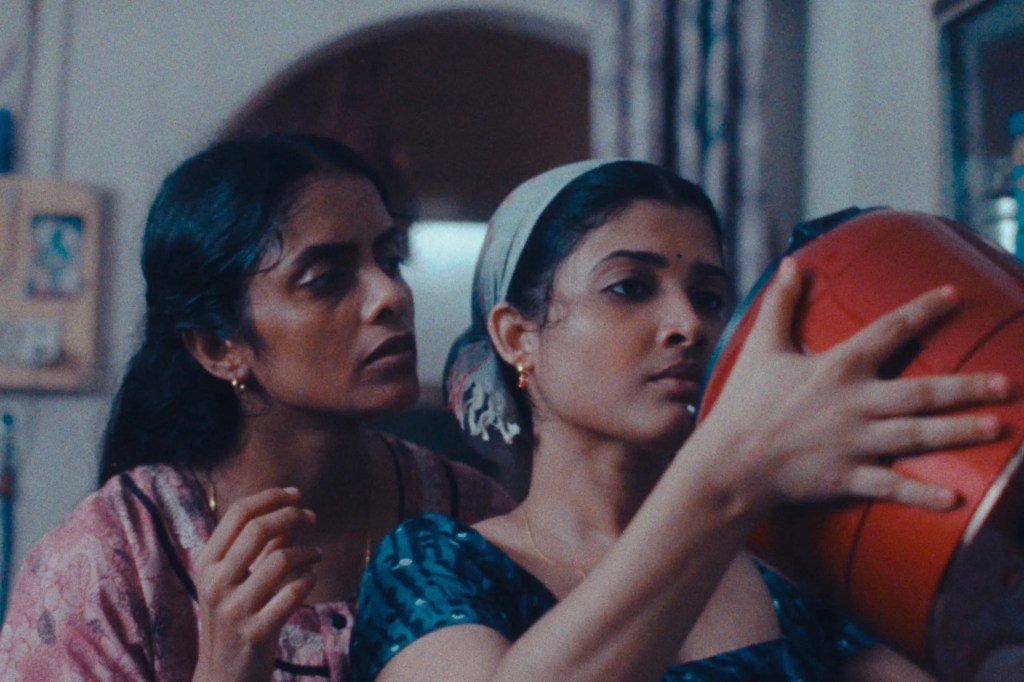
Winner of the Grand Jury prize at Cannes earlier this year, Payal Kapadia’s narrative film debut All We Imagine as Light is foremost a moody poem. Transitioning from documentary filmmaking, Kapadia begins the film with a series of voiceovers from real-life migrant workers living in Mumbai, explaining the ambivalence of their state in the big city full of lights and life. They occupy the city – crowded in train stations during traffic hours, roaming the streets selling street food and riding on motorbikes – but they never feel like home. The camera moves laterally and gently across the nocturnal without much of the embellished glamour but still exhibiting a naturalistic sense of beauty; eventually, the camera finds Prabha (Kani Kusruti), a nurse on a subway returning to her rented apartment after a day of work, the nighttime breeze gently brushes the hair on her forehead where you can see visible droplets of sweat. The vivid sense of atmosphere is created by this opening sequence.
All We Imagined as Light also focuses on the younger Anu (Divya Prabha), a receptionist working at the same hospital. Prabha and Anu are in very different stages of their lives. The former feels a painful longing for her long-time absent husband working in Germany, while the latter has developed a nascent and clandestine romantic connection with a young Muslim man, Shiaz (Hridhu Haroon). Their situations both reflect the ambivalence of yearning for a better future outside of the country and the stickling religious dogma in conflict with the more liberating, younger generation of today. An additional arc is given to Parvaty (Chhaya Kadam), a worker in the hospital evacuated from her building after living there for 20-plus years. The sad irony of the situations of many migrant workers is most apparent in Parvaty’s situation, where the absence of one document can erase her entire existence from the city in an instant. Kapadia’s documentary approach does her portrayals of these three women a lot of favour as the emotions and actions are composed naturally. The political edge is present through its choice of perspectives and the depiction of residents organizing a strike. Although its humanist, episodic nature never grants most of its events any resolution.
Kapadia composed the film with excellent usages of natural elements such as the rain and the wind. The achievement of the montages seems to be transporting the feelings of longing and disappointment from a granular, individual level to the ambivalence of a whole city, people crowding in spaces they can’t call home at the risk of displacement. Visually, it conveys its thematic displacement by assigning and shifting feelings to impermanent objects and sites in its editing, rice cooker and nocturnal city lights alike. For instance, a conversation between the young couple first plays over a tracking shot across the nocturnal streets before cutting to their table, where the talk continues. Those montages work because there is a lived-in texture to them. The trains are always passing through, the people are always arriving and departing, the rain comes and goes, but maybe that city light can last forever.
The drama does wear off when the three depart the city to Parvaty’s hometown. The side effect of those montages can be a loss of character specificity where the feelings lean towards universality and don’t extend further than our initial perception of them. This issue is common in recent populist arthouse cinema, where the film offers its viewers relatable themes to attach themselves to at the loss of the personal. The most glaring offender was Past Lives from last year, and much mitigated here through how much better Kapadia is at photographing and tuning into the tempo of Mumbai than Song with NYC. As moments come and pass quickly, there isn’t as much emotional backing when the film edges into the mystical realm.
Very interesting use of a pro mist filter during the sea village scenes – or at least that’s what I assumed the cinematographer used – that reminds me of Jean-Claude Brisseau’s Céline. However here, it is not used to convey transcendence but a form of mysticism that fills the latter half.



 Cinema Travelogue
Leave a comment