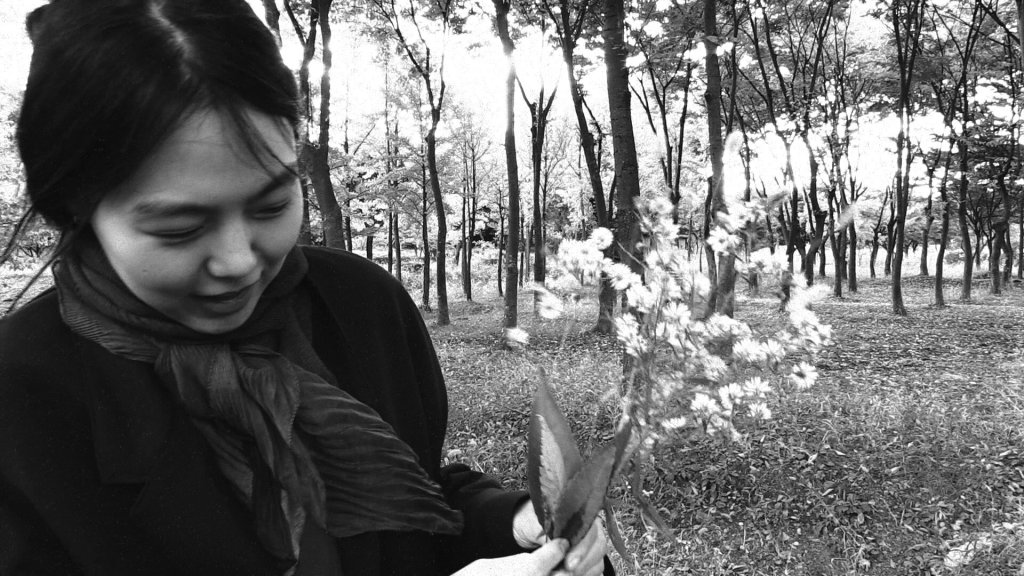
Hong Sang-Soo’s The Novelist’s Film is a pure-hearted work. Following a revered novelist, Jun-Lee, suffering from writer’s block, the film presents a series of rendezvous and new encounters that exude the life of art and the art of life. As usual, Hong’s muse, Kim Min-hee, appears in the film as a formerly famous actress, Gil-su, who now resides in a small town and takes precedence in daily speed-walking sessions over acting roles due to reasons unexplained in the film. This character’s resemblance, as it is with 2017’s On the Beach at Night Alone, connects with Kim Min-Hee’s real-life persona, who has not worked on any project without Hong’s name attached since 2015.
As the title suggests, The Novelist’s Film takes on an identity of fiction that is less seen in Hong’s other recent works. The impetus of his trademarked long-take conversation stems from coincidences as if the hand of a writer is wringing all these people together. However, each individual encounter never feels forced or unnatural. Instead, they are balanced by the meticulous and seamless performances of Hong’s frequent company of actors. Every interaction is full of nuances. Attentions are paid to people’s behaviour in front and behind each other and the awkwardness when the contradiction is exposed. For instance, in the first scene, the camera pays close attention to Jun-hee sitting at the door of a book shop where we hear the owner loudly scolding her associate offscreen. When the audience actually sees and learns the book shop owner Se-won is an old colleague and a friend of Jun-hee, the two continue on their warm greetings without any nold to the previous offscreen shouting. This decision allows the viewer to share the special knowledge with Jun-hee that is privy to only her and no one else in the film. Sometimes things are just ignored for good.
I see people always like to play a game of finding the Hong Sang-soo stand-in in his recent works. Here, I would argue everyone except for Kim Min-Hee and director Park’s wife resemble part of Hong’s filmmaking ideologies. The titular novelist envisions a film the moment she sees Kim Min-Hee and takes people in precedence of plot, her older colleague who escapes the big city to seek peace and community in a quiet town, director Park who believes his later works to be a lot more clear-minded, and the young film student who does both the editing and cinematography. It’s not that Hong is splitting his personal beliefs up and formulating them as a bunch of characters as symbols. Instead, everyone in this film is so full of life, spontaneous gestures, and minute expressions that they naturally cohere into a collective of solidarity and humanism.
Away from the raucous echo chamber of fame and ambition, the works reflect the artists by projecting personal ideologies onto lived-in spaces onscreen. Other than an intrepid foundation of staging and dialogue, Hong fills the film with small formal experimentations. Replacing cuts with camera zooms and pans that shift character focus such as the times of the Novelle Vague. The most daring one is an inclusion of what looks like a known unscripted outtake involving a kid. Like In Water’s blurry lenses, the crispy black-and-white cinematography justifies itself by the end in an extremely moving fashion.


 Cinema Travelogue
Leave a comment