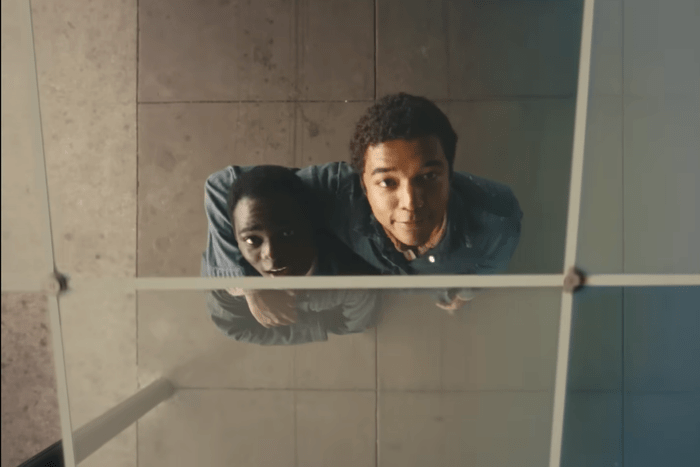
Adapted from the Pulitzer Prize-winning novel of the same name, Ramell Ross’s debut narrative film Nickel Boys is an epic both in terms of its formal ambitions and the size of its period time frame. It initially takes place primarily in Tallahassee, Florida, during the 60s, where the Jim Crow Law was still instated. Elwood Curtis, a promising young boy, is sent to Nickel Academy, a reform school, after being mistakenly charged with a crime. After the school finally shuts down in the 2010s and heinous crimes are uncovered, the film shows an older Elwood seeing this news and reflecting on this experience. Therefore, the impetus of this project is a confluence of historical reconstruction and reclamation of personal experience. Colson Whitehead’s novel meticulously documents the injustice and cruelty Elwood experienced outside, especially inside the school. Whitehead’s descriptive prose, when translated onto film, may risk the danger of becoming trivial and tedious, but Ross and co-writer Jocelyn Barnes found a solution that transmutes the film into a more sensorial experience by telling the story from mostly first-person perspectives.
The perspective shots are switched between Elwood (Ethan Herisse) and Turner (Brandon Wilson), another student of Nickel Academy. The two’s bond is the founding block of Nickel Boys’ emotions; through the first-person conceit, their subjective paths formally cross-over in ways that contribute to how individual perceptions can be cathartically passed onto another person through filmic form. And later subverting this conceit by positioning behind an older Elwood’s body, conveying an out-of-body feeling that suggests a sense of wasteful and remediable loss. Ross is interested in incorporating many historical and personal iconographies; historical in terms of archival footages of old films and historical figures like MLK, and personal in terms of the memories Elwood carry with him that the film’s form makes explicit as everything it shows the audience is what Elwood supposedly sees and chooses to remember.

With that being said, Elwood is not the author of Nickel Boys, director Ramell Ross is; just as Huw is not the author of How Green Was My Valley, John Ford is. The way Ross shapes the way the audience sees what Elwood sees is reminiscent of Terrence Malick, with the floating camera and the way that the exterior scenes seek to soak in the natural beauty, the sunlight can. The major distinction lies in how Malick’s camera usually contains a free-flowing, ubiquitous perspective, whereas Ross’s camera, attributed to his documentary and photography background, is literally rooted in a singular vision. Ramell Ross’s tremendous sense of atmosphere for the period is enough to waive some of the dubious Cinema du look indulgence and dramatic shorthand. Incorporations of fantastical elements like the crocodile, the time-lapsing sequences, prove he is much more ambitious and clear-minded than claiming the pov to be a form of reality and calling it a day. What’s interesting is not the uniqueness of the shots, but how the clear intent provides new ways to perceive shots we’ve seen in other movies. In a different movie, the shot of young Elwood standing outside of the store with the stack of TVs can be interpreted as an objectively framed shot pointed to the window which includes Elwood’s reflection, but since the film has indicated its intent right from the opening scene of Elwood looking up to the trees and his hands, it directly addresses the camera eye as the human eye, leaves to a much clearer emphasis on the acts of looking and perceiving that are crucial towards the formation of memory. The cinematography reinstated the film to a primitive, cognitive state. More importantly, the pov shots with the characters in frame add a layer of self-identification, like an organic tacit forming between the object and the camera.
However, it is awkward for me to admit that my admiration for the film still mostly lies in its production value, instead of the overall accomplishment of the film. There is a dichotomy between the personalities of the two boys, and as young boys are, it leads to conflict. But since Whitehead’s original novel is written close to a piece of non-fiction with fictional characters, the dramatization of events becomes an urgency for Ross and Barnes during the adaptation. When the film remains in an experimental expressionist state, it carries a lot of interest as the first-person perspective can ground its ambition. However, the story between the two boys never fully clicked. This is not because of direct to the direct-to-camera line delivery style – especially since actor Anjanue Ellis-Taylor manages to exert so much power over it – but the two boys’ emotional arcs that are scattered by the large historical context.




 Cinema Travelogue
Leave a comment