Photography as a means to access memories and a path to activism. Walter Salles’s true story familial drama I’m Still Here is unquestionably the biggest surprise out of the Oscars Best Picture line-up this year. In recent years, the Academy has developed a yearly tradition of granting a spot or two to non-English language films, which can be attributed to the expanding international voting bloc and their diverse tastes. This year, it is obvious that one slot will be granted to Jacques Audiard’s Mexican drug cartel opera Emilia Perez, which stars two big Hollywood names in Zoe Saldana and Selena Gomez. So the nomination for I’m Still Here over many buzzy, American titles such as Sing Sing and A Real Pain without any precursors is not only shocking, but also unprecedented.
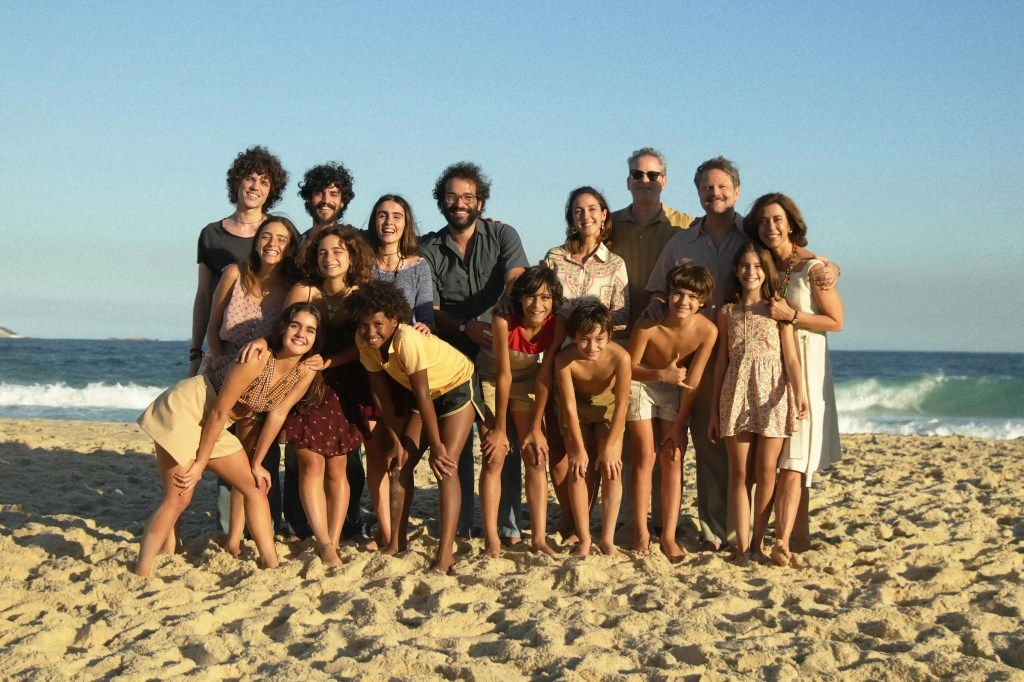
When discussing the film itself, I’m Still Here does not deviate too far from the Academy’s penchant for socially relevant historical biopic. Based on Marcelo Ruebens Paiva’s 2015 memoir, the film tells the decade-spanning tale of the Paiva family during Brazil’s military dictatorship, as they navigate interwoven political and familial turbulence. The member at the forefront of this family is its matriarch, Eunice Paiva (Fernanda Torres), and the majority of the film is told through her perspective of the story. In the first shot of the film, we see her lying calmly in the ocean, head above water; this moment of quietude is broken by the sound of a military aircraft flying over her head. Through this opening, Salles establishes a sense of instability that prevails throughout the runtime. The Paivas are a family of seven, headed by Eunice and her husband, ex-congressman Rubens Paiva (Selton Mello), with 5 children. Rubens is the head of an engineering firm, and the family is rich enough to hire a maid, Zeze and plans to build and move to a new house. Their current house is in front of a beautiful ocean with visiting friends coming and in out all the time. They party, dance, and laugh in each other’s company.
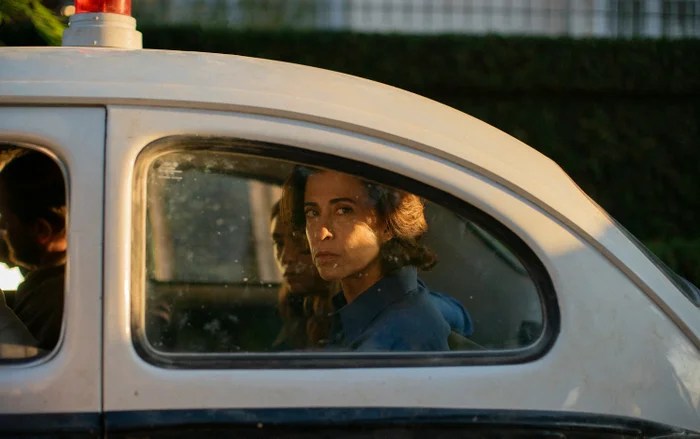
The family’s semblance of peace is contradicted by certain secrets Rubens is seemingly hiding from everyone in his family, including Eunice. He receives private phone calls and has people visiting his doorstep to deliver letters. One day, the bubble is completely burst when a few policemen in pedestrian clothing intrude on the Paivas’ home to take away Rubens for depositions. A day later, Eunice and her second-oldest daughter are also taken. The remainder of the film is centred around Eunice as she tries to protect her family by finding the whereabouts of her husband and keeping her younger children safe.
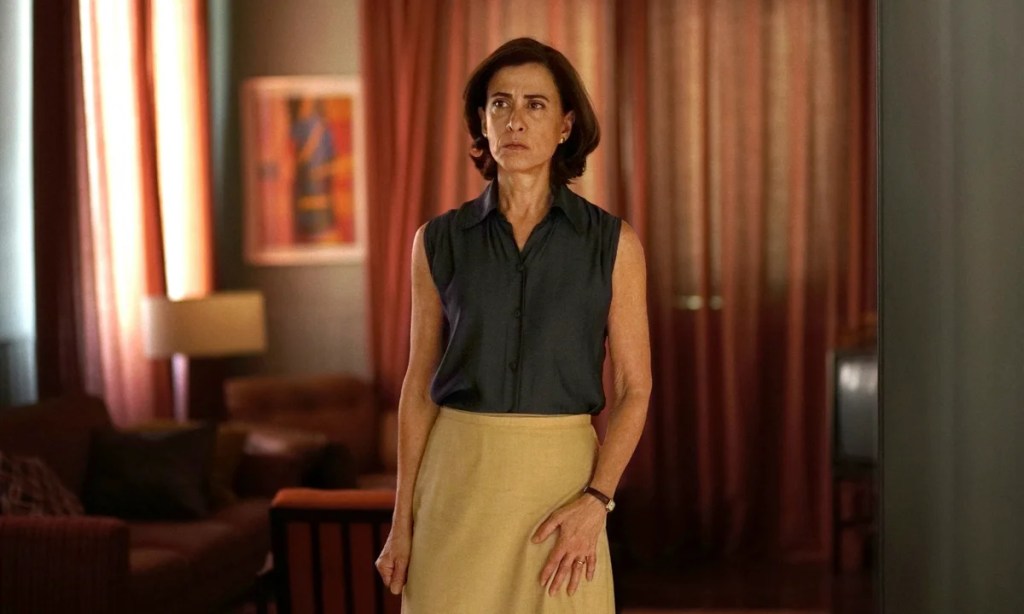
The battle being fought here is between the suppression of the environment and the resilience of the self. It is foremost reflected in Torres’s towering performance, who even while undergoing abundant trauma, barely flinches. Without her, the film can barely hold its narrative and emotional ground, and her brilliance shines through how she externalizes interior battles through her eyes. The way she expresses fear, acceptance, and determination all through the countenance of stoicism, not because Torres is the acolyte of the school of “subtle acting”, but because her character is a matriarch who needs to hold the familial fort once the father is not there anymore. In this sense, the title “I’m Still Here” aptly describes the consistent assurance of Torres’s performance.
I’m Still Here is a period piece and it’s awaringly so; one of its main thematic components is the role of photography. The oldest daughter is interested in the arts. She is first seen alongside her “hippies” friends who are pulled aside the road by the police for an unpleasant interrogation. She was on her way back from Antonioni’s Blow Up. She is not an aspiring photographer, but when she later accompanies Paiva’s book owner friend to London, she uses a film camera to capture family moments. These moments later get replayed throughout the film to remind both the Paiva family and the viewers about their ordinary lives that were completely ripped apart by the dictatorship regime. Photography is positioned as a form of activism. The infamous photo that the film reproduces is a photo of the family without Rubens, where Eunice asks all of her children to smile, in spite of the reporter wanting to record something “sad”.
The overall film, however, goes by a conventional narrative that does not extend much beyond everything that an audience who is familiar with these sorts of movies would expect; it hits every note of emotion just as one would expect it to. The portrayal of a corrupted regime is more relevant than ever; therefore, the film’s message is more resonant than ever. It is understandable that people, especially Brazilians who hold the period of history as personal reminders, would rally behind this film. However, I find its narrative power to dwindle down severely outside of a couple of emotionally resonant and cathartic moments. The main issue here is that, given its heavy emphasis on political activism, the film’s latter portion merely brushes through the actual work done by Paiva. As it begins to fast-forward in history, all the moments the audience witnesses are those where the Paiva family is posing for photos. For a film that is earnestly concerned about the familial bond, this choice is passable, but a dissatisfying thought persists that if the film is just posing for a nice photo instead of depicting the whole picture.



 Cinema Travelogue
Leave a comment