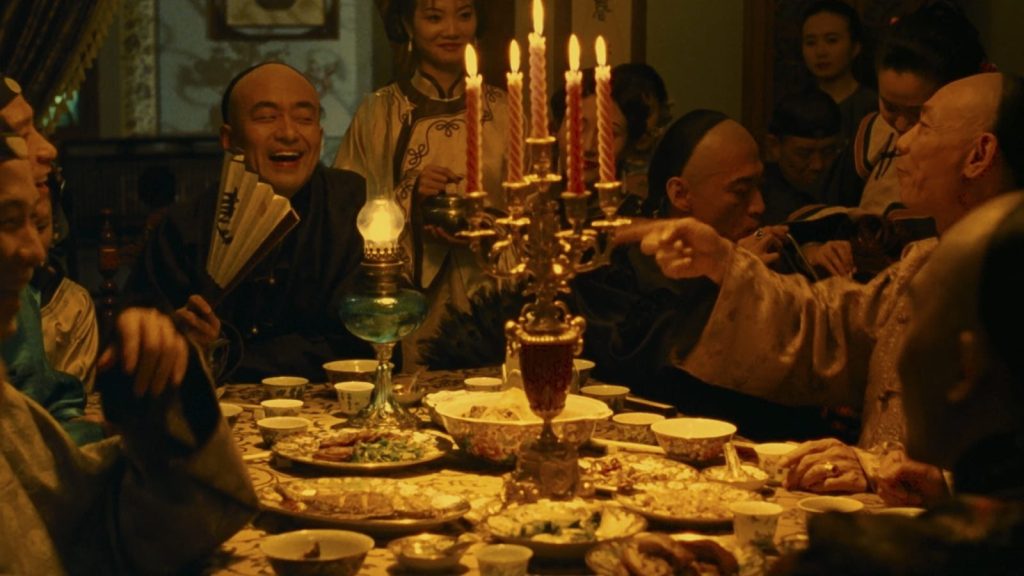
Only seen some of Hou Hsiao-hsien’s more personal works from the 80s and Millenium Mambo thus far, Flowers of Shanghai is the most fluid work I have seen from him. I have deep emotional connections to his childhood trilogy, but one can easily argue they are too formally rigorous for their own good, little bit watching paint dry even. Here, he is almost taking an opposite approach in reconstructing history. The pensive long takes swing tenderly with the actors moving freely across the frame – this world feels borderless where the amount of production details is matched by an alluring openness. Perhaps because Hou is granting himself the freedom to play with fiction that his sensibility wouldn’t allow for when depicting his personal childhood, that he accepts the depiction of history as a holistic organism than it being confined by a singular perspective. Each long take feels like an individual capsule, opens and closes on oil lamps and window lights instead of human bodies. This is not to say the characters in this film are ornamental, in fact they are the most lively out of all his works; but they are bounded by the ephemeral recreation of history plagued by a sense of inevitability, where each character navigates and negotiates their way between commerce, pleasure, and love within each of the five-minute or so window. Once a scene ends, the next may not follow up with any resolution or answer. What makes it simultaneously beautiful and tragic is the overwhelming immediacy Hou creates through the opulent frames and how a fade to black can make everything disappear in an instant, which is in correspondence to how the flower house serve as both a refuge and confinement for girls who will lose all their lavish clothes, jewelries, and social status once they step outside. For better or worse, this film has no exteriors.
Welcome to Cinema Travelogue

If we consider the overview of the world of cinema as a map, then the voyage to connect the scattered dots in between is what we’re invested in. Serge Daney once described voyage as ‘without luggage, totally self-sufficient in his dispossession’. Being a citizen of world cinema is to abandon the luggage of predefined cultural expectations and meet each film and each filmmaker on their own cinematographic terms. If you are down for this journey, please consider subscribing to this travelogue.
Tag on for the ride!
Stay updated with our latest weekly reviews of classics and new releases



 Cinema Travelogue
Leave a comment