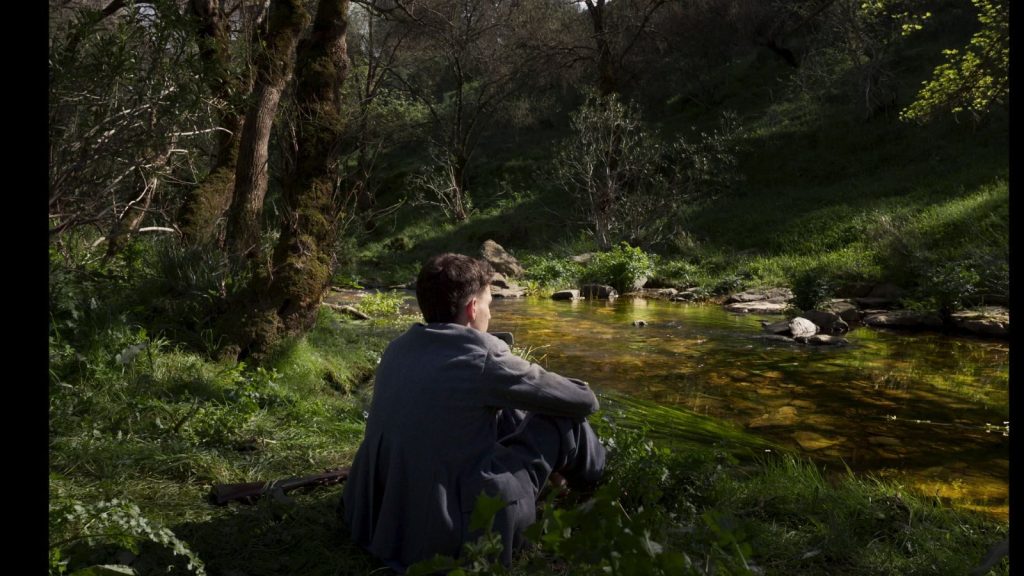
Marta Mateus’s Fire of Wind, clocking in at 74 minutes, feels like it spans decades. This is not a sly reference to its gorgeously photographed, glacially moving scenes, but a compliment to how it ingeniously pierces through time despite the simplicity of its liminal, pastoral setting.
The film opens with a series of shots of people harvesting in a vineyard. They look happy, cavorting through tossing buckets at one another. Within the organized line-ups of grape vines, they appear free, like men and women in Terrence Malick’s Days of Heaven who lie upon the vast American plains against the magic hour sunset. Fire of Wind finds its oneiric beauty differently than the Malickian floating camera. The compositions are static, and the acts of labour are from a distance. The initial peace is interrupted by the sound and image of large machinery. Throughout the film, Mateus contemplates the weary relationship between the working class and the intrusion of technology. When all the acts of labour can be efficiently fulfilled by machines, where will the workers go?
The replacement of workers by machines is at the will of their boss. In Fire of Wind, the struggle between the working class and the bourgeois is literalized in the form of a raging Bull that begins to attack several workers after they conclude a day of labour. Several workers are left injured on the floor, and others are forced to spend their nights in trees to avoid more casualties. The Bull is not just the physical embodiment of a bull; it represents a continuum of suppression and exploitation on the working class; in addition, how this inequality is like a natural force that inherently exists within a capitalistic system.
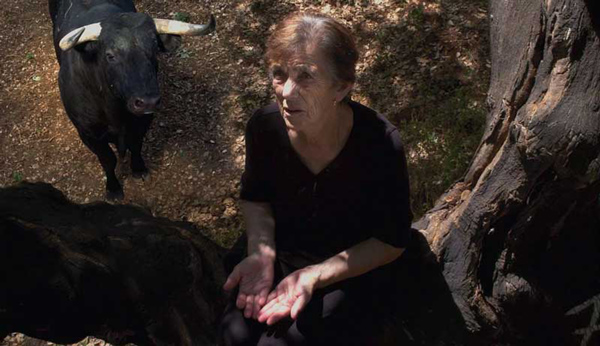
Mateus pays great emphasis on hands – the close-up of a hand clinging onto a tree or two hands exchanging a written note – recalling the works of Bresson. Like the French director, Mateus does not use these hands as metaphors for themes; they are just hands. The hands belong to people; some injured, some sharing messages of work protest; when the two hands meet to share the note, “no more working from sunrise to sundown”, one can interpret that the hands represent a form of solidarity or union; but in reality they just two hands meeting beautifully and tenderly.
The lineage of Bresson can be found in the actors in Fire of Wind as well. They are less actors than simply people, each speaks the dialogue like stilted statues that remark on the inequity and exploitation against them from the owner of the vineyard.
There are plenty of sublime images, such as sun beams seeking through the canopies, landing on a moribund old man lying against a tree, sitting next to him a child unaware of his grandfather’s. The stillness of this image contains the multitude of life and death, a dichotomy of the new and burgeoning against the old and decaying.
Ultimately, for a film that traverses across decades of class struggles and rebellions through displacement of sounds and images, this feels rather brief, and the ending rather abrupt.


 Cinema Travelogue
Leave a comment