
A lot of our world can be explained by a guilty conscience and blood rushing into specific body parts. If that is the case, Alain Guiraudie’s newest dark comedy Misericordia certainly encapsulates the entirety of the world. Following a man in his early thirties returning to his small, bucolic hometown for the funeral of a beloved local baker, the film opens with Jérémie driving across the sinuous mountain roads until he reaches the bakery of the recently deceased man. The opening images of open road ahead capture a sense of hidden, twisted danger that is ubiquitous in Guiraudie’s game of attraction. As the director of Stranger by the Lake, a movie featuring explicit sex scenes including multiple shots of ejaculation, audiences familiar with Guiraudie’s works may enter the film expecting and even predicting which character will ‘get at it’ with the main character. This distinct treat of mystery is weaponized by Guiraudie for every scene in the film, as Jérémie’s encounter with everyone in this small town is deftly acted and edited according to the subtle seduction playbook.
Jérémie’s homecoming is not a smooth riding at all. He is staying in the house of the mother of his childhood friend Vincent, whose suspicious and paranoid nature holds him not long enough to begin accusing Jérémie of seducing his mother. There is also Vincent’s best friend Walter and the town’s priest who both share ambiguous sexual chemistry with Jérémie the minute they encounter him. Vincent also has an ambiguous attraction towards Jérémie as their fist fights can also be viewed as a form of foreplay. All minute gestures that hint towards sexual progress are suspended in the air and only remarked on by other characters in a later setting.
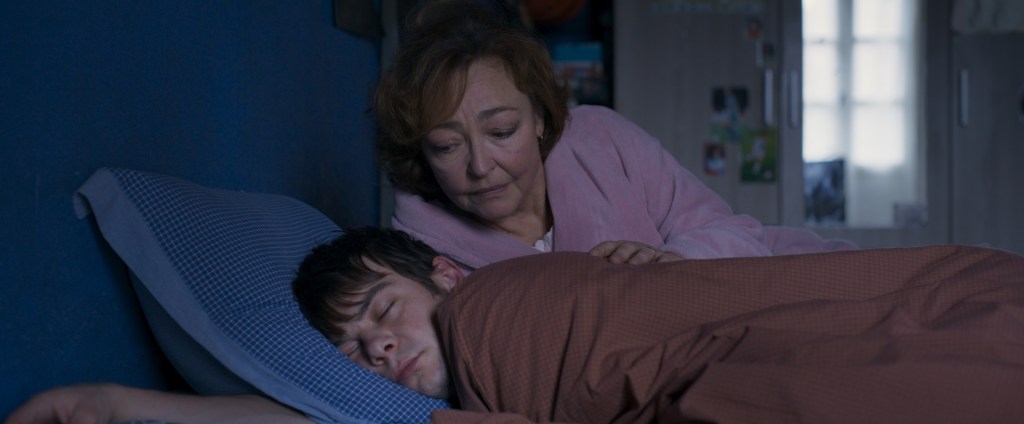
Homecoming is a common plot device used in films. It grants dramatic power to the main character – like a confrontation of an unresolved past or an emotional, nostalgic trip of lost childhood – as it exposes something innate within them. In the case of Misericordia, Guiraudie does not option for any of the ordinary paths. His approach to dialogues and dramaturgy is naturalistic; characters are refrained from saying anything expositional outside of the contexts of their quotidian conversations. Thus, Jérémie’s childhood relationship with any of the characters, dead or alive, remains mostly unknown. We are not subject to a character study regarding personal history as Jérémie’s response to remaining in the village after is always muted and unsentimental.
The brilliance of the Misericordia is how it is not a narrative designed around motifs, but a sequence of well-balanced scenes that accrues into something powerful and unnerving. When I look back at the finer details after the runtime finishes, I remember a group of fully realized characters despite them not revealing themselves fully during the runtime. When I remember Jérémie’s subtle obsession with a half-nude photo of the deceased, Misericordia as a whole does not transform into a film about necrophilia, it becomes a trait of a character that lingers without dominating. The perception towards Jérémie is not pushed onto the audience and we still gain insights into his attraction. What makes Guiraudie stand out in our current film culture, with Netflix’s intention of having characters read aloud their feelings and intentions for doomscrollers in the comfort of their own coach, is he manages to return cinema to its primitive form, the camera as an unobtrusive eye that presents the film’s world as one would see with our own.
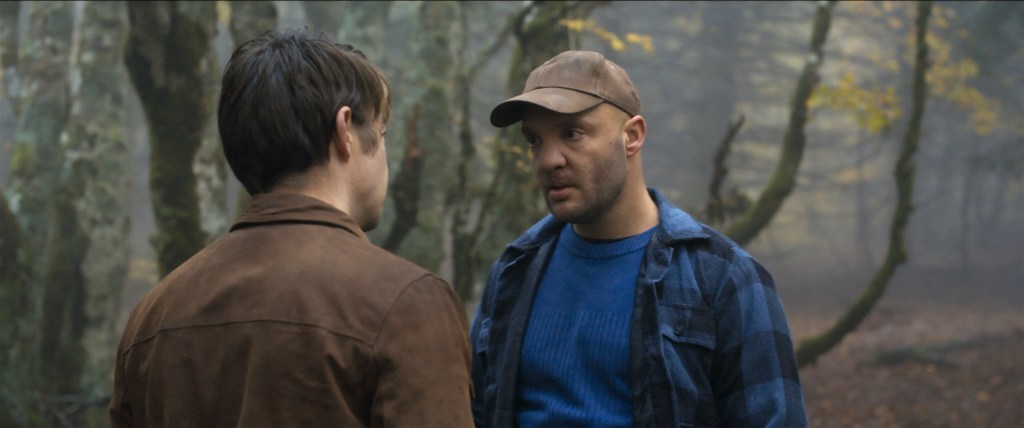
Guiraudie’s naturalistic style also extends futher into the way the film is shot. His frequent collaborator Claire Methon returns to photograph the autunmal setting – not an unfamiliar territory given her work on Celine Sciamma’s Petite Maman – giving it a muted silence that calmly awaits the fictional power of Jérémie’s homecoming to take over. The film is very attuned to the natural setting. The misty and damp forest – while having great thematic purpose – never dominates the scenery as well as the numeorous night scenes that are given minimal exposures. It provides a sense that these places look just the way they are with or without the fiction intruding the samll town.
Viewed as one of the Hitchcockian disciples, Guiraudie inevitably exerts suspense into the picture. When Vincent’s bad temper drives him crazy enough to pick up Jérémie from the side of the road; the two end up in an intense fight inside the forest and Jérémie ends the fight by bashing Vincent’s head open with a rock. This inciting accident happens not too early in the film and gravitates the power of the film onto Jérémie’s guilty conscience. Kysyl’s performance adds an additional layer as he has to drench himself into layers upon layers of excuses and alibis in multiple funny and intense conversation scenes between Jérémie, Vincent’s mother and wife, Walter, and the police.
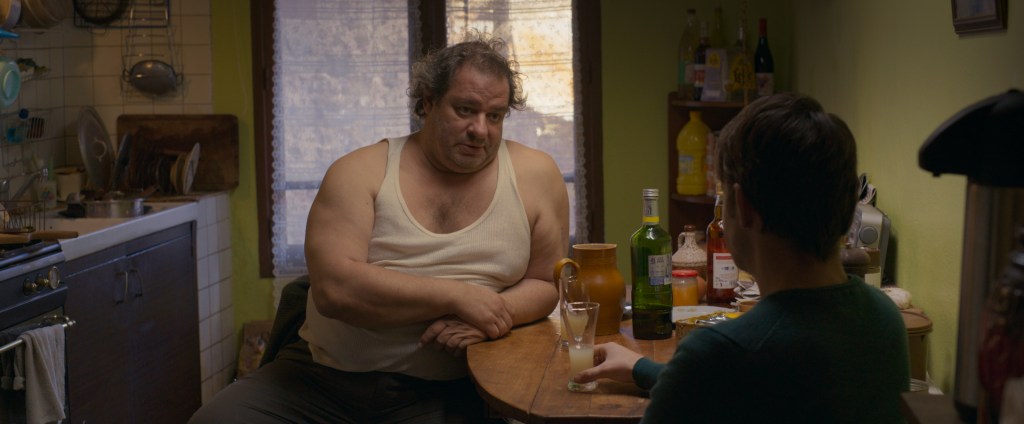
We can categorize Guirdaudie’s newest picture as one of those “people in rooms talking” deals, but given his naturalistic process, the dramatic shape of the entire film is extremely difficult to parse out. To his credit, Guiraudie never surrenders to easy cinematic tricks of intense close-ups or dramatic music cues to emphasize Jérémie’s tricky situation. But he never settles into one gear either. Where do naturalism ends and surrealism begin, during one scene where a policeman man enters Jérémie’s room at night to interrogate him in his sleep, we are treated with the same series of shots and editing pace as multiple previous episodes of him being awakened at night for numerous reasons; but this time, whether it is a small tweak in the characters’ gestures or their dialogues, this scene is granted a power that contemplates Jérémie’s psyche without ever overemphasizing it.
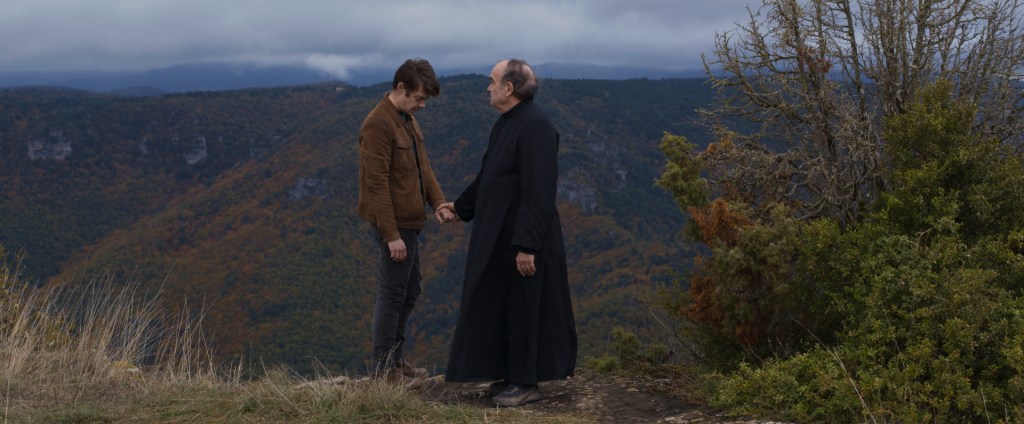
Guiraudie possesses the power to not only make nature suspenseful but also turn suspense into a force of nature. In this sense, the flickering sexual tension between everyone in Misericordia is a testament to the propellant rules of attraction that do not stop even in the face of a missing person, death, or irrational murder. What Guiraudie manages to accomplish is fictionalize this rule into a game not for ostentatious farce to taboo for taboo’s sake, but a confrontation to how normal we can be in the face of the not normal. The shots featuring Vincent’s corpse hold on long enough so we understand what has happened is horrible, but as is the case for cinema itself, what we see is already dead; the question for us and Jérémie now is how do we deal with what is in front of us and what is no longer? Through compositions that return from time to time – camera placed in front of the car as it drives, Jérémie waking up at dark with an alarm clock to his left, a table of people with questions greeting Jérémie when he returns to Vincent’s mother’s home – the answers remain vacant, but the film provides the fodder for us to keep search that cures for our guilty conscience until the day we forget it ever existed. “We need murder”, said the priest to Jérémie on top of the mountain, is this “we” also a stand-in for the audience ourselves as we fill our day searching resolutions with movies full of them?


 Cinema Travelogue
Leave a comment