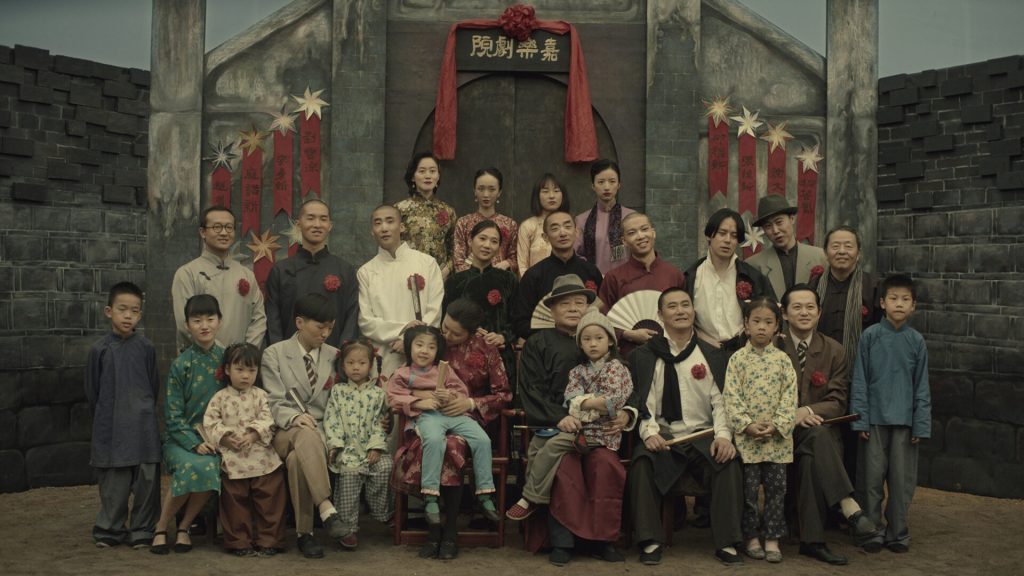
Qiu Jiong Jiong’s A New Old Play navigates through history with a very pertinent apparatus. The story at large has already been presented in myriad Chinese movies by countless masters; it’s about the artists against the ever-shifting political currents. The history is finite, but it shapes individual families in drastically different ways. Hence, the streams in which one can recall history, the amount of personal narratives, and how we can tell those stories are infinite. Here, the artifice, the ways the actors move around their conspicuous stage-like environment, fit their professions as Sichuan opera performers. Horse-face, Ox-head, and soup you drink before crossing the bridge are popular myths I’ve learnt since I was a little child.
The way Qiu visualizes them is very compelling and charming. He also cordially believes in these tales – when his family burns paper money in the world of the living, Fuxin receives this money on the mahjong table, indicating that a connection between the “real” world and the afterlife truly exists. I think that comforts the living more than the dead. The movie is obviously very concerned with death as the decade-spanning story is told from the point of view of someone who has passed, and the film interchanges between the passage before death and flashbacks.
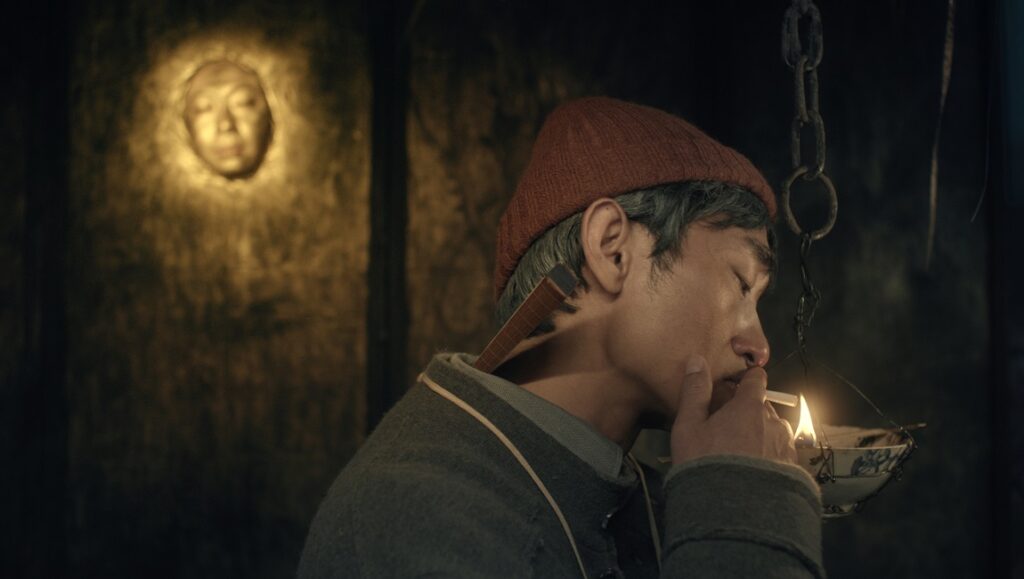
The performative aspects and flourishing designs are reminiscent of the sequences late in Bergman’s Fanny and Alexander and Kurosawa’s Dreams. Notably, those two are late works from the two filmmakers, and A New Old Play is Qiu’s first narrative work. The other two are acts of two filmmakers looking back and confronting their imminent, inevitable fates, while Qiu’s work is more a probe into family history instead of his own. The final lines in Fanny and Alexander are “Time and Space do not exist. Only a flimsy framework of reality. The imagination spins, weaving a new pattern.” The quotes fit this film well as it is a tale of origin, and it frames its reality through the art which the main character dedicates his life to, who has the same name as Qiu’s grandfather, one of the most renowned clown actors of the Sichuan stage. While you can sense the temporal shift in the make-ups and costume changes, everything remains very intact as a whole, where the weight of the production outsizes the weight of time. Since everything is filtered through the stage, we can interpret the whole project not as a commentary towards any of the political events, but a love letter and tribute to the perseverance of performance despite those arduous circumstances. In the end, one’s story is forgotten once they disappear from this world; the only way to remember is to continue the work that they dedicated their life to. In a time where we are plagued by symmetrical gimmicks imitating Wes Anderson and Stanley Kubrick without much consideration, it is nice to have a film that considers its apparatus personally and endearingly.



 Cinema Travelogue
Leave a comment