
At the 2013 Venice International film festival, Kelly Reichardt premiered her most genre-focused work even up to today. She set to premiere a heist film starring Josh O’Connor at the upcoming Cannes, so it seems wise to look back at how she fares under a more stringent genre framework. Night Moves is a film with two distinct halves. The first half is a glacial, moody procedural of environmental terrorism; slow but not dilatory, with plenty of pensive imageries that might serve as reasons for actions. Reichardt meticulously maps out the journey the trio takes to acquire their tools to carry out the act and associated commerce – purchasing of boats and ingredients to create bombs and also acknowledging the source of money – a sign that the three is not isolated from the general logic of the world and a harbinger for the nightmare proceeding ephemeral heroism that can be summarized by a chuckle. The second half is a paranoia thriller that deals with the psychological aftermath, shifting its focus onto Jesse Eisenberg and transitioning from a triad to a solo character study.
The film of comparison for me is Bertrand Bonello’s Nocturama; however, the latter has a more drastic shift in pace between the two parts, while Reichardt equally imbues her methodical style here. What is most different, though, is how Bonello’s film casts a playfully anarchic and inevitable doom over the entire second portion of Nocturama that ultimately plunges into its collective, predetermined pessimism; in Night Moves, we really only witness Eissenberg/Josh’s personal downward spiral as he reckons with his actions. Without the literal confines of a shopping mall, what unfolds in the second half is adjacent to Reichardt’s own Wendy and Lucy, where the main character gets pushed and slowly eroded by invisible social boundaries. Wendy’s desperation is now Josh’s guilt; the investigation from the FBI and the police are only featured in the peripheries. The three has agreed to stay off the internet and avoid telephone communication as much as possible, yet you can sense the impending prosecution through Eissenberg’s strained physicality and Reichardt’s neonoir flourishes.
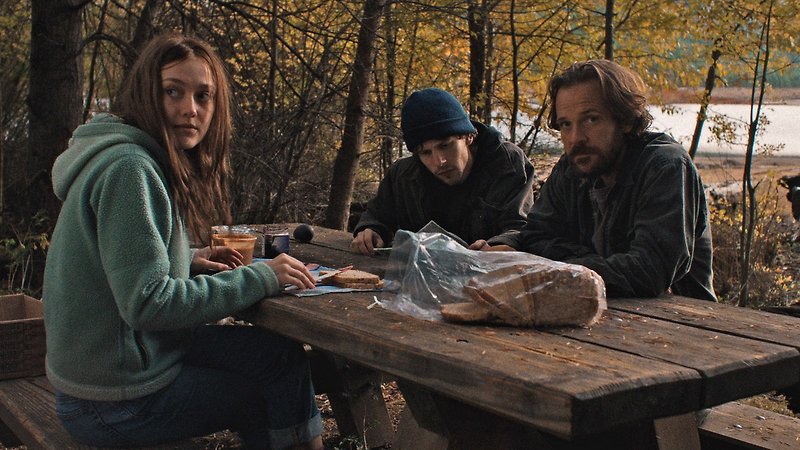
Despite the formal elegance, I can’t help but escape the feeling that these scenes are too literal-minded. There are clever scenes that replicate actions from the first half and Reichardt playfully uses shadow to convey the psychological – the best example is during a dance scene inside a barn where the shadows of people dancing interstitially covers the desolated Josh – but I don’t think the first half provides enough fodder on Josh for the second half to completely run on his psyche. Eissenberg is not bad, and his taciturn dislikability is certainly not an issue; it’s just that when a character is thin, the scenes become segregated from one another and are only attached based on tone that ultimately plays like a run-on sentence. Many contrivances from the first half are never mentioned again in the second. In my opinion, films like these rely on the ambivalence of reasons; the best example for me is last year’s Juror #2, where individualism and civil duties silently collide and wrestle against each other. While the film ends on a note that feels like a devastating stalemate, similar to the Eastwood film, the disparate two halves have mostly left the personal reasons behind.





 Cinema Travelogue
Leave a comment