
In the opening sequence of The Periphery of the Base, director Zhou Tao’s camera steadily observes the desert landscape, with the horizon in the middle of the frame. The wind is constantly howling, and the weather is shifting capriciously as the shadows cast by the sun emerge and disappear within seconds. Given these strenuous physical conditions, one would assume human civilization would stay far away from this place. Yet, the same camera captures scattered people trying to navigate their way through the dust. During the film, it was never revealed why these communities of people occupied these places; the only clue was given during a casual lunchtime conversation between two labourers, which is the only scene in the film that keenly focuses on human conversations. As the conversation carries on, the camera slowly tightens in on the two and one of them complained about his boss’s exploitation. However, we never get to learn about the work done by the workers or watch them perform their tasks. The theme of class conflict is not at the centre of Zhou’s interest, nor are any themes per se. Through the kaleidoscopic methods that Zhou silently captures the relationship between the community and the unique landscapes—employing a combination of long shots, sinuous lateral pans, and zooms—the film transforms into an odyssey that piercingly echoes the most primal struggle of all: man versus nature.
The foremost point of intrigue is the nebulous intentions of Zhou’s camera. Instead of tracking specific actions of people or dedicating his camera to the distinctive landscape of the Gobi desert, Zhou modulates between the two and gradually accomplishes an incredibly intoxicating obfuscation that deems the two inseparable from one another. For instance, a scene that begins with a wide shot of two women walking and collecting rocks in the middle of the desert, the formal expectation of this scene is that the camera will track the movements of the two women until it eventually cuts to the next shot. However, the camera subverts this expectation by remaining static while the two women move to the left of the frame, then gradually pans and zooms in the opposite direction of the women’s movements; an abrupt cut transitions this shot to a complete different landscape while the camera continues to pan and zoom in the same direction before the last shot concludes. Through this scene, Zhou’s cinematic language appears to jettison spatial continuity for a congruous mode of camera movement, cementing the participation of the observer while eschewing and mystifying what is being observed, merging the land and its people.
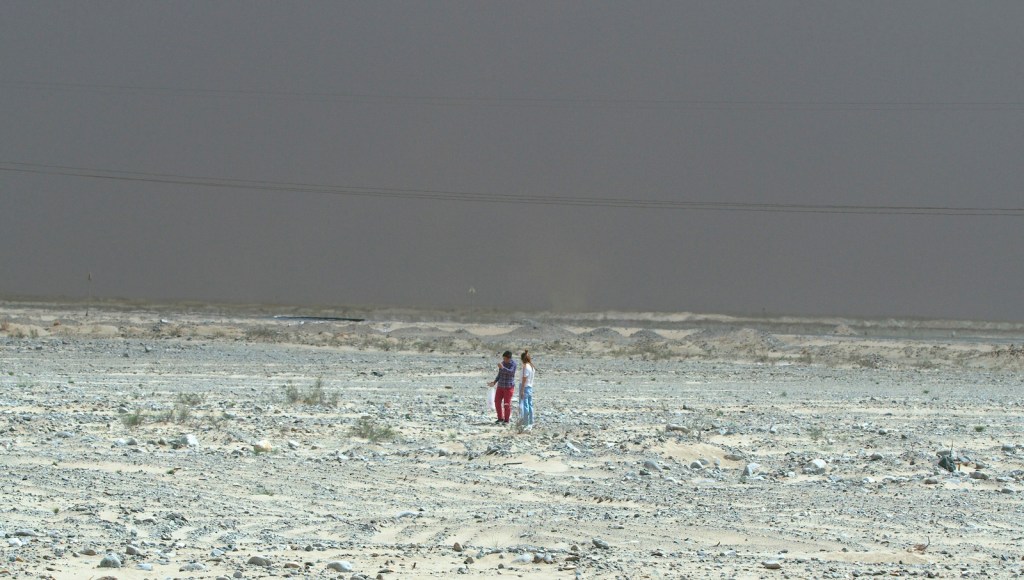
Such mystification continues to appear in the later part of the film, where the camera begins to move even more freely across spaces. Zhou uses the natural climate to his advantage – the sandstorm that frequents the community living in the area is scrupulously incorporated into the cinematography as a blurring technique that inserts a malleable dimension into the frame. It is a dimension that blocks the perceptions of the viewers from fully seeing the people in frame, while this extra layer is the same visual obstruction the civilians have to face in their daily lives. The freedom of the camera is based on the ambiguity of what exactly is being captured in front of us. Their movements are not guided by any specific objects or people, nor is it trying to find anybody or anything either, so there is an emergent agentless quality inherent to the film. One can argue such quality is a detriment to the filmmaker in terms of forming an actual perspective on his subject. Yet it is this pure visual confusion that contributes to a heightened feeling of desolation, heavily associated with the desert, that is neither schematic nor didactic. This representation creates a confluence of the people and the land, like a fabric blowing in the wind, looking identical to the undulation of a large area of sand, while a high aerial shot of the desert can somehow feel like a microscopic observation of a tiny organism. These individually exhilarating shots accumulate into a final 15 minutes that envelops into a journey that is truly unexplainable by words as it includes moments that feel belonging to either the outer universe or a dreamscape completely outside of reality.
Zhou ultimately returns his camera to the very land he is trying to capture. Despite the film’s consistently shapeshifting form, Zhou never approaches the people or land with exoticism. The seldom appearance of music is diegetic, and the people are never shot with additional sentiment or intrigue that insists upon their emotions. The Periphery of the Base, at the end of the day, returns from a place of visual wonder to a dedication to the wonder of nature. The stars which we imagine are as tangible as the nature surrounding us, and the final transition is an acknowledgment that the film is at one with it.




 Cinema Travelogue
Leave a comment