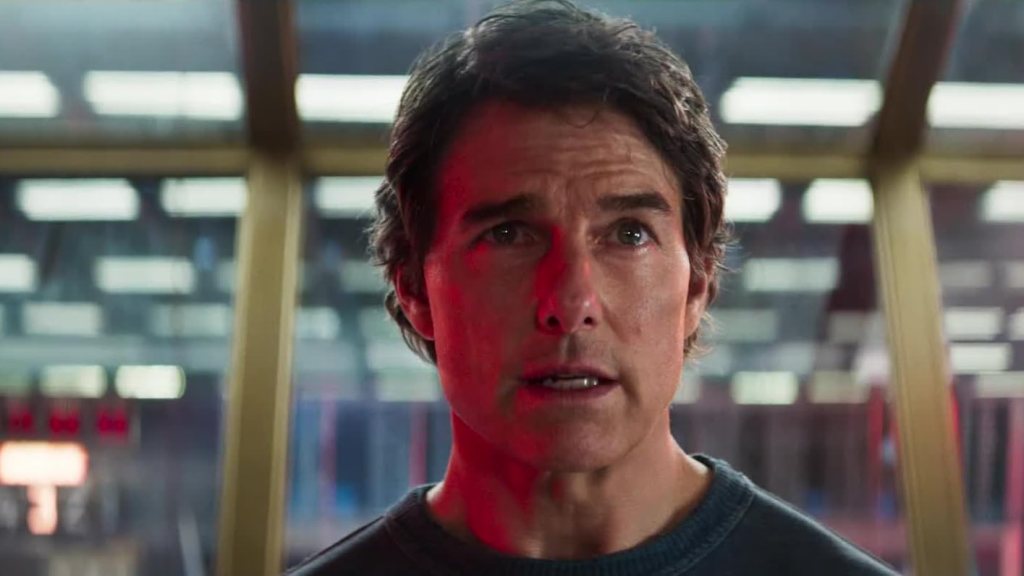
During Ethan Hunt’s apocalyptic vision in Mission: Impossible – The Final Reckoning, the final film in the Mission: Impossible franchise, a series of nuclear missiles is launched by the Artificial Intelligence antagonist, the Entity. The first city he sees under attack is none other than Los Angeles, with the iconic Hollywood sign conspicuously in the foreground. The stakes of the second half of the final film are higher than ever. The first half introduced a villain who is unreachable in physical form, yet ubiquitous throughout the hero’s path, by predicting his every move. But let’s be honest here, the real draw of the film is not to see the defeat of a villain that echoes the looming threat of proliferating and infiltrating uses of A.I. across all faucets of our society, but the types of stunt will Tom Cruise put his life at risk for for this exact purpose.
The fact that a 62-year-old is being labelled as the last real movie star speaks to the lack of identity Hollywood has suffered in recent years. The unspeakable truth is that people don’t need movies as a main source of entertainment anymore, so the bar for one of these blockbusters to prove its worth as a spectacle is higher than ever. For Mr. Cruise, this seems to imply stacking more and more chips on his life, which has developed from endearing professionalism to slightly off-putting masochism. He seems to have embarked on the the most impossible mission of all: to redeem Hollywood from the impending doom imposed by short video and YouTube algorithms and reinstate “THE MOVIES” as a primary source of entertainment, but unlike Ethan Hunt against the Entity in this film, it might have been a tad too late.
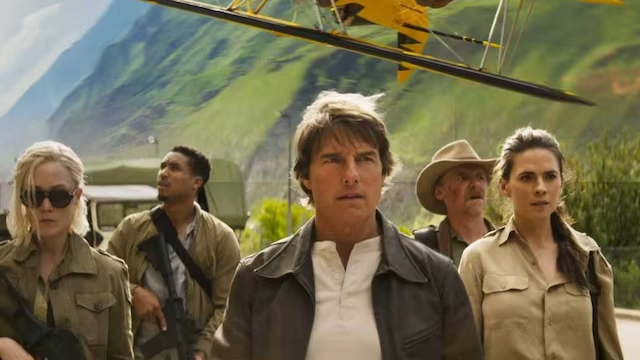
Perhaps that is why a feeling of desperation is dominating the entire film. From the opening montage that consists of the greatest hits from all the previous films, which runs the gamut from climbing the Burj Khalifa to skydiving off a plane (more than once), to its rapid-fire incoherent expositions that have two people from completely different times and settings talking off each other. The film feels extremely rushed, but confused by what it’s rushing away from. An argument can be made that the pacing of the first hour is trying to mirror what it feels like to live in today’s world, always chasing something unreachable and sensing there is an impending evil force that will swallow you whole if you are not paying attention. Perhaps the tepid box office performance of the first half raised the weariness of the entire cast and crew, and their solution for a better box office is a more exciting and exhilarating film; they found the solution in faster cuts – we don’t care about narrative coherence, just makes the movie appear like it’s flying by. In reality, it’s just spinning headlessly in circles.
To give where credit is due – perhaps they are the only parts of the film that should be mentioned for Cruise’s sake – the two central set pieces contain real grit and tactility that clear every other Hollywood blockbuster from this year without much of a competition. The two scenes spatially mirror one another; the first is set in the deep ocean, and the second is high up in the air. The nailbiting nature of both scenes is augmented by the perspectives delivered through wide shots and various camera angles that are only possible when a bravura performer like Cruise chooses to commit to his stunts. The practical sets ground the film in a heightened reality that the remainder of the film is completely devoid of. If one really wants to witness those two scenes, they should treat it as if they’re going to the circus; you will have to endure interminable and needless banters from the host and subpar acts just for those mere 10 minutes of wonder. Make sure you’re not already asleep by then.

Despite its seldom excitement, its narrative dearth is also worsened by its lack of conceptual ambition. In Part One, the personified voice of The Entity and its human sidekick, Gabriel (Esai Morales), grants the invisible villain a form that feels threatening through its unpredictability. In Part Two, however, the threat of The Entity has turned into a literal time bomb that will trigger a nuclear apocalypse once it infiltrates the weapon base of all 8 countries that possess nuclear weapons. The Entity is voiceless, and Gabriel is mostly detached from the story, serving more as a plot device. As a consequence, conversations revolving around the presence of The Entity become extremely rhetorical and didactic, where individual conflicts between parties are mixed with sprinkles of “This is what The Entity would want us to do” that serve purely as a pessimistic undertone. The film is in the orbit of solipsism for imposing a collective panic while offering blank moral posturing as the only counter. For a final film in a legendary franchise, it’s just sad to see a film that dies with a shortage of ideas.
In The Final Reckoning, Ethan Hunt is elevated to the position of a messiah that serves as the one last hope of humanity, even the President of the United States will lie to her cabinet and pull private relations for Hunt to proceed with his mission. Hunt is deemed the final rational conscience of humanity, just as Cruise is the final hope for the movies to be glorious. Yet Hunt’s lauded humanity and rationality do not translate into the form of the film. Hunt is devoid of sexuality, and his chemistry with a female partner is at its peak when performing something as mechanical as mouth-to-mouth CPR. Instead, he advances through obstacles like a phoenix glitching through certified death scenarios. On several occasions, the film forwards its plot by jump cutting from the most intense moment to Cruise suddenly waking up. It feels like Hunt is having a fever dream; this whole film is like an unreachable dream that Cruise and his director, Christopher McQuarrie need to wake up from.



 Cinema Travelogue
Leave a comment