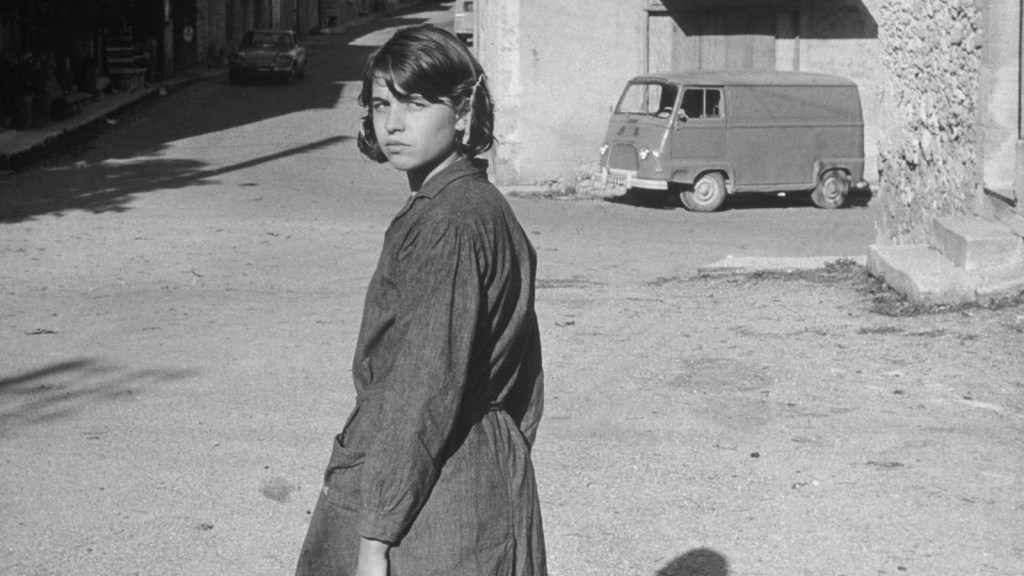
Robert Bresson is a filmmaker whose style has been revered, studied endlessly, and regurgitated by many who claim to have been influenced by him. In the TIFF Wavelength screening that took place this last Wednesday, Mouchette, one of Bresson’s slightly lesser-known works, was preceded by Nadine Nortier, a 2012 short named after the actress who played the former’s titular character. From this short -let’s first disregard its quality- one can observe that the non-acting from the non-actors, as Bresson calls them, models, are the first trademark one would think of when they try to pay tribute to, or perform mimicry of (whatever you want to call it) his work. The three young actresses in Nadine Nortier are placed in a rehearsal room, where they perform tasks individually -putting on a pair of oversized shoes, wringing clothes dry, singing- that Nadine Nortier herself performed in the film. The mundane tasks paired with the actors expressing nothing more than their youthful faces are conduits to the common reception of Bresson’s films, a rejection of feelings that reflects the coldness of the surrounding world.
This sentiment is not entirely wrong, and Gillian Garcia’s exercise is not entirely fruitless, but what the short fundamentally diminishes is the idea of how the actors are always subjected to their surroundings in Bresson’s films. Certainly, they are treated closer as object than many other films, but the non-acting is not a symbol of dullness, but as focal points upon a vision that serves a plane of reality. What the short does is to reduce the non-acting into a form of theatricality where the mundane acts being performed can only be viewed as “acts”. If one sits down and watches Mouchette, they would realize Nadine Nortier is anything but lifeless. Because a human presence itself is inherently full of life.
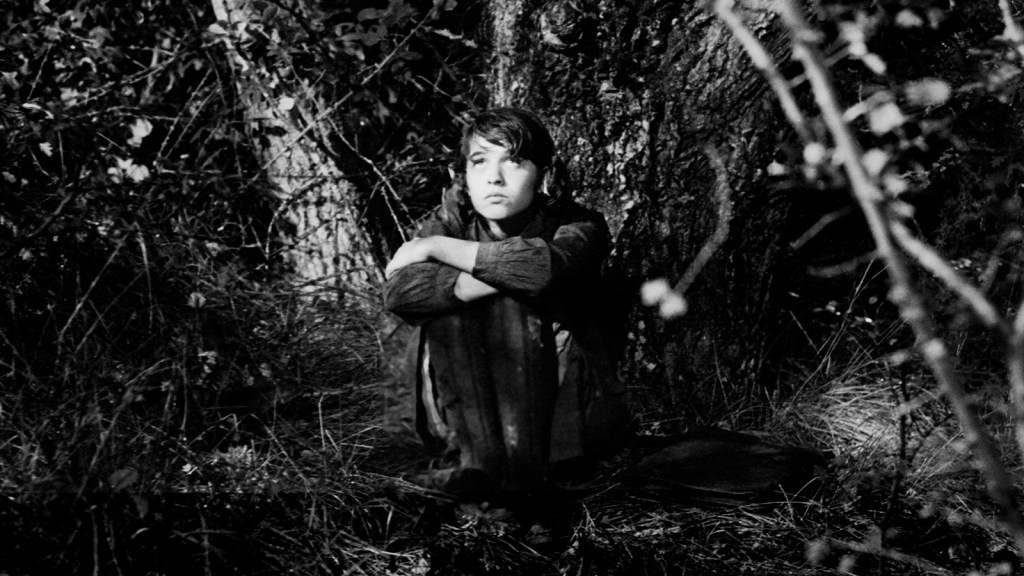
Ostensibly, the plot of Mouchette aligns perfectly with the presumed bleakness of Bresson’s work. It’s a film centred around youth, so it operates in the orbit of the 16-year-old Mouchette. Her situation is dire. A bedridden mother, an abusive, alcoholic father, a detachment from her schoolmates, a man who tries to rape her, and a community that provides no solace for any of those. Here, the expressionlessness and pure physical movement of the Bressonian actor is salutory to film. Where a more melodramatic portrayal would drag the film down to maudlin cartoon, Bresson provides the film with a refreshing clarity. What’s most intriguing about this method here is how he manages to sublimate the actors, mainly Mouchette’s presence, into pure material essence. A trivia from the making of the film states Mouchette’s tears throughout the film are artificially placed. While this technique is not uncommon, the film differs by not hiding the artificiality of the placement. Bresson is removing the linearity of emotion that are usually offered by the naturalism of an actor’s performance, and replacing it with an emotional and material essence that regards the idea of realism on film that is purely driven by the implication of one object (the actor) encountering another (water, as in tears). He is stretching the boundary of the type of real emotion can cinema truly convey through its principal illusions. The actors playing the character crying are not as important. The expression does not originate from the actor, but the ability of film to perceive and capture them.
The physical matter of the film does not stop at actors, but the world that surrounds them as well. People usually remark on how he films people entering and leaving doors with a few extra seconds; isn’t this an active acknowledgment of the physical existence of the doors, thus the boundaries which the characters are constantly crossing and bumping into? The film’s misery reaches a cosmic level, which cannot be achieved by the simple rejection of the standard mode of performance or cutting rhythm, its author has to input it with some sort of aesthetic determination for something beautiful to occur onscreen, and not resort into the rhetorics of restraint, which are prevelant in what many Bresson’s imitators are making, a theatric of insipid and pointless ridiculousness. If there’s anything that’s extremely effective, that is how Bresson manages to enhance physical matters to a degree that they match the degree of Mouchette’s spiritual impediments. The flipping of a table that only reveals Mouchette hiding under it, which he punctuates the sequence without any suspense, but with helplessness.
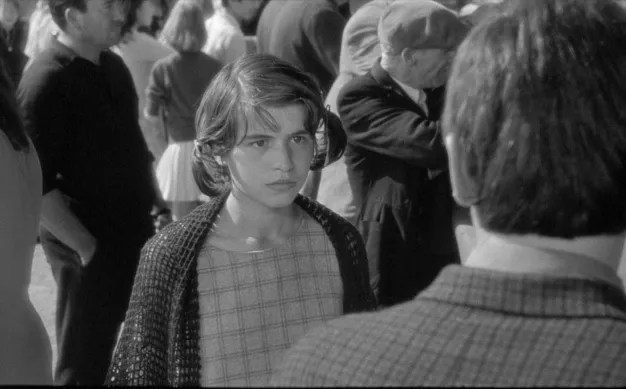
Bresson is usually a reticent filmmaker who prefers to use actions to depict pure effect, which is put on full display in a sequence of Mouchette’s attempts to talk to a boy she met on the bumpy car ride. It first establishes a medium shot of Mouchette scouting around for the boy in the crowd. The boy then enters the frame from the left behind her. he turns around, looks at her for a second, but instead of staying with her, he walks straight towards a booth in the background. This is followed by an axial cut to the boy standing at the booth looking back at Mouchette, who is out of the frame; it is now her whom moves into the frame from the left, the boy moves again to the right as if to avoid her and camera tracks his movements and leaves Mouchette out of the frame again; Mouchette then follows him and moves into the frame again. It then cuts to a reverse shot from Mouchette and just when she smiles and opens her mouth, her father enters the frame and spins her around; the spin is matched by a quick cut to a shot that for the first time in this sequence, sees both people facing the camera; but it’s too late, another chance for connection is lost. This meticulously planned sequence does not include a single word spoken by the actors; through physical movements and well-coordinated cuts, suspense and despair are expressed not through a rejection of cinematographic language, but using the cuts and arrangement of spaces to create an invisible barrier that prescribes the oppression Mouchette faces throughout the film.
We also see the role that chance plays into the scene. Mouchette was given the opportunity to ride the bumpy car purely out of the benevolence of a stranger who hands her some coins. She gets to meet the boy in the first place because of serendipity, yet it turns out to be a false one, one that ultimately rips hope away from her once again instead of one that sets her on a positive path. This self-contained parable is part of a larger cycle of hope and its diminishing return that Bresson creates in Mouchette; the film is Brechtian in its own way
Mouchette premiered in 1967, on the heels of the May ’68 protests of the proceeding year. One can make linkage of the oppression of the film’s titular character with the the discontent and that leads to youth rebellions in real life. The film does not offer a hopeful or rebellious note, nor does it reinforce a pessimism and passivity that one would often mistake as social critique. Instead, it’s a holistic work that is indelibly sensitive to elements surrounding Mouchette -the strokes of tree leaves, the serene river, the quietude of the night- that it accomplishes a vision of world that is never been seen in Bresson’s earlier films (the spiritual trancendence of Diary of a Country Priest, the triumphance of the last note in A Man Escaped) or the arid plague of reification and pessimism that intrudes his later works (L’Argent, The Devil Probably). The final note appears to be sharply violent, unlike the elegiac acceptance of natural processes in Au Hasard Balthazar, the nature is placid to a point of unnaturalness. In the usual Bressonian cause-and-effect editing style, we see Mouchette row out of the frame, down the hill, and water splashing. The moment feels abrupt like the cruelty of chance strikes once again. Spirits of anger and defiance undulate across the screen like crashing waves, yet the accompanied music is tender, destabilization in the face of images that are absolutely stable.



 Cinema Travelogue
Leave a comment