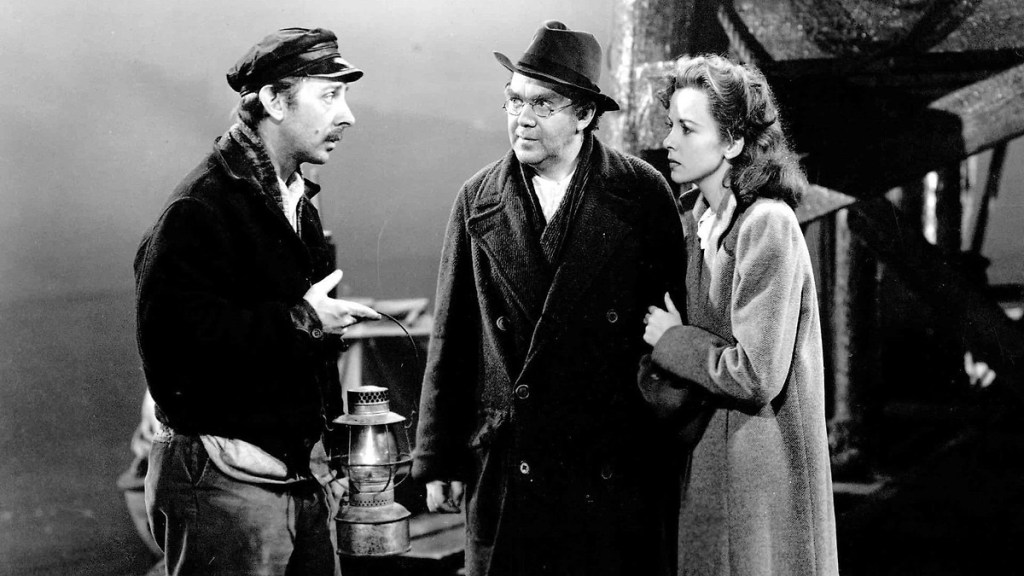
Anatole Litvak’s 1941 noir thriller Out of the Fog employs the setup of a detective noir to portray the gentle spirits in a small community. A suspicious man named Goff (John Garfield) enters a small seaside community, lights a boat on fire, and enters a bar with a grin on his face like it was a great accomplishment. Unlike a noir, the film has no femme fatale, no death that instigates the plot, and no detective running around trying to solve the case. The town consists of mostly working-class people who own the local restaurants and shops. They live a rather repetitive life, and the only thing that excites its two inhabitants, Jonah Goodwin (Thomas Mitchell) and Olaf Johnson (John Qualen), is rowing out a boat and going fishing after a day of work.
The community of Out of the Fog is the strong backbone for the film’s drama. The locales are all vividly filmed, especially a Russian bathhouse that grants the film’s setting more pertinence, as well as retains the film’s visual motif of fog in an interior setting. The drama of the film unfolds between Goff, Mr. Goodwin, and his daughter Stella (the remarkable Ida Lupino). Goff turns out to be a gangster who is familiar with the ways of big cities and extorts Jonah and Olaf to pay him $5 per week or he will burn down their precious boat. The conflicts between the characters reflect the central ideological contrast between small village life and big city bullies. The close-knit milieu is mundane, full of innocent goofs that deal with minor, quotidian issues, and as Jonah would put it, they live a normal life. Meanwhile, Goff impedes the mundanity with a panache that is attractive because of the danger it insinuates. He understands how to work the law on his side while acting as an enforcer. Jonah and Olaf are forced to sign a debt certificate at gunpoint, which Goff later used in court to justify himself; the callousness of paperwork dominates the simple right-and-wrong represented by Officer Macgruber (Robert Homans). Goff’s influence extends romantically as well. Stella, who is bored by her normal life and normal job at the Brooklyn Phone Company, jettisons her high school sweetheart George (Eddie Albert) to go on dates with the more sinister and mysterious Goff, who, as she describes it, gives her more of a “burning” feeling.
Lupino portrays her character with intensity and vivacity that make her stand out the moment she enters the screen. Her first real dialogue is two rapid-fire monologues where she conveys her dissatisfaction with living in a small town where everything has been and will be static for the rest of her life. Her eyes clearly yearn for something more, and her physical movements declare anger that drives more dramatic power than the words can convey. Playing a 21-year-old who has not seen much of the world yet, the character’s initial set-up as a wide-eyed girl is complicated by the determination of her performance, quickly turning around to address all the older men surrounding her when she interacts with others. Her father, played by the experienced Thomas Mitchell, is technically the lead of the film. He balances between a harmless, avuncular figure who is satisfied with the small pleasures in life. Later in the film, as if he is possessed by the thriller aspect of the film, a darker edge percolating beneath him begins to show as he needs to hold his own against Goff.
As if to accommodate the presence of Goff or to elude the banality of the village life during the day, the film solely takes place at night. Whenever Jonah and Olaf get to their boat, Goff emerges almost out of nowhere, with his faux-enthusiastic radio voice asking the pair to pay a debt they never owed in the first place. The titular fog, although it can be used as a metaphor for the intrusion of Goff that inserts uncertainties into the villagers’ lives, is a physical presence throughout the film’s exterior scenes. This setting reminds me of one of Howard Hawks’s masterpieces, To Have and Have Not, which takes place on the coast of Martinique. Out of the Fog was released in 1941, just a year before the Americans officially entered the WWII battleground. While the Hawks film brings the resistence against Nazism to the centre stage, there are only murmurs in the dialogues from this film that hints towards the war. If the nexus of the pictorial and thematic elements of To Have or Have Not is the matter of life and death surrounding Humphrey Bogart, a morally righteous man with nebulous intentions, then Out of Fog more so revolves around a communal spirit warding off extraneous evil, while hinting at potential factors that will completely alter the lives of “the innocents”.





 Cinema Travelogue
Leave a comment