Through the canonization of the Criterion Collection, Kiarostami has become a keystone filmmaker and a monolithic representation of Iranian cinema at large, almost ten years since his passing. Perhaps his formidable run of films through the 90s has left such an unerasable impression, but during the later sections of his career, he has become more of a travelling journeyman. In 2003, he made Five Dedicated to Ozu, set in Iran. Six years later, Like Someone in Love premieres at Cannes, a film set in Tokyo with the cast consisting of only Japanese. And this feature is not the only time Kiarostami has expedited to another country to make a film, as he released Certified Copy the year prior, set in Tuscany, starring Juliette Binoche.
When making a film set in another country, with people not only speaking a different language but also embodying a completely different culture, the false welcome of exoticism can easily set a filmmaker down a false path. Fortunately, these two astounding features manage to retain a formidable sense of integrity through their persistent formal incision and succinctness. Kiarastami’s approach towards his subject matter is simple; his actors, whether it’s a real-life figure playing herself or Juliette Binoche, are never melodramatic. Through this reservation that he manages to heighten the effects which artifice plays and steers his work into mysterious territories. This mystery in play does not lie within the plot or any ostensible narrative elements, but a documentary axiom in that one can never objectively represent reality and a camera cannot truly elucidate the content of the heart; all you can try to do is to configure the film’s reality in the context of the subject. Like Someone in Love feels like a collision of perspective by Kiarostami’s way of breaking down Japan into a series of reflections, shot-reverse-shots, and interior pans; by keeping his distance, he manages to convey universality.
The first scene of the film set in a bar, which involves Akiko dealing with her micro-managing boyfriend, talking to her friend, trying to refuse a client assignment from her pimp boss, is captured using one shot/countershot setup. The use of digital photography fully pays off here. The reason that such simplicity can be accomplished is because each pictorial unit ubiquitously captured every single person and object within its frame. Whether it’s strangers entering the bar through the door, or the barstender standing in the back, or another character hanging out in the background, the depth of the field manages to defy the conception that a shot/reverse-shot set-up only belongs to the two people in conversation; instead, it can be extended to everything in frame. In the case of the film’s opening scene, the milieu of the bar matters as much as the verbal conversations. The film’s naturalism thickens as the scene unravels in real time, with its rhythm of cuts not specifically emphasizing Akiko’s mental plight; her situation feels helpless without the mise-en-scene exaggerating it as such. This confluence of temporal and spatial lucidity emphasizes what late-stage Kiarostami has been working towards and ultimately materializes in his final feature, 24 Frames, to contain every movement and gesture within a singular, continuous world.
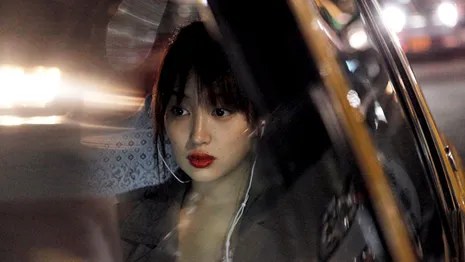
There is constant interplay between perspectives. While in a taxi, we are privy to Akiko’s voice messages that the taxi driver is not. By understanding the situation with her visiting grandmother, a series of shots that show the passing streets of Tokyo transition from curious exploration to a heart-shattering familiarity.
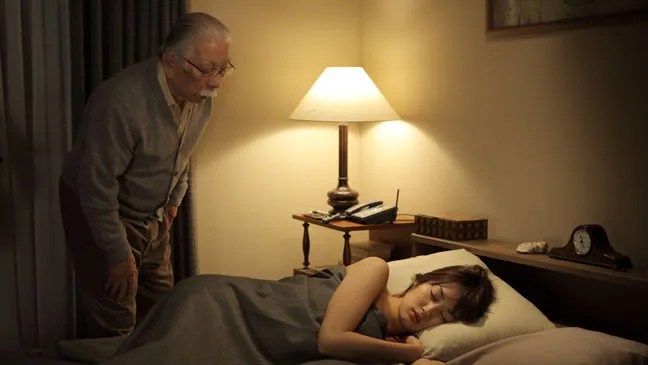
When Akiko gets to Takashi’s apartment, the camera jettisons being static and begins tracking character movements across the confined spaces. The perspective switches deftly between two characters, and the interpretation of the same camera movement manages to differentiate through the dialectics and dynamics between character and space. When Akiko first enters the room, Takashi receives a call and sits down to perform translation work for the caller. We follow Akiko as she moves across the room, and we explore the decor of the place for the first time as she does. Later, when Akiko gets into the bed and goes to sleep, we follow a worried Takashi who is unsure of what to do; here, the image of Akiko, who is foreign to this space becomes ascetic like she always belongs in here, and it’s the owner of the apartment who becomes unsettled.
I started wondering about the challenge of working in other cultures. What I reached was the sudden acknowledgment of the universal aspect of filmmaking. Not that I ever felt the necessity of proving that all human beings suffer the same way, feel joy the same way, but it happened on my way — when I get close to these people, just by the simple intervention of translation I can actually reach them and ask them something, and their reaction is as I expected. I see that the relationship goes so smoothly, and I realize that cultural languages and specificities are nothing but simple obstacles that you can easily overcome. It’s obvious that human beings are the same wherever they are.
A way to elude the troubling globalization of cinema is to convery a personal vision of the world through film grammar. Like Someone in Love isn’t Kiarastami’s attempt at a “Japanese film”, but a leap he takes to see whether his own cinema can manage to transpass the language barrier. There’s a frequent use of reflections in the film, which isn’t foreign in Kiarostami’s cinema. Images reflect off glasses and windshields in the same way, no matter if it’s an Iranian car, a French car, or a Japanese car. But since this film is explicitly set in Japan, the reflections show neon lights on the street and sky bridge; the shots are set in frame-within-frame through bamboo panels and ramen shop counters. The Japanese characters react to these spaces naturally, as do Iranian characters react to their surroundings naturally. This is not an aesthetic or philosophical choice, but a push towards an integral realism across Kiarastami’s oeuvre.
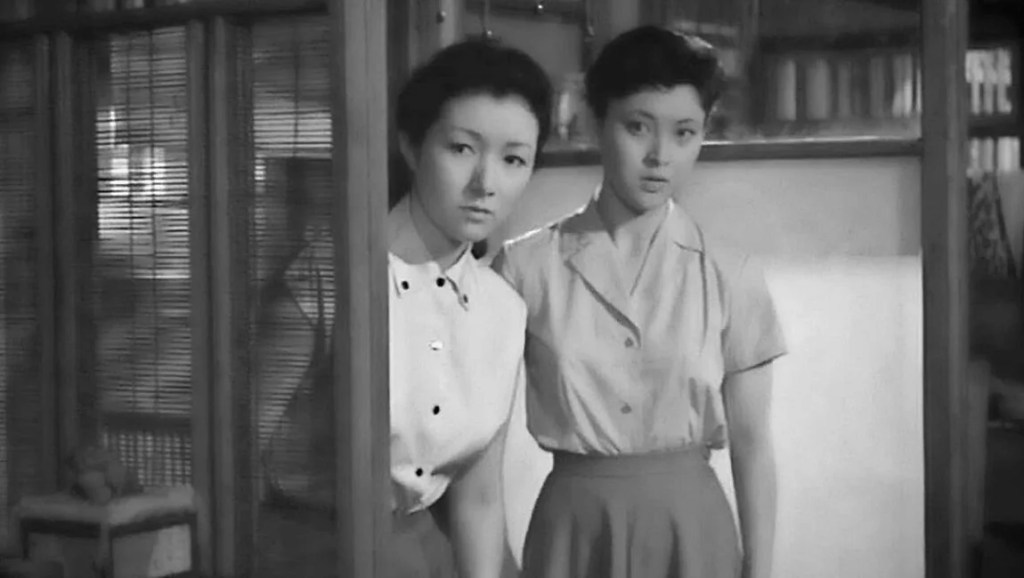
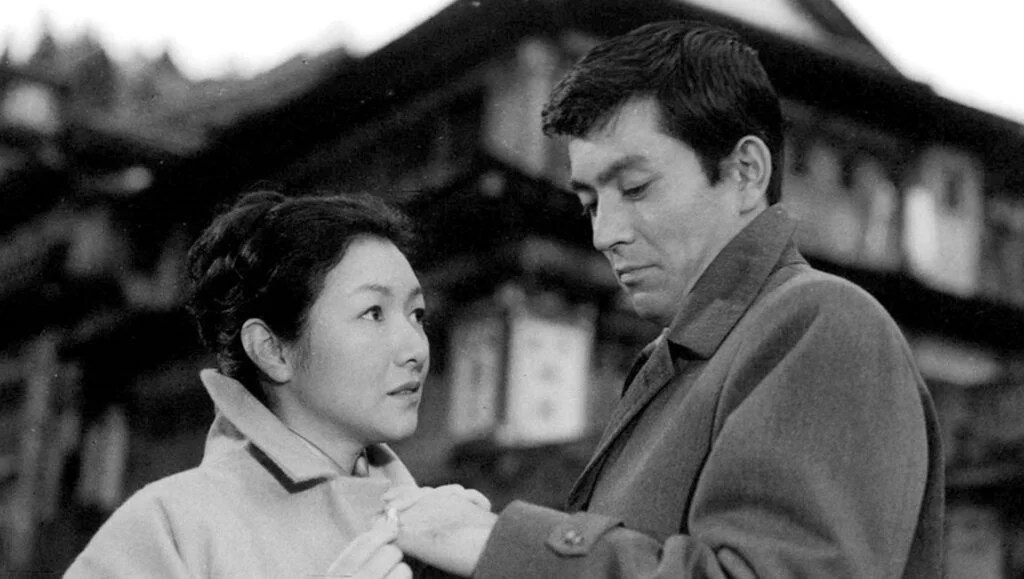
The mystery of the characters can be experienced on their own terms without any cultural baggage. A prevalent theme in Kiarastami’s films is roleplaying. One can clearly imagine the interplay of roles between the grandfather, granddaughter, and boyfriend being incorporated in another cultural context, but it’s the linguistic cadence of the Japanese language that grants Like Someone in Love its power. In other words, Kiarostami believes in the reality of his films enough that he achieves a sense of universality, where certain intended opacity in Like Someone in Love is equally fascinating as the taciturn mystery of the main character in Close-Up. Kiarostami’s reverence for Ozu does not lead him to make a film with the same sentiments and dramaturgy as the Japanese masters. Ozu does not represent Japan; he represents a cinematic form, like how a Kiarostami film is the product of his form applied to individual places. That’s why the ending opts out of the euphemism, and becomes unsettlingly abrupt to an absurd degree.




 Cinema Travelogue
Leave a comment