
Bigger Than Life
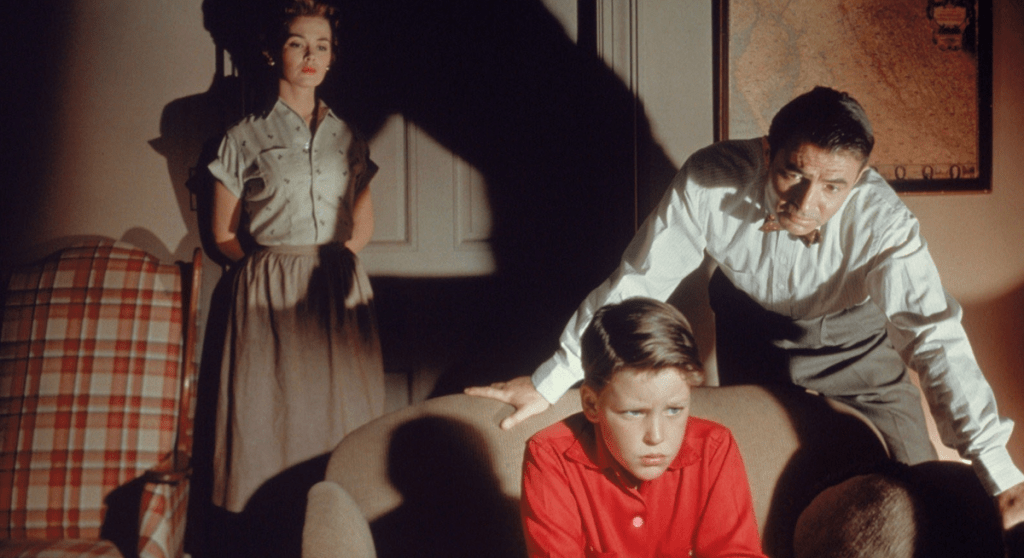
Nicholas Ray crafts a domestic theatre made of mirrors, staircases, and door frames. This is the fourth film I have seen from Ray, and every one of them has made me more invested in his oeuvre. His main characters always feel like they are being eroded by their decrepit emotional shortcomings. In Bigger Than Life, this inner motivation that literally drives James Mason into madness is the banality of the American middle class and Mason’s innate desire to escape it, to not carry any baggage, to return to his high school football ego-trip. The scene where the two men fighting breaks the staircases in the house has an intense physicality to it, because of how frequently Ray sizes the characters and frames them against this house that is the prison of materialism. It’s hard to compare anything with Johnny Guitar, but the use of CinemaScope here is absolutely gorgeous.
Le Pont du Nord
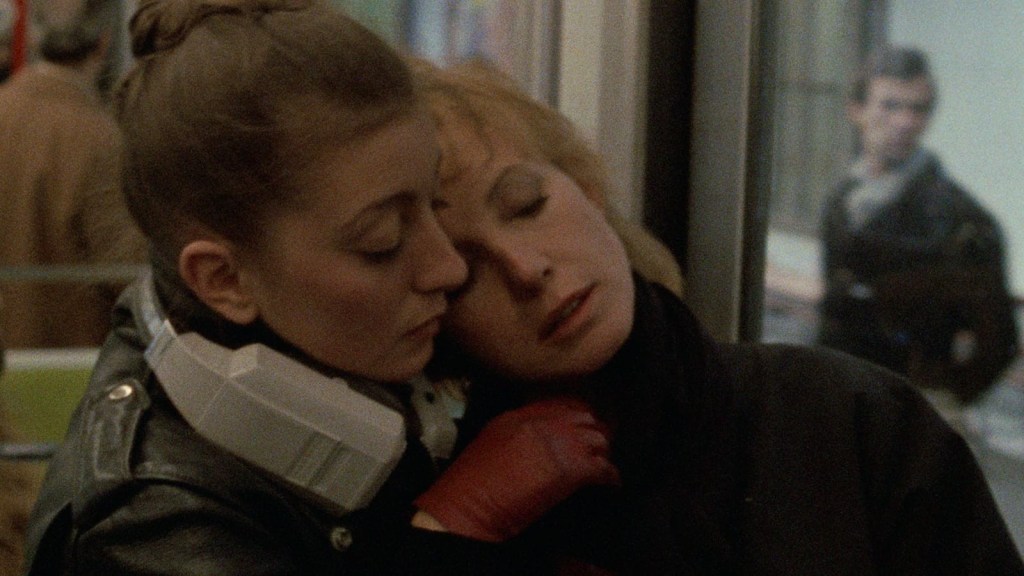
I always try to watch at least one Rivette film a month; he is one of my favourite directors, but their extended runtimes make it difficult for someone with a 9-to-5 office job. Le Pont du Nord is one of his shorter films, and although the elements that constitute Rivette’s cinema persist, I would not recommend this as the entry into his filmography. The two main things, the improvisational actors and the mysterious MacGuffin, are both present here. This is as much a mother-daughter film metatextually (casting real-life mother-daughter Bulle and Pascale Olgier) as it is within the film’s content. The two generations have two different perceptions of the world, and the film is actively negotiating between the two; the daughter’s world is more fantastical, and the mother’s more conspiratorial. The two extended takes of the two trying to rescue each other from their plight are very moving, as the harmony of bodies has always been the best part in a Rivette film. In terms of the macguffin, Rivette imagines Paris, which is stripped of romantic exoticism and full of building ruins, as a maze in which the two characters play in a convoluted game. The confusing nature of the game is why I would not recommend this as someone’s first Rivette. The depiction of Paris here is a deliberately political decision, and despite its grey palette, Rivette captures the seasonal beauty very well.
Hatari!

Howard Hawks’s most liberating game of life and death. After watching Hatari!, I immediately rewatched Only Angels Have Wings, the film that made me fully love Hawks the next morning. I am so impressed by how concise Hawks has become in the later stages of his career. There are significantly fewer cuts to close-ups shot/reverse-shot here compared to Only Angels Have Wings. Yet the dynamics between the characters, especially how the groups accept Dallas into their circle through the piano and how Pockets’s feelings for Brandy are revealed, are delineated so effortlessly that it would’ve taken pages of expositions for a lesser filmmaker; Hawks only needs one scene for each. What is dominant in this film is the unreserved satisfaction of the cars chasing animals, using a rocket to catch monkeys, and the love and camaraderie that Hawks never allows to become mawkish in any sense. “How would you like to kiss?”
Angel Face

It functions as a hybrid of two of Otto Preminger’s most famous works, Laura and Anatomy of a Murder, by featuring a courtroom scene where the justice scale does not know where to tilt and a scene where a character walks through the spaces left by a deceased individual. Rivette was correct that this is the film that elucidates what is essential about Preminger’s cinema. There are a lot of cycles and repetitions within Angel Face, Robert Mitchum returning to the same woman as romantic refuge, two identical car crashes, the staging positioning lawyers of the opposition at the same camera angle, and the camera revisiting the space that was once filled with human beings that now long gone. The plot and characters make less of an impression here than Preminger’s elobrately crafted lucid chamber of doom that meets everyone with perfect equilibrium.




 Cinema Travelogue
Leave a comment