
How to discuss a film as hectic as Paul Thomas Anderson’s sophomore feature Boogie Nights? By asking this question, I have already fruitlessly initiated such discussions. This is a film that has progressively disappointed me through repeat viewings. Rewatching it in 70mm this last weekend – I’d imagine the ideal condition a devotee of the format like Paul Thomas Anderson would prescribe – my impression has gotten even worse than my previous viewing almost two years ago, coincidentally in the exact same theatre, also on 70mm. What to do?
Boogie Nights’ surface stimulation is extremely evident at first glance. The opening long take that glides into the Reseda night club and subsequently reveals all the principal players is better conceived than anything in Paul Thomas Anderson’s debut feature, Hard Eight. For how addicted the current-day, populist “auteur cinema” is to long takes, there is a refreshing swiftness to how the staging reveals each character, very attuned to the neon-colored milieu and this closed-off, alluring community of pornographers, so that the take feels less prone to the decrepit indulgence of a “big-boy” filmmaker playing with his toys – his camera and his dolly tracks. After this uncut sequence, we see a shot/reverse shot of exchange looks between Eddie Adams (Mark Wahlberg) and Jack Horner (Burt Reynolds), the film’s two central characters.
Who are they to each other? Eddie and Jack’s relationship ranges from the exploitative nature of a money-grabbing individual and the 17-year-old he exploits, to a visionary and his muse, and ultimately to a surrogate father/son dynamic that invites comparisons with the one in Hard Eight. The fact that the interpretation can be so malleable speaks to the aberrance and toxicity of their relationship. The two’s initial look exchange is interrupted by no other by Little Bill (William H. Macy), whose name and countenance of truncated masculinity automatically intrudes the frame with a self-deprecating humour and introduces a subtext that underlies every relationship within the film, a mixture of absurdist comedy and sexual ambiguity that pairs impotence which extreme masculinity, where everything, money, fame, and even family, all revolve around a 13-inch dick. See Jack’s reaction shots to Eddie’s schlong: the camera zooms into his palpable looks; although we can interpret that he is witnessing a money tree, an admiration of manhood that plays as deadpan humour percolates behind his serious mien.
Similarly, with Amber Waves (Julianne Moore), the maternal figure is to Jack’s paternal one. The camera lingers on her close-up, checking Eddie out during their first sit-down meeting. We can contemplate whether this is a sexual fascination or a motherly embrace. But Moore imbues enough ambiguity within her gaze that makes both valid answers. Amber welcomes Eddie into the family through the exchange of bodily fluids and introduces him to cocaine like a mother would to her child, her most cherished cuisine. This is not to mention the more melodramatic moment between Amber and Rollergirl, who acknowledge themselves as mother and daughter while high. All this creates a family finding their own bonds not in bloodlines, but through extraneous factors such as coke and sex, both supplementing for the absence of love from their original families (although we never get a sense of Jack’s familial background).
All of this would work if the film is firmly established as a hang-out movie, seldomly conveyed through the opening long take and Eddie’s introduction to Jack’s mansion. That is, if the movie consists more of Eddie and Reed just hanging out around the pool and going through side quests. However, Boogie Nights follows a typical rise-and-fall arc of hubris and reconciliation, to such levels of parody that Johnathan Rosenbaum noticed, “to plagiarize a sequence from Raging Bull that itself quotes from On the Waterfront“. Without a narrative leanness, Anderson dives head-first into heady montages without any understanding of space or time. Pacing is basically non-existent during the progression of the plot.
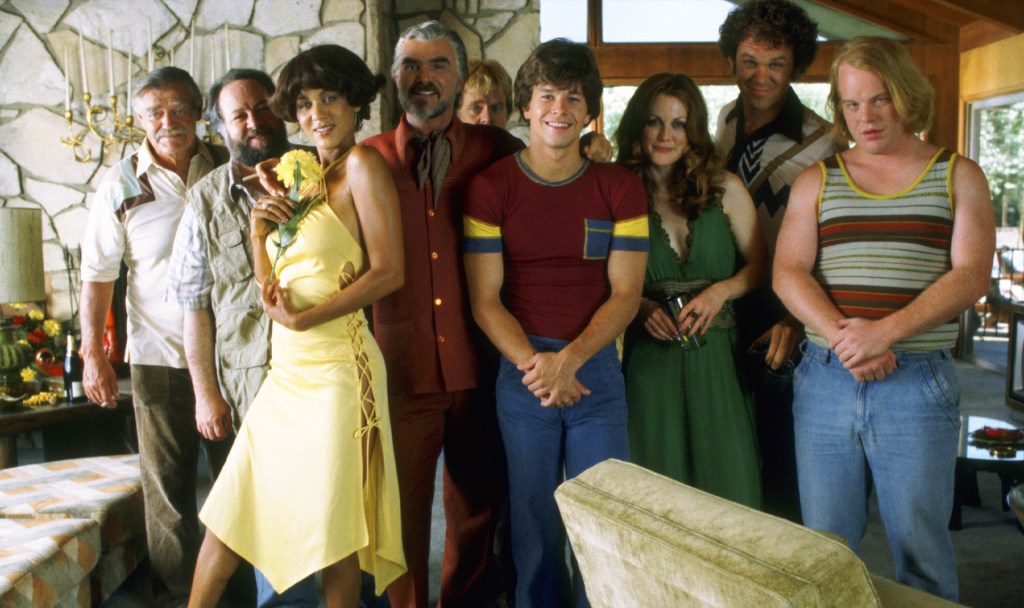
The main problem with Hard Eight persists in this film and is even exacerbated: a complete tonal incoherence in conception and execution of certain thematic ideas that falls completely flat on its face, degrading Anderson’s cinematic reference point down to derision. Throughout the first half, we see interstitial segments of Little Bill being the cuckold to his wife having sex a stud under the public gaze. Her wife’s mechanical movements mirror the horrible acting from the pornos that turn this ostensible absurdity into a Brechtian display of the milieu’s sexual gratuity. Its allegorical nature, transitioning from a background side gag that the characters barely acknowledge during their conversations, to a gunshot that clearly bookmarks the distinct two halves of the film and plunges the characters into the downward spirals of the 80s, is invariably diminished by poor dramaturgy throughout the film. The surface irony can help unveil a deeper truth to the reality, yet Anderson fails to establish a plane of reality upon which the ironic situations can inflict upon. The melodramatic confrontation between Eddie and his mother, or the flimsy camera movement that lost its cool after the opening sequence, only serve as didactic gestures that affirm the wastefulness and deterministic nature of Eddie’s journey, without any further exploration of the characters. Anderson wants to be both a hedonist and a skeptic. He wants to have both the flashy formal tricks and the big, symbolic moral gestures. But he cannot create a middle ground to sustain it. Consequently, we never have a sense of the doom that led Little Bill to pull the trigger.
The talented actors, similar to Hard Eight, are again unexplored and self-contradictory. This contradiction raised by Tarantino is evident during my screening, the audience erupted with laughter when Jack looks at a parodic James Bond rip-off and claims it as his masterpiece. This irony is not reflected in Burt Reynolds’ deeply solemn performance, nor in the reality surrounding him; the audience is thus laughing at the film instead of laughing with it. This inherent contradiction between Paul Thomas Anderson’s cinema, the need to be viewed seriously and the need to insert juvenile hilarities, cancels one another out at the end. We see his attempt to juxtapose two different worlds, the world inside Jack’s house and the outside world belonging to Ronald Reagan, whom we only see in a divorce lawyer’s office, through the distinct two halves. But we also see one high-octane montage of the camera floundering around sets after another, cramming multi-character experiences into a single needle drop. During the final stretch of the film, he even assumes a demiurgic figure that inundates the film with two sequences of blind chances that cease to wrap the main character’s journey up, but plunges deeper into self-indulgence. We can’t take anything seriously, or any character for the value of their own words or behaviours. What results is a work where its ridiculousness precedes its values.
All Images Courtesy of Warner Bros




 Cinema Travelogue
Leave a comment