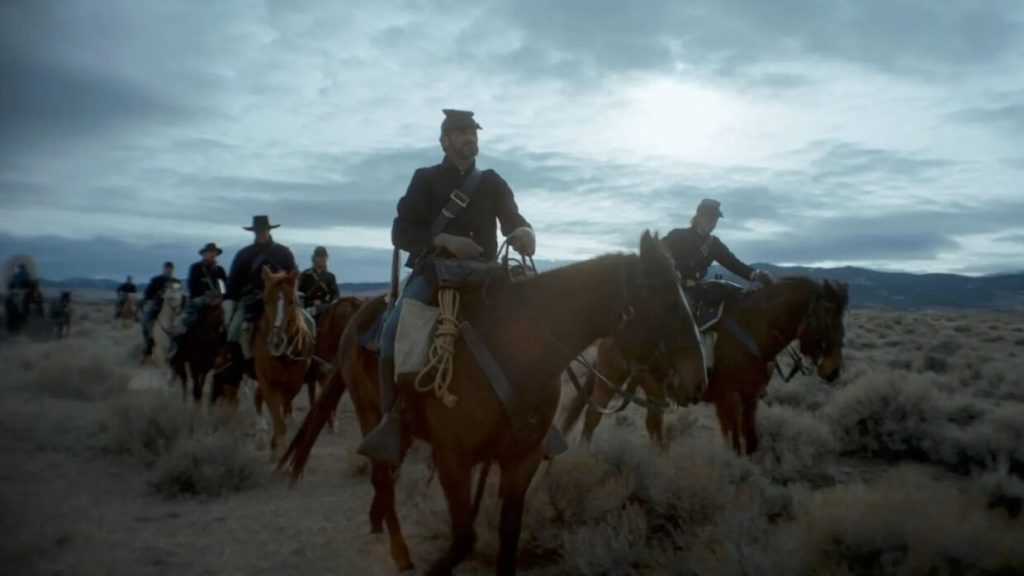
Set in 1862, amidst the raging American Civil War, a group of volunteer Union soldiers set to scout and garrison the unmapped frontier of the West. This is the premise set by texts that precede The Damned, Robert Minervini’s sixth film, his first narrative feature that won him the best director award at last year’s Cannes Un Certain Regard section. This is another foray into a type of revisionist Westerns that I would describe as cerebral. A typically masculine genre imbued with a sense of fragility and tenderness through the involvement of a handheld camera. This group of men, who find themselves in a waiting game of survival upon a land with no human traces except for themselves, become an archipelago of identities that, together, search and question the meanings they seek in this war. There’s a man who’s fighting with a clear ideological pursuit, a man who’s fighting without, and a young boy who’s searching for one.
In Westerns, the men and the permanent landscapes are always the name of the game; except in The Damned we can barely see the landscapes, as they are consistently blurred out by the film’s radical use of extremely long, shallow-focus lens, which primarily tracks the faces and movements of the human characters, and leaves everything else as a muddled whole. Initially, the extreme cinematographic choice appears to be simultaneously distracting and fascinating. The visual integrates a separation within the frame, without any additional need for blockings: the division between what’s in the centre of the frame and everything else that’s left out. This very deliberate choice exudes an emphasis on how the men, who Minervini consistently films in the centre of the frame, are desolated from the land they are attempting to explore and live on. Everything but men and their tasks, even the horizon, is always out of reach.
During the few scenes that involve soldiers from the Southern army, their presence is also obfuscated, either appearing as a blur in the background or emerging as faceless gun-firings from the other side. While one can be discontent with this lack of humanist representation, especially when Minervini offers the Union soldiers plenty, we would be overlooking an immediacy of the moment conveyed through a lack of hindsight or introspection about the aftermath. It makes intuitive sense that these soldiers would not have the time to contemplate the faces of the opposing side that’s actively trying to kill them; the goal of survival makes everything else a blur.
Perhaps it is Minervini’s documentary background that ultimately comes back to haunt him. Like a cameraman who is at the scene with those soldiers, he records them monologuing their character motivations into the camera, which detracts from the realist approach he takes during the non-verbal scenes. This blatant dramatic shortcut manages to reveal what the film accomplishes less the more it tries – registering a lived-in experience through its form. Its images become unconvincing not because they lack an idea, but because the idea becomes so self-evident that the film becomes that idea, instead of the images. We don’t need to see the mountains blurred out to know they are immovable, and we don’t need to see blank Southern soldiers to understand that war is a dehumanizing concept. The flow of the monologues would’ve been freer if everything were left for the perceivers, us, to perceive.


 Cinema Travelogue
Leave a comment