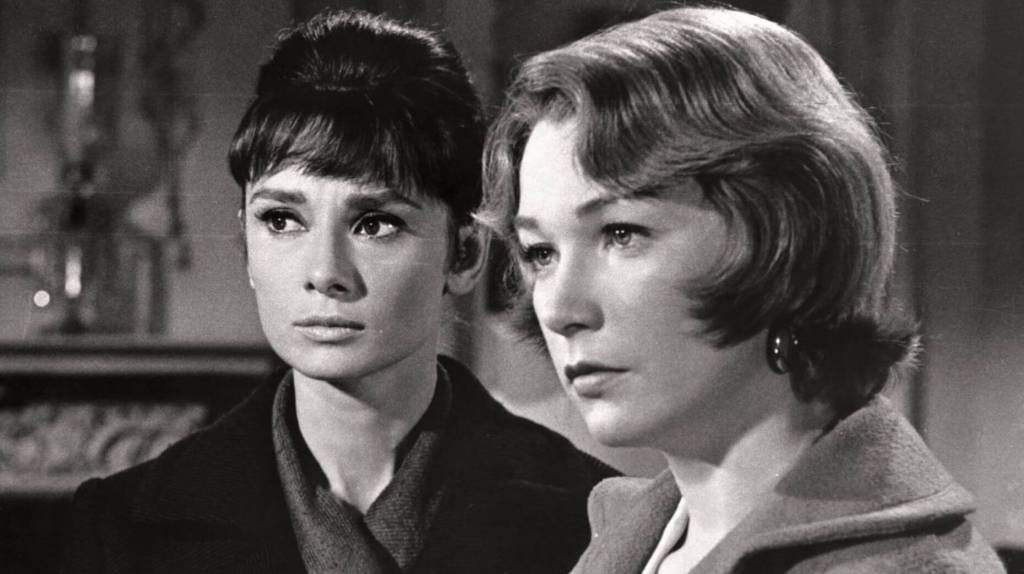
One can easily trace the theatrical roots of William Wyler’s 1961 film adaptation of Lillian Hellman’s 1934 stage play The Children’s Hour: the actors are facing away from each other when delivering dialogues, turning their bodies toward the cinematic eye. They often exclaim with a desperate unnaturalness and a lack of dramatic verisimilitude that one would often degrade as second-rate melodrama. We often falsely emphasize the duties of total immersion in cinema; a notion that seeing, but without acknowledgment, is the pinnacle of cinema. So nowadays, the hottest films and the most cherished “authors” are either someone who can manage enough resources to submerge us into a total, and false state of stimulation disguised as immersion, usually achieved through accumulations of flashes, or someone with enough wisecracks and cynicism to abandon it totally and instead seeks to continuously wink and remind us that we are in the age of “post-post-post-post-post-post-modernism”. Both paths are either impossible, contradictory, or redundant for an audience that actively engages with the image and sound projected, which is essentially what cinema entails.
A film like The Children’s Hour makes me feel like there is actually an author behind all the actions I am witnessing, but without Wyler literally pointing his fingers at himself. It’s a film that is abundant with emotional violence and actively aware of its own vulnerability. Perhaps it may not fare well for today’s audience. I cannot begin to imagine the chuckles and laughter this would receive during a repetory screening, when children deliver their lines with every bit of intended menace. But I firmly trust in this film’s power. It’s filled with active judgments, which is one of the pivotal themes and also what constitutes the film’s overall atmosphere. You can judge a world only when you have a vision to represent it in the first place. Wyler does not conjure a social harmony like Hawks, nor does he cast a cold objectivity onto his world like Preminger. He actively judges everything through deep depth of fields with intense close-ups that not only fully captures characters vividly reacting to an event, but also alert the audience to this reckoning.
One person’s reckoning does not equal a society’s. Wyler and Hellman both understand they do not possess the ability to overturn an entire social dogma. Justice cannot function as truth when everyone persists with their prejudices. That’s why the pivotal courtroom battle that spans months and subsequently lands a spot in a nationwide newspaper is completely skipped over. Instead, the film shows a mock trial with all the principal players in Mrs. Tilford’s have; unofficial but with all the loud arguments and exciting rebuttals that a movie courtroom scene can ever have. Showing the actual courtroom battle will be redundant after this, as the two women have already lost, when a lie like this can possess the power of overturning years of hard work.
What Wyler achieves in this film that cannot be done in the theatre is a play with subjectivity. The best example can be found when Karen and Martha find out why all of their students are taken away from their parents. When Karen follows Mr. Burton out the door, as the door shuts, the film purportedly aligns itself with Martha’s perspective, where the film cuts back and forth between Karen and Mr. Burton’s muted conversation outside and a close-up of Martha observing from the inside. It’s only after Martha steps outside to join Karen after Mr. Burton’s departure, with the same deep focus frame and the same door frame, that the film switches from subjectivity to a deadly quiet objectivity. Having experienced the despicable impetus of this rumour before the two women, we seek comfort in Martha’s unawareness, yet this subtle change in perspective strips everything away and returns us to where we originally were. Now, the sound of the creaking door frame is the only thing left on our side.
What The Children’s Hour ultimately accomplishes -perhaps it seems quite bleak after a first viewing- is the futility of mutual empathy in its milieu. Or more specifically, how empathy is impossible to grasp when subjectivity dehisces the gap between the eye of the beholder and what he is beholding. Dr. Cardin is portrayed as an ally to the grand social issue. His limitation as a supporter is not revealed through his own hypocrisy, but unmasked by Karen in a way that might as well be delivering an axiom of cinema at large: that she will never know if Dr. Cardin is telling the truth when he claims to believe the rumour is nothing but fabrications. The reality onscreen can never equal the truth; it is always reflected and refracted through perceptions and representations. No matter how close the close-ups on Hepburn and McLaine’s faces are during the film’s climactic conversations, they are sharp edges of anguish that exude nothing but confinement and reflect harms already done. So when Pauline Kael condemns Lillian Hellman for her lack of empathy towards the regretful rich old woman, whose apology is harshly rejected, she clearly does not realize that such reconciliation is impossible in Wyler’s The Children’s Hours, where theatricality is transformed into a cold prison.



 Cinema Travelogue
Leave a comment