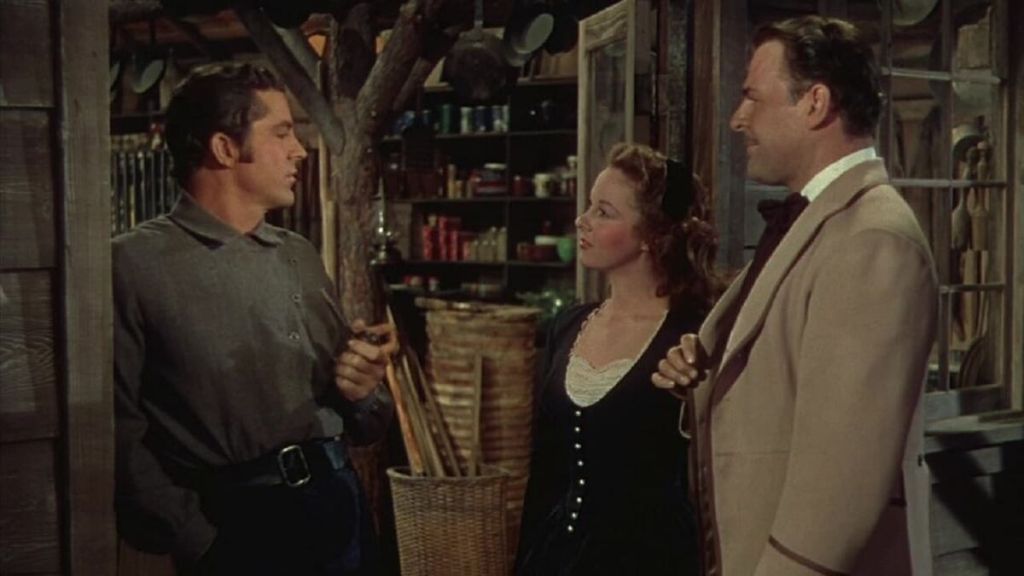
Jacque Tourneur’s Canyon Passage is as about rituals as any westerns. For it is through patterns of distinctive habits that we can clearly understand the characters onscreen, whose presences feel permanent despite we’ve only been with them for less than 90 minutes. These are Logan’s constant travelling, Camrose’s flipping of a coin, and Linnet peaking through a window, watching him do so. Their summation is the perpetual American dream of civilization and progress that drives men to attend uncharted territories, lending the voyage of westerns the majestic views of mountains, creeks, and forests, all as brief encounters or views to to torn apart – dynamites for the mountains and axes for the trees.
The abstract space between the concrete state of nature and men’s inner reasons that contribute to their perspectives is where civilizations reside, for it is reason that leads them to cut down trees (nature) and call what remains, the barren fields, their home. Not to mention how men are also the ones who coin their earnings with the word “dust”. In Jacques Tourneur’s Canyon Passage, when a man becomes only one of two, such as Ward Bond’s Bragg acts with and eventually gets subsumed by raw nature, he becomes alienated, chased by the Indians and repelled by the town, like a prey caught within a trap between the confines of two invisible walls of humanity.
Despite the two groups always being on opposite ends, and the only time of joint presence in a frame is through murder, their similarity lies in how, like animal herds, they always come in groups. Other than the few principal players, the rest of the men in the town are always filmed performing their tasks as a collective – fixing houses, hunting Indians, dancing. Their joint choreography operates like they are a singular identity operating as a symbol; individualism of dominance of spaces looming around in contingents. The Indians, as well, are portrayed as an identity that opposes the “progress” proposed by the town’s people and responds to barbarism enforced upon their people with reciprocating violence; the men on both ends are equal in this sense.
The images of violence and stone-cold bodies as the results of the Indians’ massacre may seem abrupt for a film that has been so reticent in showing the death of any of its characters. Logan does not kill off Bragg after winning their duel; the film transitions to the next day before it has a chance to show the death of McIver. Similarly, the death of the Indian girl that instigated the massacre is only insinuated through Bragg’s evil expression. But the film does provide an example of the killing, in the form of Linnet’s banjo, which gets brutally ripped apart by an Indian during the first confrontation between the townspeople and the tribe people. In the name of progress and civilization, men is defined by wealth, which is dust; their deaths signify nothing but possessions returning to the earth, and the emphasis paid to the deaths has less gravitas than watching a banjo being tore apart, because it is an instrument that defines each scene with music – something more spititual which cannot be defined by dust.
Despite Logan being the protagonist, the one in the orbit of ladies and wealth and acts arbitrarily as the head of the town, Camrose has a much stronger presence. Both driven by wealth, Logan’s presence is as ephemeral as his perfect persona, affirmed by his concrete reasons and how they perfectly aligned with his actions as a man; meanwhile, Camrose is actively tempted and charged with impotence. Both of their fates are predetermined: observe how Camrose is already filmed behind window bars the first time he is shown pouring dust from one pocket to another, and note how, when the film opens with Logan travelling, we realize by the end of the film that he is fated to do so.
In this journey, everyone is suspended in time, perpetually pursuing their journeys, seekings progress and revenge; constantly moving, constantly part of a passage.



 Cinema Travelogue
Leave a comment