André Bazin described the frames of the moving image as “not, as the technical jargon would seem to imply, the frame of the film image. They are the edges of a piece of masking that shows only a portion of reality.” This claim laments the fact that cinema is an art form that relies on and reflects reality, and cannot function independently of it. Furthermore, a film’s connection and relation to reality beyond its representation is what makes it a fascinating object. As Bazin puts it, “The picture frame polarizes space inwards. On the contrary, what the screen shows us seems to be part of something prolonged indefinitely into the universe. A frame is centripetal, the screen centrifugal.” A film can operate as a film not only because of what is framed within, but also what is left outside the frame, where its power is driven by the viewers’ infinite reach for the unknown.
In Mademoiselle Kenopsia, Denis Côté takes on a distinct and challenging task, which is to delineate the identity of liminal spaces. How do one portray something that inherently does not exist? For example, the negative space and static noise that are often left unnoticed in the background. The film’s take on Bazin’s theory expands beyond simply a way of seeing and transmits its scope of study into an internal philosophy regarding how one interprets what they can or cannot see. This is the exploration of an abstract connective tissue that acts as a vessel for the interchange of information between two concrete identities.
The opening wordless sequence shows a series of empty spaces. Through door frames, windows, and sunlight entering the interiors, a relationship between the viewer and these seemingly meaningless, identity-less places is established as we ponder about what is usually asked about a “place”: who lives here, how is the interior organized, and what is the meaning of us being in this exact room? As the viewers of a film, we act as outsiders looking in. The way we are taught to think about what we see is to consider how everything is related to the self. In these static shots, the law of nature (sunlight casting shadows on objects) applies to the anthropogenic spaces in the absence of man. The viewers are on the other side of the screen, and the fascination is driven by frustration at our inability to possess this space – these empty spaces are of no use to us, yet we are asked to witness their presence, despite the case.
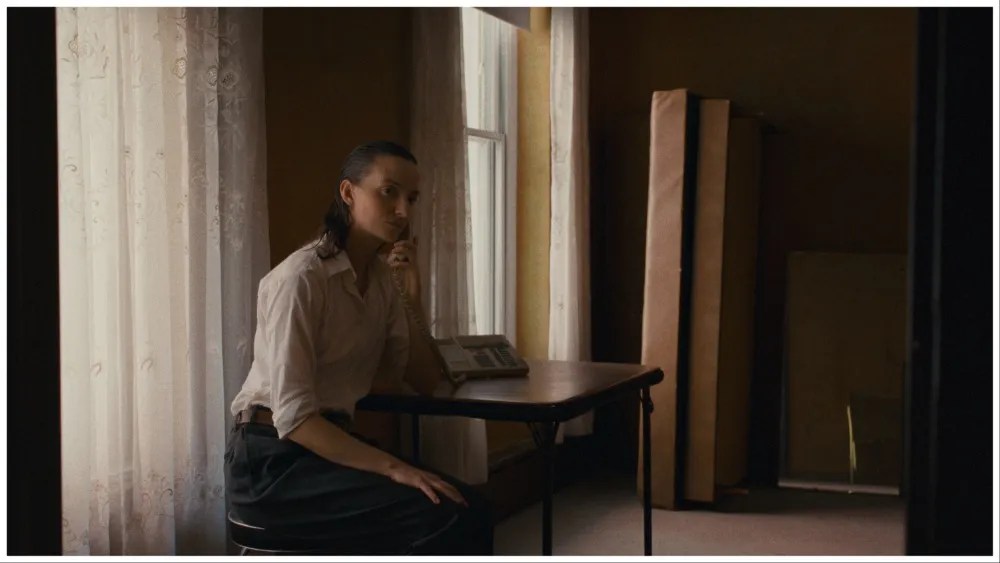
Through the introduction of the custodian, who remains nameless throughout the film, the film’s dialectics begin to shift, exploring the relationship between her and the empty house she is guarding. The presence of a human being differs from the presence of an object, as a human onscreen is identifiable and relatable. The custodian’s purpose within the house is easy to grasp: to guard it, keep it tidy, and remain within it throughout the whole film. So we become less skeptical about her identity and shift our focus onto her actions within the house and the way she connects with the outside world; actions that would’ve been completely normal in a quotidian setting, now beg to be questioned. For instance, her series of phone calls where she delivers long philosophical monologues to an anonymous at the opposite end of the line, raises the suspicion whether she is in fact talking to someone or if she is just talking to herself, which reinforces the thesis of the film that is already iterated in the film: what exactly constitutes the connection between two person, two identities? And in the case of a film, how does a shot and its counter-shot relate to each other?
The most commonly used film grammar is put into further investigation when a mysterious older woman enters the house, asking the custodian for a light. Deviating from the usual editing techniques for shot/counter shot set-ups, which is to constantly cut between the two parties to establish and maintain a connection during speech, the editing here holds on the woman delivering her monologue without cutting back to the custodian. This accomplishes a similar effect to the custodian taking phone calls, where the longer the lady’s monologue drags on, the more one begins to suspect that she is just talking to herself. What is ultimately dissected in the film is the importance of being reciprocated in life. The film suggests that meanings can only be applied through their relation to the self. The derived question is thus: how does one’s speech, thinking, desire matter in a world where no reciprocation is available, where there is no counter shot to react off a shot? A classic question: if a tree branch falls in the middle of a forest and nobody hears it, does it really fall at all?
This question is later addressed in a social setting when an electrical technician arrives to install a surveillance camera, as requested by the owner. The custodian’s deliberate sexual interest is ignored, and her solitude within the house continues. Does the woman’s desire matter if it is not being received, or even worse, denied by the person on the other end? This is where the viewer comes into play; as the custodian’s desperate attempt to gain the electrician’s interest drags on, it becomes a form of hilarity, and we notice it, even if we are not in the scene. Throughout the film, the custodian is also haunted and paranoid by a buzzing sound that she cannot find the source of. However, as the audience, we were given knowledge of that source, yet we couldn’t make use of it in any meaningful way. So if neither the audience nor the custodian understands why this mysterious entity and its buzzing noise exist, by the ways of utilitarianism, is it abandoned by its own mystery?
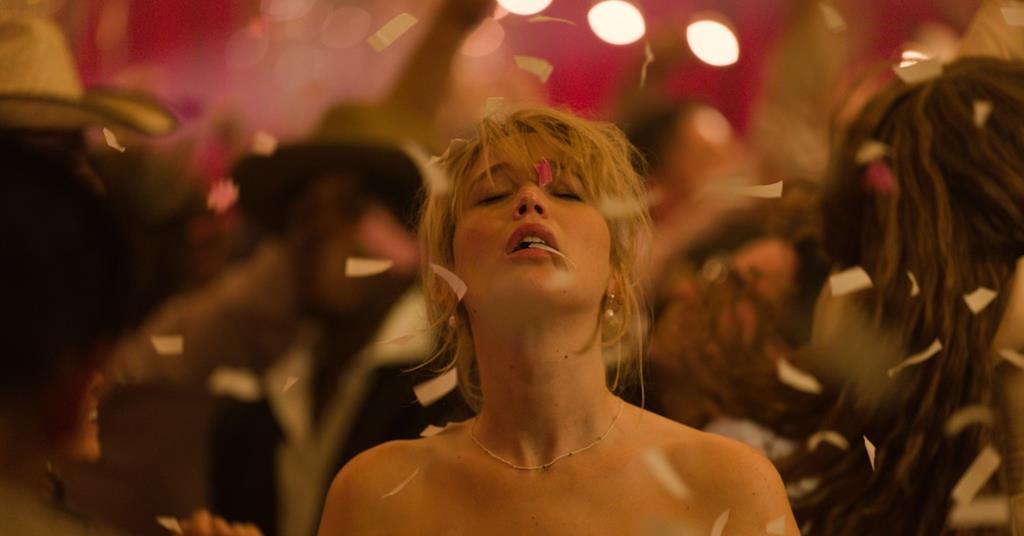
Later on, the film takes on another interpretation of the gap between one and the other; this time, through its use of cinematography. As the custodian drifts into sleep, the film shifts into a handheld dream sequence that follows her as she wanders across a crowded island, filled with people partying to loud music in the background. Completely different from the previous section of the film, a blurry hue covers everything in the frame, even including the custodian herself. The dialecticism shifts back to between the film and the viewer. The ocean of people around the custodian cannot satisfy her desire – which gradually turns into ours as the film progresses – to connect and relate with others. Even our connection with the custodian herself is obstructed by the blur, and we fail to communicate with her; we are all dissociating in different ways. Our association with humans onscreen cannot be complete. The dream sequence thus does not fully represent the custodian’s desire to connect, but provides another showcase of the distance between the viewer and the object.
As the world becomes progressively more dominated by screens, Bazin’s theory of the screen being centrifugal extends beyond a claim regarding cinema. As social media apps, YouTube, search engines and whatnot all gather on this screen, our mind has the illusion that we are connected with the world. We are not actually just staring at flat screen, there is purportedly a whole universe offscreen. In Mademoiselle Kenopsia, what’s inviting is the promise conveyed through cinematic form that something else is available beyond the plain concept of “a woman in a house.” It keeps us intrigued, guessing, and our vision locked onto the screen, even what’s in front of us is just an empty space. Perhaps this illusion is dangerous when it breaks, but it is part of the new way of life that we must live with.



 Cinema Travelogue
Leave a comment