Image: Courtesy of TIFF
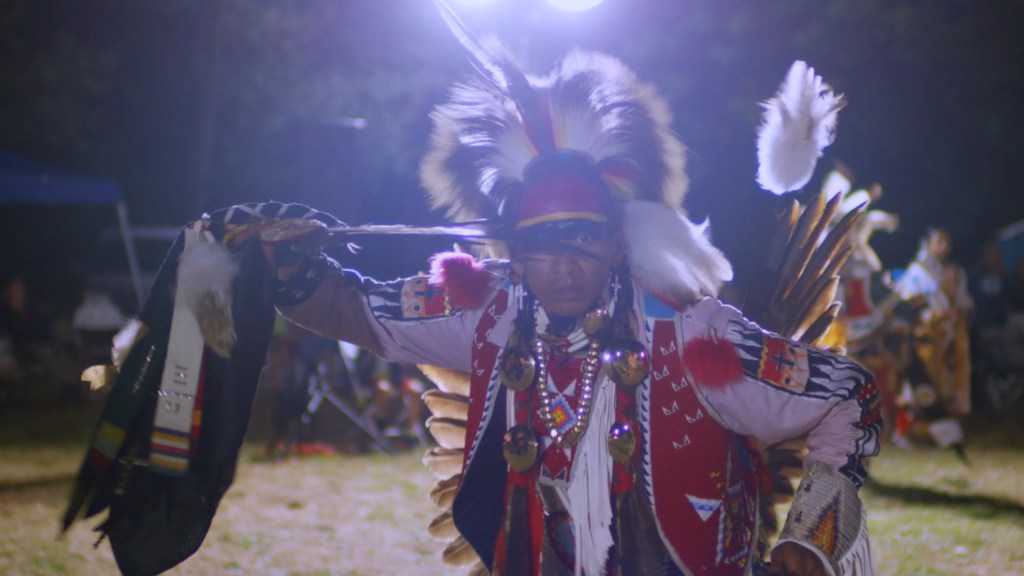
The visual plan of the long take can often be associated with a showcase of technical bravura, the imprimatur of a director’s “genius” that is inextricately linked to a “look at me” quality that points the frame back to the director themselves. What does a long takes entails? Movements? Perhaps, but definitely duration, which contains its own importance within the context of the work. It can be the suspense of a behind-the-back tracking shot for someone to walk from place A to place B; or a stable plane for two people to fall in love onscreen in real life; or just the pure excitement of seeing time taking its effect on nature. There are plenty of directors who can implement a long take that is perfectly attuned to the physicality of the images and the temporal frame of time. In the case of Sky Hopinka’s latest documentary, Powwow People, the long take is all about preserving tradition through the representation of physicality and movements.
Powwow People is set within a neat temporal framework. Taking place within the span of a day, the films follows the gathering of communities of indigenous people across North America who come to Portland, Washington, for a gathering of ceremonial dances, music, and booths. Amongst the communities, are four people whose roles span from the organizers to the active participants of the events: Gina Bluebird, who frames the powwow’s shape and guides its setup; Ruben Little Head, the MC whose presence anchors the present moment; Jamie John, a non-binary dancer imagining the future of these traditions; and Freddie Cozad, a singer and drummer who considers the past. Each of them lends their voice to the events presented onscreen and shares their perspective on the personal significance of the Powwow. All of which is to provide a throughline of events that shows a very present effort that goes into preserving traditional and does not take it entirely for granted.
The vérité-style of documentary filmmaking, typically characterized by a passive approach, is subverted by MC Ruben Little Head’s sporadic shout-out to director Sky Hopinka during his commentary. Hopinka is not an outsider passively observing, but a participant and a preserver of tradition himself. Fans of Hopinka’s experimental shorts may be surprised by how little he plays with the texture within the frame; the only noticeable aspect is how the camera would sometimes shift in and out of focus, which presents certain activities as abstract silhouettes.
Hopinka’s goal for the overall presentation seems to not be the material essence of the individual frames, but to craft a cohesive and comprehensive experience that represents his community with both rigour and attentiveness. Evidently, with the 88-minute runtime, the film does not operate in real time. Yet the transition from day to magic hour to night is basically seamless. During the film’s 30-minute-long take, where a group of dancers go through three rounds of dancing, with one is crowned the champion in the end, there is a sense that both the dance and the shot are collaborative efforts. Hopinka himself is amongst the competition and celebration of rituals. He takes a break between the rounds like the dancers and tracks their movements with a rhythm that is vividly in sync with the banging drums and singing in the background. No wonder Hopinka himself is also presented with a prize in the end, a crown for celebrating community through pure cinematic form.



 Cinema Travelogue
Leave a comment