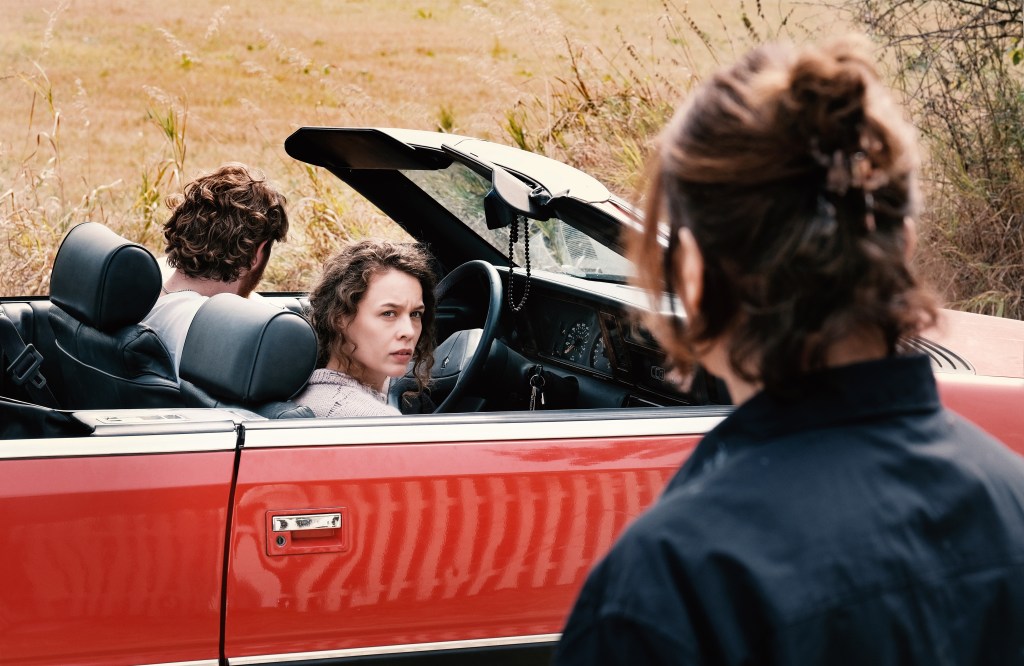
Image: Courtesy of TIFF
Christian Petzold is simply incapable of orchestrating an uninteresting shot/countershot, a cinematic tradition that relies on finding the balance between two opposing frames and somehow relating them to one another. Complementarily, he has also been one of the finest directors working today at capturing the act of seeing, which, in a Hitchcockian way (someone he’s often been compared to), derives danger and suspense from the obsessions of images and one’s willingness to be subsumed by them – a role, familial, gender, etc.. The combination of the two is how his ability to entangle the viewers within a web of disguisely straightforward narrative through his ability to invite the mystery of ostensible balance and a threat of rupture into each minute moment of interaction. His latest, Miroirs No. 3, marking his fourth collaboration with Paula Beer and starring some of the frequent players in his previous films, is his purest display of his most prominent formal interests, perhaps to a fault.
Miroirs No. 3 has a much simpler premise than most of Petzold’s works from the past decade. It does not work within a historical framework, such as Phoenix, Transit, or Barbara, or a mythical one like Undine. It is also his most hermetic work, in that the rest of the world seems to be detached from what is occurring between the central quartet. Everything envelops so suddenly: a university student, Laura (Paula Beer), who appears to be having relationship problem in the beginning of the film, gets into a car accident while on a country road drive with her boyfriend; her boyfriend dies at the crash site and the injured Laura is taken in by Betty (Barbara Auer), who happens to be working on the fence (not the Claire Denis one) in front her house when the accident occurs. After spending some time with Betty, who is ostensibly a kind-hearted stranger, Laura later meets the two men of the family, Richard and Max (Matthias Brandt and Enno Trebs, respectively), and begins spending time with the family.
Petzold plunges us into the situation itself, and the initial narrative pull of the movie seems to focus on reaching the central set-up in the most efficient manner possible. Such is a proof of the skeletal nature of Mirroir No. 3’s narrative. If we look at it simply, it’s a found family film, where a woman in peril finds people who are willing to shelter her with kindness and compassion. However, Petzold complicates this setup by stripping away the emotional backgrounds that would typically garner relatability for this type of situation. The audience is not provided with any context about Laura’s emotional plight, her relationship with her boyfriend, or her newfound family. The first encounter between Laura and Betty is marked by a shot/countershot that cuts between the two as Laura, sitting in the passenger’s seat of a car, meets Betty’s eyes as the car speeds past her while she stands in front of her house. We barely know either of them at this moment of the film, yet the shots linger on both of their gazes with a substantial gravitas that we immediately sense an importance, without knowing why. So, when Betty later takes Laura in and Laura agrees to stay, these acts obtain justification through a formal union from the previous shot/countershot, rather than an emotional one. The connection arrives almost like providence, and Petzold would continue to use setups like this to create an omnipresent portentousness; everything seems to be part of a larger, more complicated setup, because what is in front of you is full of intrigue but without explanation. A simple narrative set-up in which a union obtains the form of a trap signifying impending disunion.
In the Petzold tradition, the movie is suspenseful, but the more subtly strange imagery is in cohabitation with the more quotidian storytelling. He lingers but does not underline; one of the opening images in which Laura stands next to a river and a shadowy silhouette of a person kayaking passes in front of her is one of the most memorable images of the year. Yet, it contains no explanatory meaning outside of its existence. Without an overarching historical or fantastical framework, the question of what exactly is bringing together each of the narrative elements, besides an expected twist around the third act, becomes more nebulous. Almost to a fault, the character psychology is glossed over in favour of the more exterior mode of exploration. We are expected to take every action from the characters as givens and solely based on these well-balanced, choreographed sequences of conversations and physical movements.
All of this would not have worked without Paula Beer, who, in her soft-spoken femininity, lends the film gravitas through her gaze, reacting to every situation and every small detail within the house and the family dynamic. The film builds itself around her and uses her as a vessel of interests; each of the family members is choreographed around her. Each scene, each mystery, relies on how Beer can strangely seem so natural being in an entirely unfamiliar place. She is lively and so pleased to be taken care of. Through her understated physicality, she melds perfectly with the methods in which Petzold subtly sets up the daily routine – from Laura’s waking up to her participation in the dinner table conversation and playing the piano – the simplicity with which Laura seems to greet every moment forms a deshiscence between the viewer and the film where our notion of instability within the scene is challenged by her complete stability.
Each moment is deliciously formed with well-timed humour and unexpected tension, so the film only falters when its narrative bubble bursts and the characters are suddenly faced with a great deal of moral and emotional confrontations that previous scenes do not warrant. An argument can be made about how the film’s flattened psychological aspect ultimately sacrifices the moral ambiguity that this particular situation could’ve had. As a fan of his, I, of course, am inclined to exculpate Petzold. But more genuinely, his formal power to sustain a mystery that’s not really a mystery, is genuinely exciting. With a film teetering on the edge of breaking apart from its own setup, Petzold shows no ostentation, but creates a formally concealed world purely founded on gazes and subtle actions through a precision that almost all filmmakers working today lack. When the epilogue finally arrives after the reveal, its effects linger like the thickened air flowing out of an ancient vault. This is not a minor work, but a delight from a major director working in minor keys.



 Cinema Travelogue
Leave a comment