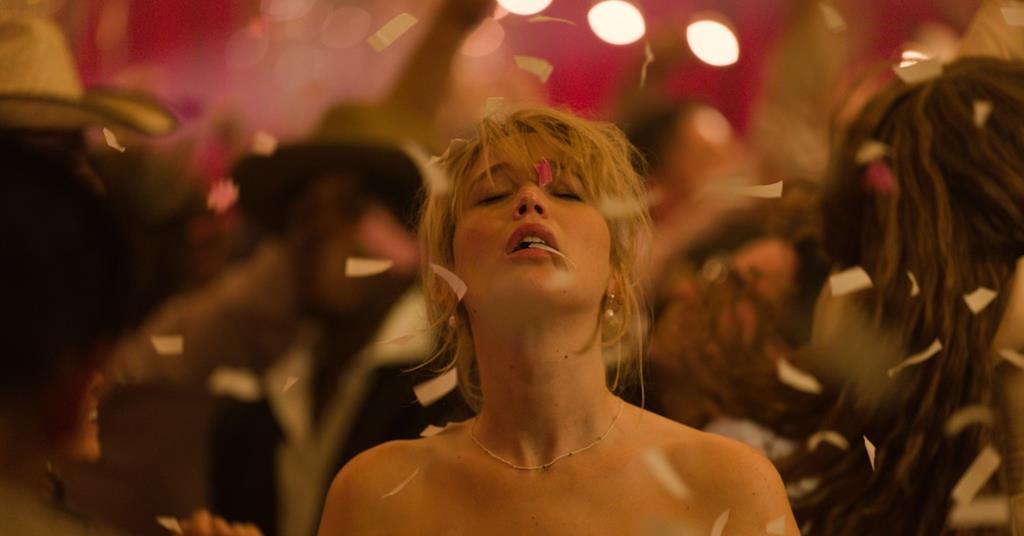
Image: Courtesy of TIFF
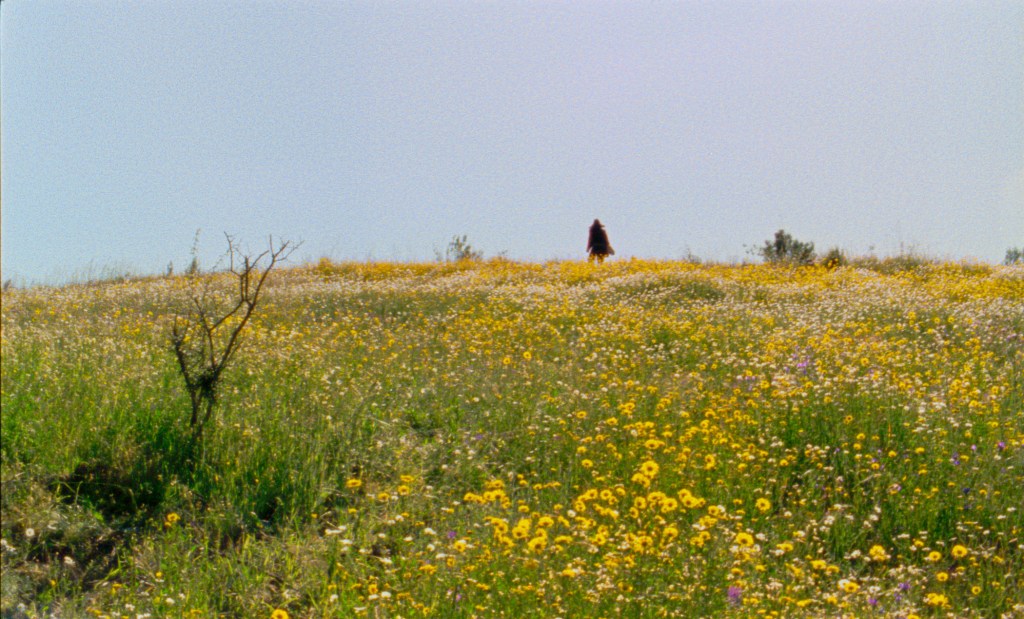
Close to the beginning of Maureen Fazendeiro’s solo debut feature (given that a feature is >45 minutes long), The Seasons, a wide shot tracks a man pushing a wheeled land surveying device. As one would expect the camera to continue following the man and his equipment, it instead continues panning to the right and sets its cinematographic eye onto the mountainous landscape, eventually leaving the man and his tool out of the frame. A few minutes later, a group of people enters a cave with a guide who introduces the history of the animals carved on the cavern’s faces. As the shots swirl around these protruding shapes, we first hear sounds of nature, which is then succeeded by a sequence set in vast outdoor moorlands, inhabited by a large flock of living goats, giving birth and herded by shepherds. These two scenes are exemplary of the approaches Fazendeiro has taken to explore Alentejo, a region in Southern Portugal; through the connective tissue of cinema, she creates a portrait that probes the interconnectivity between the land, and various forms of documentation – archeology notes, geography, retelling of local myth, and filming itself – all cohering to account for a place’s existence.
Fazendeiro puts a tremendous emphasis on the role of history, both mythical and archival, as a crucial part of her presentation of Alentejo as a cinematic object of interest; the records of people who once visited the land and the desire to present them on the same plane as the landscapes that remain thus create overlaying temporal layers within the project. Landscapes are accompanied by narrations of footnotes from two German archaeologists, Georg and Vera Leisner, who visited the region during the 1940s. Their record is marked by historical turmoil, as their home country was under the reign of fascism and undergoing the travesty of WWII. The narration documents the people the Leisners interacted with, the places and sites they explored, which, when overlaid on top of the non-intrusive, observational style of the 16mm / super-8mm films Fazendeiro use to film the landscapes, creates an interesting dissonance between a passive, visual travelogue and an active verbal account of activities, both taken on the same land.
When filming the people, Fazendeiro shows them performing hands-on labour – measuring and surveying the historical monuments for the crew, and herding goats and bark stripping trees for the local inhabitants. She lines up elderly people sitting in chairs, retelling local myths that occurred centuries ago and singing songs about socialism. The distinction made by Fazendeiro between things that can be filmed and things that cannot is notable. Verbal retelling is the common access point into history, but the methods of representation differ between things replayed (such as notes from archaeology and archival footage of the past) and things reenacted (such as local myths). The existence of archival photos, videos, and written documentation seems to create a limitation for the film, as an old man’s retelling of the rise and fall of a communist movement in the region is only matched with existing, grainy, black-and-white footage. In contrast, a local myth, something essentially unverifiable, is a wellspring for creativity, where imagination can be sprayed into frames – the glistening sunshine reflecting off a lake as a shepherd ventures off seeking his goat; an outlaw cripply walks across the moorlands; the angelic singing of a goat spirit.
Nonetheless, both are facing the same landscape that Fazendeiro and her crew see upon their visit. The landscapes are essential in this work, as their beauty, first, provides a vibrant backdrop for the enactment of myth, and second, signifies something permanent across history. With fascism looming in the voiceovers, we question what shall be preserved and cannot be taken away, as well as acknowledging the ones who fought for them. During one specific instance, the Leisners’ archaeology notes recorded them learning the news of their home back in Germany being destroyed. We do not have visual access to such footage, only the voice of the Leisners against footage of trees and moorlands passing in the present tense; history is accounted for by the land.
The Seasons feels like an intricately hand-crafted object, which does not fall too far beyond The Tsugua Diaries, a film co-directed by Fazendeiro with her partner Miguel Gomes. The 2021 film directly addresses its production limitations – mainly COVID-19 and Fazendeiro’s pregnancy, which caused her to direct the film from afar – as part of its final product. This time, while the filmmaker herself does not directly appear or lend her voice to this film, there is a raw feeling of filmmaking practice that can be sensed through how many of the research materials directly appear within the film; the filming and the research become two inseparable practices. Through filmmaking, Fazendeiro scrappily tallies an inventory of historical and current accounts of a piece of land that, ultimately, shows the epistemology is a work of art itself.


 Cinema Travelogue
Leave a comment