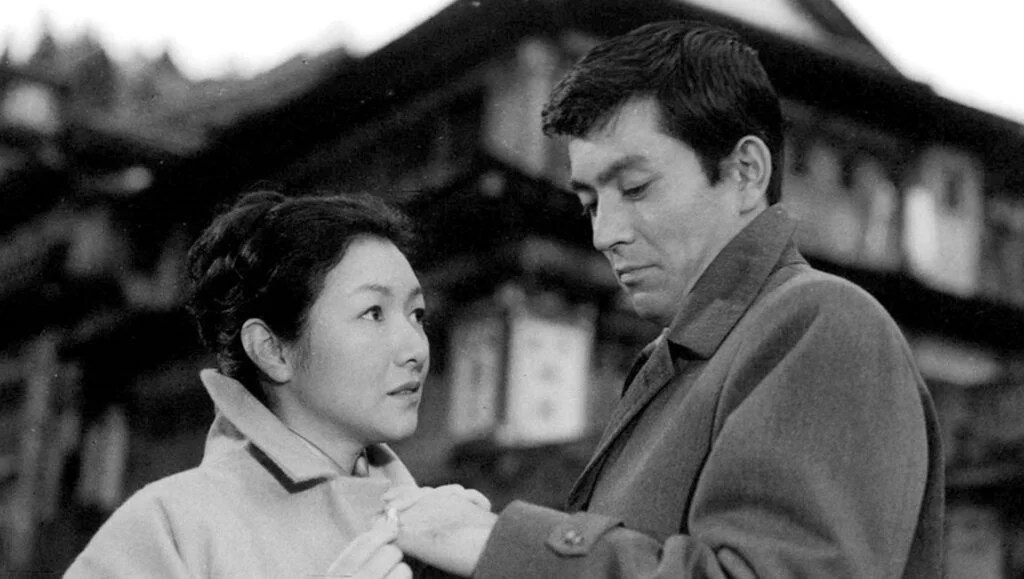
Ostensibly a two-hander, but the movie feels like Naruse’s largest film in terms of scope (not just because it’s shot on TohoScope). The opening scene, following an advertising truck of the new supermarket in town, proposes an external force that complicates Naruse’s usual examination of society through an individual’s navigation of its imposed pressures and prejudices. The film does not begin from a subjective point of view like When a Woman Ascends the Stairs, but uses the advertising truck as a device to provide an overview of the town itself (two identical frames of two different family grocery shops with sounds of the truck driving past them), before narrowing down into smaller social units. Unlike Keiko in Ascends the Stairs, Reiko is not cynical about her position in society or the family of her dead husband – or at least her internal doubts are so buried that even dubious voice-overs cannot be found – and seems to have found an equilibrium in her living. So the conflict in this film relies more on external factors, igniting a chain reaction that forces Reiko to confront herself.
Time has always been a crucial component in Naruse’s work. It’s evidently found with Koji and Reiko on the train – arguably his most elegant and formally audacious sequence – where through each cut to the unstoppable movement of the train, minute gestures accrue across successive time ellipses. But what is also impressive is the overarching latency in its form and structure. Conversations between Reiko and Koji are always formal, both in how they’re filmed and in how the dialogue is written with dense expositions of family history. Even during the highest point of emotions, like when Koji confesses his love for Reiko, the precise découpage Naruse implements – how the characters move around spaces to make a shot-reverse-shot pattern look like the two are spinning in orbit – contains a very clinical and distant quality. However, the fulcrum of emotions does not rest in the moments when they are expressed, as close-ups and set design in a Sirk film would draw out their maximum expressive power. Naruse leave the effect of the spoken words to time, showing that the impact of a moment isn’t immediate but rather dispersed across the future. See how the film obtains a montage-like quality after the confrontation, where scenes begin to flow more like a stream; the two characters start to glide past and bounce into one another with movements less assured, but with more fluid emotion as their beliefs begin to dissolve and unravel. Naruse’s form here seems to centre on how the effects of a single significant moment can be reflected through gradual, systematic changes, whether it is the impact of passion on someone who has lost the ability to face it, or the cultural and economic erosion of a small town at large.
In terms of the “generosity” that Edward Yang said about Naruse, Reiko’s expression in the end does not say anything conclusive; it’s instead a mixture of shock and an impending burst of devastation. So the ending’s abruptness is not correlative to her own acceptance of time and fate, but a sign of willingness from a filmmaker to stop this endless cycle of emotional torment, leaving the fate of Reiko offscreen, a place where the melodrama can no longer be indulged by spectators. I guess this act can be described as “generous, but it feels somewhat cold to me personally, and the word is more applicable to Late Chrysanthemum (the climax of the conflict resolved by a cut to the next morning).



 Cinema Travelogue
Leave a comment