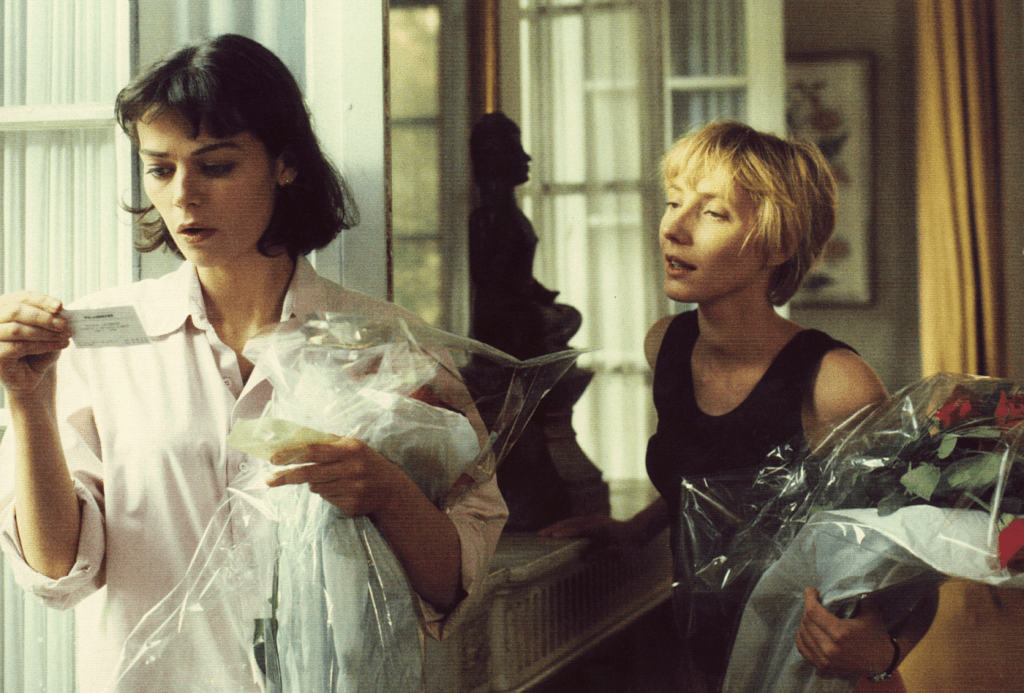
Near the end of his 1954 essay “The Essential” on Otto Preminger’s Angel Face and The Moon is Blue, Jacques Rivette makes the claim, “What is cinema, if not the play of actor and actress, of hero and set, or word and face, of hand and object?” Certainly, the films he makes in the following decades back up a particular interest in cinema that finds their intrigues in the mysteries and adventures drawn from the dialectics between the presence of actors and their surrounding spaces. Is there any genre that accentuates the physicalities of the actors, immerses them into a vibrant union of themselves and with their surroundings more than the musicals, especially the 50s MGM musical that inspired Rivette to make Up Down Fragile in 1995? The film stars a few of his common players – Nathalie Richard and Laurence Cote both appear in Gang of Four, Marianne Denicourt was in La Belle Noiseuse, and the legendary Anna Karina from The Nun back in 1966. The cast revolves form the interconnected stories of three women, who are confronted with mysteries, romantic flings, but ultimately centred around the joy of solidarity and companionship. It is one of the most beautiful films ever made and Rivette’s most underrated work.
The synopsis from the first paragraph may seem too generalized. Still, I genuinely believe this film, or any film with elements that can speak for themselves, should be experienced without the a prior knowledge of the plot. I prefer to view Up, Down, Fragile in the context of its maker’s oeuvre at large. We can see Rivette’s penchant for mysteries is evident at the beginning of the film. Upon their introductions, the three women -Ninon, Louise, and Ida – are all ostensibly trapped in some sort of plight. The film matches this feeling with a comparatively more intense energy than the latter half. Ninon seeks to build a brand new life in Paris after running away from a deal that we have no specific details on. Louise lives in a high-end hotel, making her evidently an outsider to the city; a furtive man also follows her around wherever she goes. Ida’s first appearance concludes with an old man claiming he recognizes her from somewhere else next to a hot dog stand, which she then panics and rushes away. All three are seeking or avoiding something in the city. Paris transforms into a central hub of suspense where people try to find answers or dodge them.
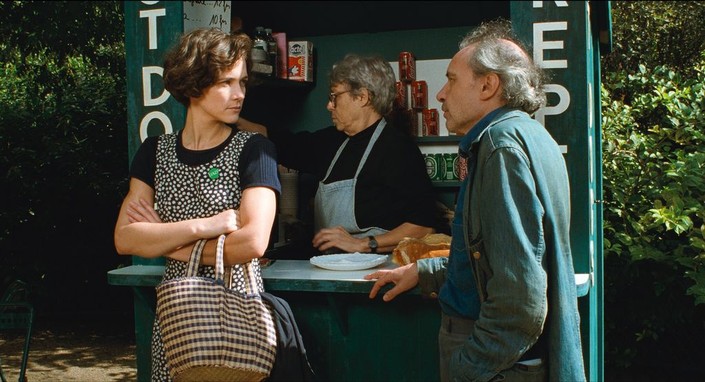
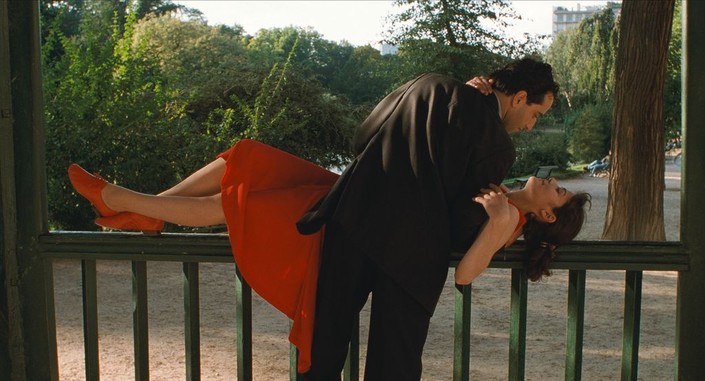
However, conspiracies and mysteries do not propel Up, Down, Fragile into a full-on thriller. The most exciting aspect of a Rivette film is seeing how he navigates between the constraints of a plot and the liveliness of the actors he is obviously invested in. In the first scene, Ninon confronts the man who ripped her off and declares her independence; directly afterwards, she hops onto the downstairs dancing floor like nothing ever happened. The rest of the film is synonymous with the previous scene; the mystery never dominates the narrative and is always secondary to the moment-to-moment interactions occurring on-screen. Captured by Christophe Pollock’s photography, the environment dabbles less in the glamorous pastel of the Hollywood Technicolour musical or Rivette’s fellow Nouvelle Vague filmmaker Godard’s A Woman Is a Woman, instead featuring a Paris that is more natural-looking, with more exterior features, gorgeous in a distinct and unfiltered way. Rivette is usually tremendous at location work. The blue sky in the early morning, the glistening park under the afternoon sun, and the lavish old Parisian house after the rain are all posited into the spaces the beautiful characters inhabit. Primary colours dominate both the exterior and the interior, but they are ingrained in the setting rather than painted on.
Another one of Rivette’s signatures that makes an appearance in the film is an artistic studio. Lucien, who becomes romantically or coincidentally involved with the lives of all three women, opens a large studio next to the delivery service Ninon works for. Similar to Gang of Four and La Belle Noiseuse, the atmosphere within the studio is drastically different from the atmosphere outside. Despite workers and artists constantly moving around the studio, the film never makes it clear what exactly Lucien is working on. When he provides a tour of the studio to Louisa, he showcases his inventions and collections, such as a wall of water, a tree of wisdom, and old furniture from Louisa’s aunt’s old house that he claims to have personal connections with.
During the tour, “the most interesting is above”, Lucien states and points to his upstairs office. The camera subsequently pans up to follow the two going up and reveals a blue neon sign of the word “Cinema”. This sign is placed between upstairs, where Lucien, the artist, spends hours thinking and conceptualizing, and downstairs, where artisans create and realize his visions. Through this quasi-breaking-the-fourth-wall moment, Rivette reveals the principle of his production methods. The studios within his works signify the role active inventions play in a film and they are never preordained. No wonder he gave his main stars writing credits; to him, is script is an ongoing negotiation between actual shooting location and the improvisation of the actors. This negotiation navigates the process which the artifice he introduces as mcguffin and initial intrigues is recursively subsumed by the realism through each cycle of musical.
Rivette’s mysteries never settle on the surface of its narrative. Instead, his films always probe deeper to an inherent level where the film is conceived. In La Belle Noiseuse, it is the rigorous methods with which Michel Piccoli approaches painting. In Gang of Four, the film often switches from real-life to acting on stage without any signifier. Such techniques provide an invisible self-reflexivity that emphasizes the human contribution to, whether painting or theatre, the synthesis of a “great piece of art”.
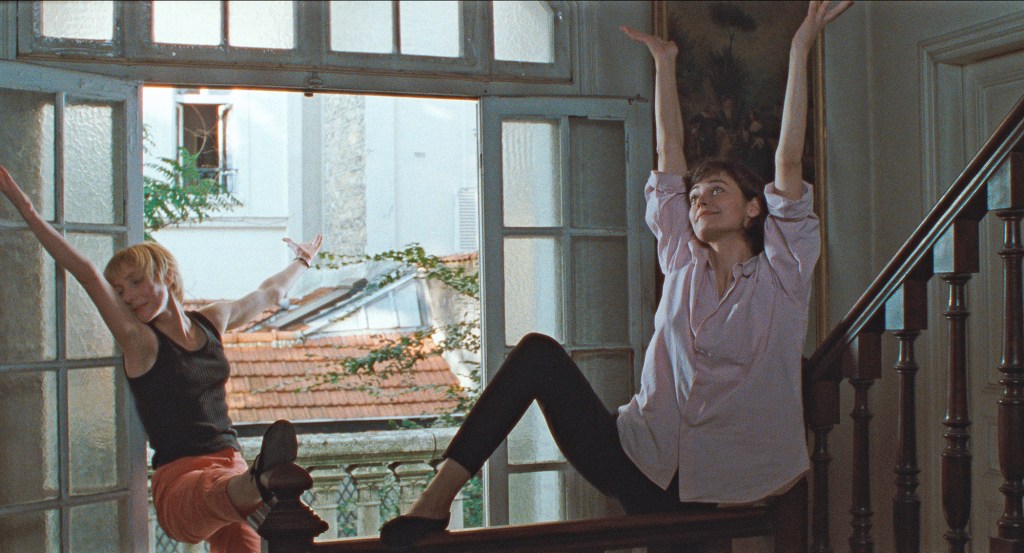
In Up, Down, Fragile, Rivette is not trying to link cinema with another art form, but on the musical genre itself. What makes this film unique is how late the first number appears. Beforehand, the movie calmly follows the path of these three women. The editing splices their stories apart to connect the momentum of the three individual stories, while ensuring the individual stories remain rather disjointed. Without the numbers, the film still consists of scenes of characters dancing in music halls and bar owners (Anna Karina) singing. When the first number begins, it is surprising and refreshing, as if the people within the film developed another way of expression. Rivette’s vision for reality has always been intentionally and fascinatingly obfuscated. Here, the transition into musical number, although preempted by the characters’ rhythmic movements and exchanges, is sudden. Yet the musical and non-musical movements are both contained by seamlessly designed long takes that make the two part of the same reality. The bursts into musical are corollaries of the characters’ bursts of emotions, but unlike many musicals that create an alternative, more flamboyant reality for the intense emotions, Rivette believes the passion, love, and the chaotic feeling in between are essential and inseparable from the realities of these characters. The dances are raw, physical, yet incredibly tender, like the two bodies are actively sensing and basing their movements off the other. The music never dominates the other sounds in the environment as we can still here the sounds of the performers’ shoes tapping on the wooden floor. It is this roughness that subsumes the musical artifice and makes it an aspect of the everyday life of the characters.
Rivette never reduces people to symbols, in turns diminish their existence, and he never premits his characters to do so either. When Roland and Ninon see each other at Ninon’s apartment, Roland speaks of Louise as “She is innocence. She is purity. She is chastity.” Ninon immediately asks Roland to see the door, because purity is never of this world and Ninon’s earthly presence needs to be respected. When Ida visits Anna Karina at the end of the film, Rivette has an opportunity in front of him to play into the nostalgia of one of, if not the most essential film movements in cinema history, one which he played a pivotal role in. But Anna Karina looks at the youthful photos of herself and tells Ida to “forget about those old things”. As much the mysteries of youth, of your parents, of the past can be luring, the only way of moving forward is to quit finding the keys that unlock the past. To be present is to live forward, to come down the alter, to exit out of the cinema of the past and run towards the early morning sky.




 Cinema Travelogue
Leave a reply to In Theatres: Bonjour Tristesse – Cinema Travelogue Cancel reply