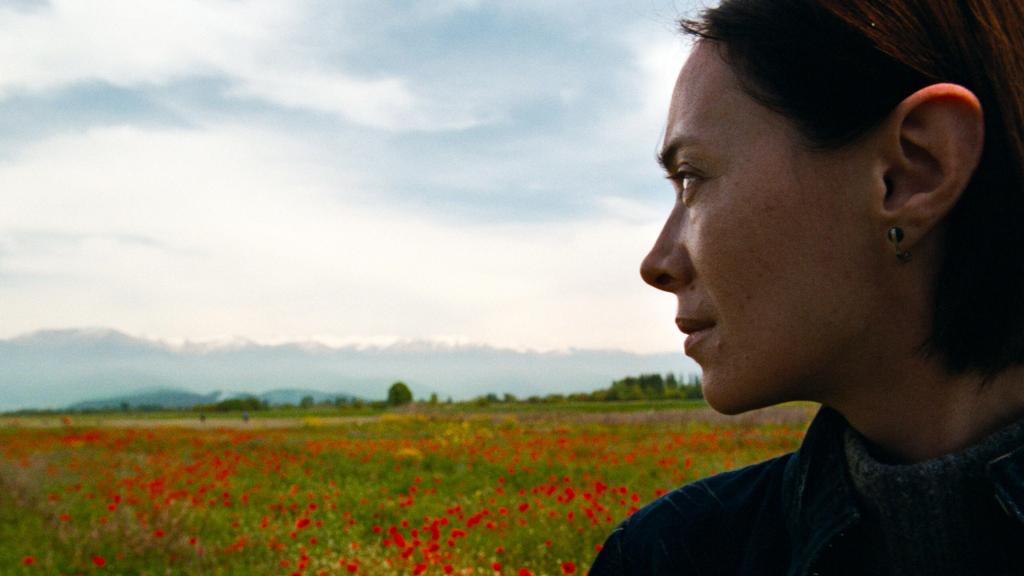
In complete darkness, a naked, disfigured monster slowly lurks in the distant background; offscreen, upbeat sounds of children cavorting juxtapose this discomforting off-kiltered composition. Next shot, a shower of rain pours onto the pavement until the accumulated water almost inundates the entire frame. A couple of shots later, the camera is positioned at the top, looking down as it unflinchingly observes a woman giving birth to a child that is dead on arrival. These opening shots of Dea Kulumbegashvili’s sophomore feature April, which premiered and won the special jury at the Venice International Film Festival last year, are litmass tests to its audience, as people who are unprepared for its blunt, glacially static shots and graphic content will already be gone before the rest of the two hours unfolds. Metronomes of beeping hospital machines, clocks, heavy raindrops, and baby crying dominate the film, as if to stagnate the film’s pace and intensity in each scene; do you know April has a shorter runtime than the past two Palme d’Or winners (Anora and Anatomy of a Fall)?
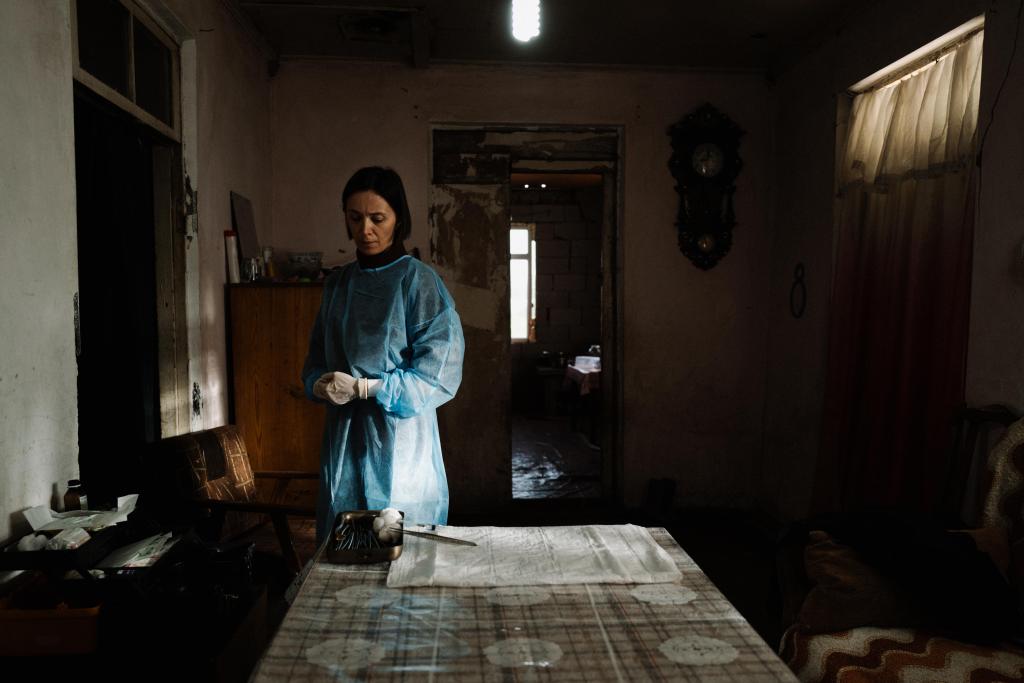
Is it coincidental the first time we see the main character Nina, an OB-GYN who clandestinely operates illegal abortions for women of her village without any alternative options, that she is also framed in the distant background, just like the monster from the opening shot, but within a brightly lit hospital hallway with both sides of the wall sharply confining her in the middle? The film offers no specific explanations for the impetus of this monster, but from its repugnant ugliness, one can derive that it at least has something to do with the dogmatic marriage system and female repression that loom over the entire village and set the film under a cold and bleak tone.
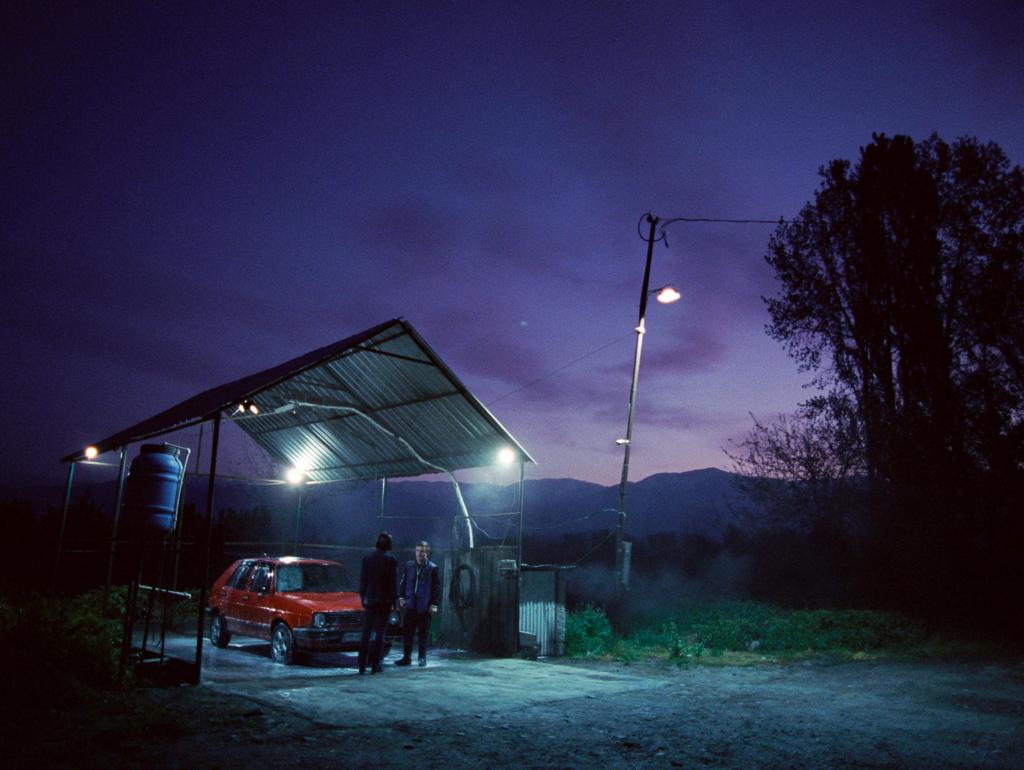
This blend of fantasy and horror elements with gritty, serious cinema vérité is not uncommon in today’s International cinema landscape. But whenever I see one of these films, I begin to wonder, as I did during my viewing of April, if such a heavily conceptual allegory is necessary for what the film is trying to say. There is no doubt that Kulumbegashvili possesses the formal precision to craft effective images out of this concept; the monster only appears at night, mostly in distinct, unrecognizable spaces, engulfed in shadows, just like the sexual quests Nina takes on at dusk and how her underground abortion acts turns her into a household tabboo. The topidness of the monster’s movement exudes a form of resentment and unremediable sadness through its timidity to react within its surroundings or march towards any direction. Similarly, Nina herself has claimed her personal desolation. “My life has no room for anyone”, she answered David, a close male colleague, as to why she refused to marry him when they had the chance. Perhaps it is her stone-cold rationality and clinical nature that allows her to take on this thankless job. In the same conversation with David, she refuted his suggestion to wait for the legislation to change by questioning him, “Has the ministry ever written back?”. She believes somebody has to do it, so like Furiosa in Mad Max, the darkest of angels, she steps up to the plate; no wonder the monster ends up wandering in the woods at night. But why isn’t Nina’s actions and her social encounter enough to convey the intense and risky situation she has put herself in?
When portraying the subject of abortion, Kulumbegashvili is very upfront while demonstrating an extreme level of restraint. The most glaring example – this is where a couple of people from my screening decided to walk out – is when she films Nina performing an abortion on a deaf-mute patient in real-time and chooses to position the camera on table-level next to the patient’s torso. During the entire sequence, the only onscreen event that the audience can see is the patient’s sister’s hand strenuously pushing the patient on the table. Even with no explicit details being shown, sounds of scissors operating and the patient hissing are enough to convey the pain and unjust social conditions. Meanwhile, the brutal, physical nature of the sister’s hands conveys a sense of desperation that is vividly present onscreen. This is one of the few times Kulumbegashvili’s approach works wondrously.
Nina’s sexual quest is the other aspect that the film decides to portray. Her sexual repression is where the monster’s, and ultimately the film’s highly allegorical and elliptical nature disappoints. We see her driving out at dusk to find an alone man whom she will then try to make sexual advances on. Nina is like an Haneke protagonist, where her taciturn and reclusive physicality operates as a point of intrigue for the audience. As the film progresses, all of these intrigues drown deeper and deeper into muddled water; similar static, long takes play with explicit emphasis on body parts, but it feels like the film is speaking into a void instead of conveying concrete emotions.
There is also a surprising lack of formal integrity that connects each scene, or you can call it a shot because of how long each of them lasts. There are mainly three variations of spatial configuration from Kulumbegashvili’s part. First, the prismatic interior with deep depth of field that positions Nina in the far distance; second, long exterior tracking shots that at first impression, come from first-person perspective, but later debunked as the character appear in front of the camera (the occasional shots of the flowers I believe to be slight variations of this); and third, a static wide shot with characters centrally frame and later pans laterally panned to reveal offscreen voices and characters outside of the frame. Due to their highly “composed” nature, all three cease to document the actuality of living in a village – the characters are staged like miniatures instead of people – and they do not seem to interconnect with each other. Kulumbegashvili’s method of representation seems to dissociate from realism and finds her mode of expression through obscuration and reduction. I begin to wonder, is this kind of minimalism filmmaking another form of maximalism? We have so many gorgeous natural images in the skies and thunderstorms, yet they are all in line to serve the film’s miserabilism.
I don’t believe Kulumbegashvili has made a bad movie. She clearly has a distinct eye for natural beauties and is interested in incorporating them into the film. There is a sequence featuring a thunderstorm that is amongst the most visually and auditorily overwhelming sequences from a recent film. The sensory effects which Kulumbegashvili can extract from the muddy roads and blossoming flowers are similarly impressive. However, disappointment arises when you have someone with this much talent, then uses it to on a form of arthouse exoticism that detracts farther and farther away from its subject and area of interest the more it plays. During the aforementioned storm sequence, the camera moves from static observation to a crane shot that rises above the field and oversees the entire neighbouring area. I thought to myself: this is absolutely majestic, but what is the filmmaker seeing from this?


 Cinema Travelogue
Leave a comment