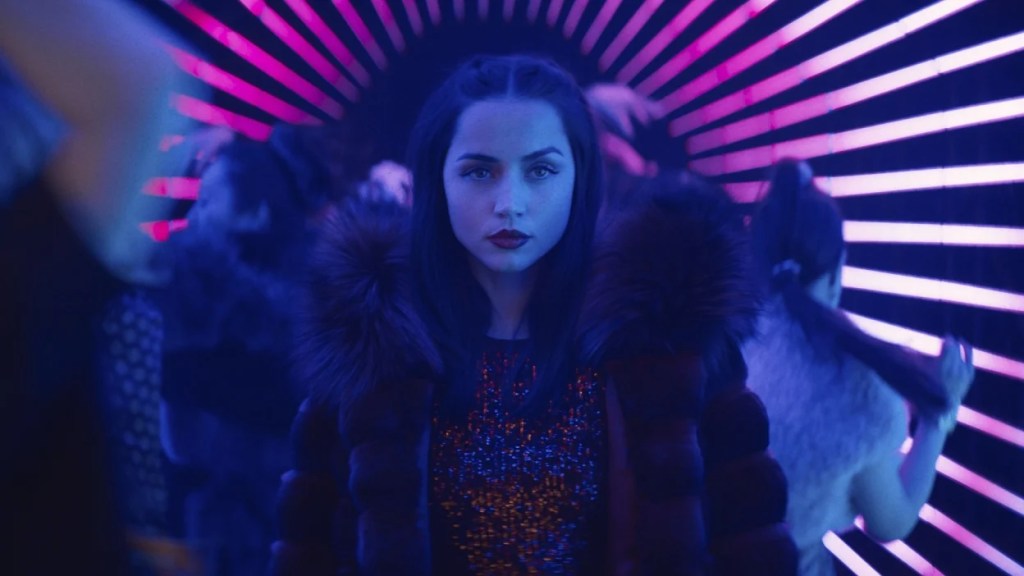
In case you have not noticed from its title, Ballerina is a spin-off from the John Wick franchise. As a fan of the franchise, rumours of extensive reshoots that loom over this film’s release were concerning. In turn, there is an awkward, synthetic quality in the final product, where the action sequences inherit the creative kineticism from Chad Stahelski and the remainder of the film screams a complete null, full of incoherence. These incoherences are dissimilar to the prevalent flaws in the previous four films, which have been assimilated into its worldbuilding logic as the scope and duration of subsequent films continue to expand. They convey an inert bombasticity that is too dry to be remediated by the actions.
Similar disparity in quality between exposition and action also exists in the new Mission: Impossible. Luckily, this strikes a much better balance between the two and personally, I would rather stare at Ana de Armas for two hours than Tom Cruise for three. However, I question what exactly Keanu is doing here other than being a franchise logo. There is an attempt to create a parallel between John Wick and Eve through the conversation between fate and choice, but it ultimately resorts to Reeves claiming in his jaded sighs, “Go back, you still have a choice”. Also, let’s be honest here, nobody chose to watch this film because they are interested in its philosophical implications.
I find the film comparable to another recent spinoff, Furiosa (which is technically a prequel, but I’m focused on how these films depart from their titular characters). The two share a similar prologue where a child witnesses the death of a parent, a.k.a. her innocence, which the preceding film sees its protagonist crawling through blood and sweat trying to regain what is taken away from her and avenge the taker. However, the trouble with this film is that it seems to have taken the word ‘fate’ in a literal sense and misinterpreted it as coincidence. So despite the main character’s name literally being Eve and the script’s shameless attempts to drop in some biblical allusions, the storyline is much closer to daytime soap opera (most notably, the stuff with the sisters) than George Miller’s ballad of desolation and decadence or even the eclectically heightened demigod status Wick acquired in middle of Chapter 4. Both of which contain images that mythify the main character and magnify the scope of the story. The images here are mostly recycled settings, iconographies, and symbols that feel like Thanksgiving leftovers.

If Ballerina accomplished anything, it’s proving Ana de Armas’s ability to carry an action film through her formidable presence and physicality. However, the question regarding whether Keanu can hand over the baton of the entire franchise to her remains ambiguous, because it’s ultimately not up to her, but whether this continuation is possible for a franchise that, in my opinion, has reached its maximum scope in Chapter 4. Ana de Armas will not be the issue; she gives a standard, great movie star performance. But the character of Eve lacks a distinct edge that would serve as the nexus of the urgency and ridiculousness of the world around her. Subtlety is not the issue, nor are the overbearing ballet metaphors that do not make much sense besides feeding into the trivial fan service. Eve does not possess the subliminal weariness that Wick reaches close to the end of his arc; as a young heroine, nor does she possess the propulsive anger that Anya Taylor-Joy delivers through her eyes as Furiosa. The film has to borrow and plug Wick’s own mythology onto Eve’s, but without enough set-up to convey the gravitas of her mission. We may need three more films for Eve to get there. The question is whether the audience will have the patience?



 Cinema Travelogue
Leave a comment