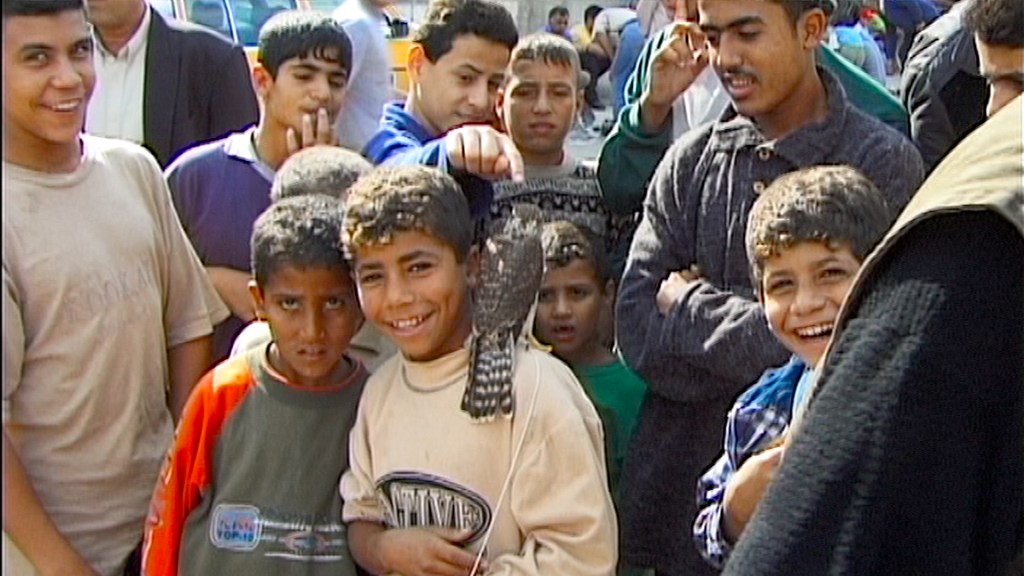
Image: Courtesy of TIFF
When the end credits begin rolling for With Hasan in Gaza, a film entirely made of footage taken during Kamal Aljafari’s visit to Gaza back in 2001 – a tour he carries no memory of until rediscovering the footage over two decades later – we see him giving himself the “conceived by” credit instead of the usual “directed by”. As the found footage emerges through the cracks of memory and arrives in the filmmaker’s hands through serendipity, the “conceived by” is an admission that the existence of With Hasan in Gaza as a found footage film is a fact that needs to be reckoned with itself. Because time and retrospection deepen the meanings established within both the filmmaker and the audience.
There are many movies about the ongoing genocide occurring in Gaza and the suffering and resilience of the Palestinian people throughout film history. Oscar-winning documentary No Other Land and Venice Grand-Prix winner The Voice of Hind Rajab are the most recent examples. Existing in an age marked by the omnipresence of screens, a film like No Other Land operates as an immediate cry for help, consisting of Instagram reels, news footage, and videos taken by cellphone, conjoining to state the urgency of the situation. But standing ovations, golden statues, and artists in texudos crying, hugging, and taking photos with one another do not save lives, and there comes the question of whether all the critical acclaim is just a pat on the back. So when a film like Hasan in Gaza presents a documentation of reality from two decades ago, the temporal distance and current-day relevance create a fissure, and through staring into it, we create a connective link between immediacy and remembrance, a perspective is formed.
There’s the temporal distance between the people that we see onscreen (including the significantly younger Aljafari, who appears a few times), and the distance within filmmaking. As Aljafari did not manipulate any of the footage or even distort their order from when he discovered them on tape, the only creative input he has on the film is through onscreen text, where he would insert his personal perspective and diegetic music; he is essentially collaborating with himself from 20 years ago, a creative ghost. It is through this limitation that the perspective becomes one of remembrance. Through onscreen text, we learn Aljafari has not seen the titular Hasan since the tour and does not know his whereabouts. Yet Hasan’s footprints are left all over the film; not only did he serve as a guide for Aljafari’s visit, but he also influenced his filmmaking. We would hear him asking Aljafari to zoom in on specific images, to give certain places a closer look, and he would seldom operate the camera himself, pointing it back at Aljafari. He understands the patterns that the political conditions and geography both trace back to the personal loss a person found on video, acts as a ghost that reminds us about the aphorism that the most personal is the most political, because politics are most effectively captured as personal history.
The fact is emphasized by footage of pedestrian lives, people hanging out on the beach, and the market that is still bustling with smiling children who are willing to gather around the camera to be filmed. The urgency to deliver a message on the issue is on the periphery of Aljafari’s instinct to represent life as it is, and let the citizens themselves live out their own images. The camera is guided by Gazans. There are the adults who indignantly point to windows and rooftops shattered by Israeli attacks, trying to use the video as evidence of the injustice reality they are actively living. There are also the children, whose naïveté allows them to see Aljafari as a photographer and ask him to photograph them. Another kid repeatedly asks if the travelling crew needs him to bring them shrapnel, as if it’s his favourite toy. Their innocence is one of poignant irony; no coincidence that Aljafari and his camera found the safety to sleep in the children’s room at night.

It is through time that we understand the devastating situation at hand. There’s a brief moment during the scene at night, where, even though they are still actively hearing loud noises of attack coming from both sides, a remark to the camera points to the fact that the aid van sent by the UN has already departed. The film not only focuses on wrongdoings but also on the passivity and non-action of global power; an evil that is because it preys on the fact that it cannot be seen or heard. People disappear in time, but the devastating reckoning of the insinuations of such disappearances in a place like Gaza creates a bridge connecting two different mise-en-scènes, one of the film itself and the other in our minds of everything we see in the news and on social media. What has changed? What is actively being eroded?. Some things wear out over time, like Aljafari’s memory of this visit back in 2001, the continuum of injustice alongside lives carrying on. Indeed, we don’t need films to prove courage and combat injustice, but a video that vividly documents the lives that are important in the continuous river of time, records them so that they can never be taken away.




 Cinema Travelogue
Leave a comment