As one of the few – maybe the only – major international directors who unabashedly depict the daily lives of service workers in his cinema, it feels inevitable that Radu Jude would direct an adaptation of Octave Mirabeau’s “Diary of a Chambermaid”. The novel has been adapted for the screen many times, most notably by Luis Buñuel and Jean Renoir. Renoir’s adaptation was one of his Hollywood misadventures after he fled France at the start of WWII and resided in the U.S. until he left to shoot The River in 1949. It is this strange cultural Frankenstein’s monster: a French story that takes place in France, but made with sets and English-speaking actors from Hollywood – an odd mixture of the original novel’s sexual perversity – there is a scene where the captain got so horny for Célestine he suffocates a squirrel to death – and a classic Hollywood happy ending. As others have described, the film feels like The Rules of the Game, but where reasons have transformed into madness of the Hollywood machine – the estranging sense of cultural displacement makes one wonder whether Renoir ever thought about his home country across the ocean and got homesick.
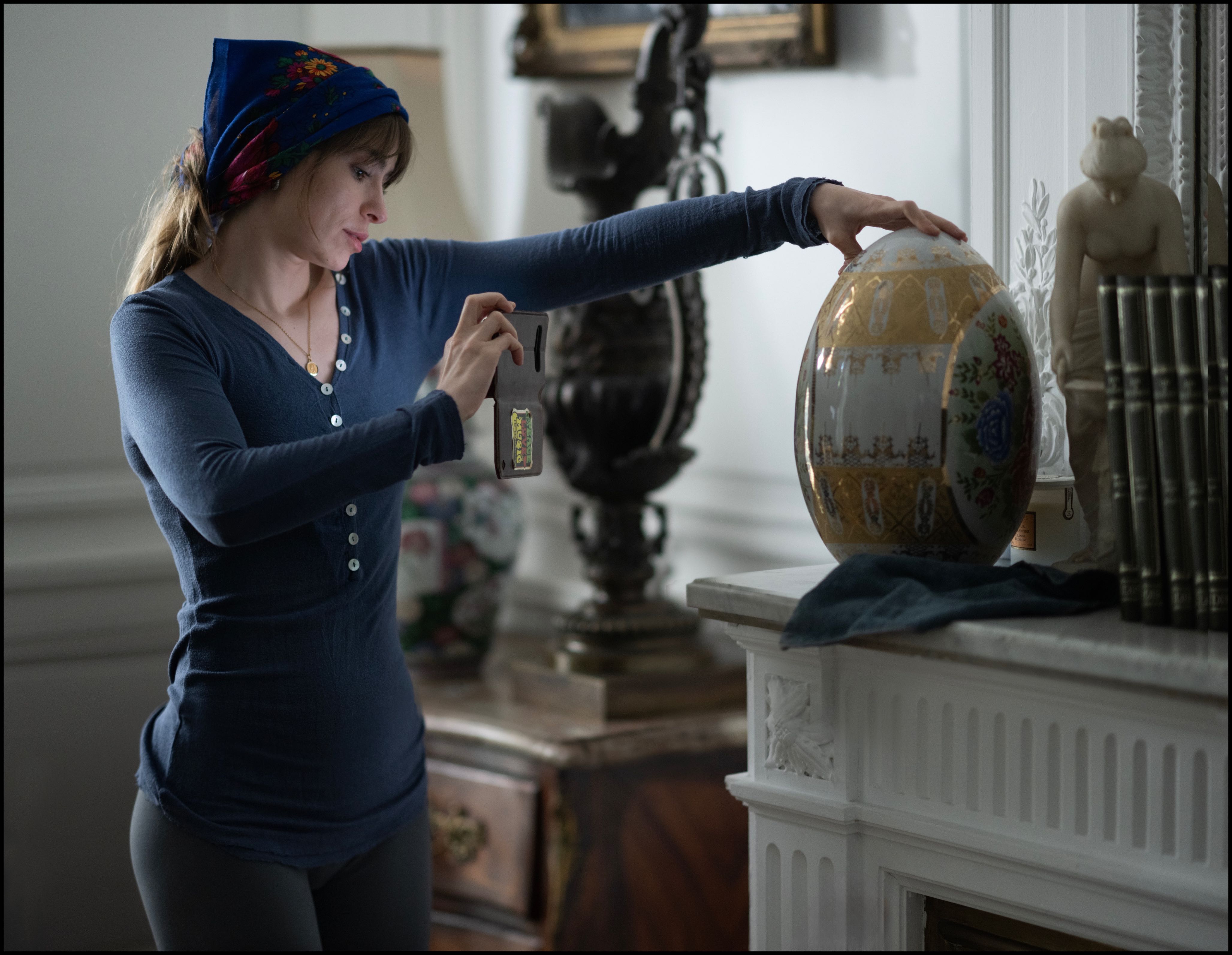
The distance demarcated by home and work is the central struggle of Jude’s adaptation. Gianina is a migrant worker from Romania who works as a housekeeper and nanny for the Donnadieus, an upper-middle-class family in Bordeaux. She works to support her daughter Maria and her mother, who live in rural Romania and await her return during the Christmas break. Most of the original novel’s character dynamics and specific eccentricities are stripped away, leaving only the underlying tension between the working class and the bourgeois family. Gianina is not a new arrival to the household, as in Renoir’s version, but an existing member who has been working at Donnadieous’ home for some time. Her relationship with the family is less dramatic. The parents, Marguerite and Pierre, are both highly regarded academics who maintain a facade of politeness and try their best to play the part of employers who care about their servants. They often greet Gianina with respectful smiles and sweet compliments, and occasionally offer sympathetic remarks about her circumstances, but their relationship never moves beyond the ostensibly nice but impersonal exchanges. Gianina also cares for their son, Louen, who has few defining traits besides being a kid. He serves as a surrogate that reveals Gianina’s natural gift for storytelling when she tells him bedtime stories. This act also emphasizes the distance between Gianina and her home, as the stories are oral tales from Romania, and it highlights Maria’s growing jealousy because Gianina is taking care of other people’s children instead of her own.
Of all the adaptations, Jude’s version most closely resembles the structure of a diary – which essentially is a series of chronologically connected vignettes – as it is the least concerned with creating an overarching ebb and flow of narrative progression and character dynamics. The film is chaptered by dates and, in a diaristic fashion, the chapters are not given equal weight – some days pass with just video footage of an empty field in an unknown location. Jude updates the material by replacing the handwritten diary with videos – recordings of rural Romanian life that Maria sends Gianina and video calls between the two.
Jude has been a strong champion of video art, with a particular affinity for TikToks; he has incorporated them into recent projects to depict the many facets of contemporary life in Romania. Last year, he co-directed Little Poems in Prose with Andrei Rus, a 35-minute assemblage of TikToks from Romania. In The Diary of a Chambermaid, there are no TikToks, but the videos interspersed throughout the film support the class relations the narrative focuses on. They create a portal that remotely connects the two worlds and two different social classes; one can see the disparity between how Maria’s bedroom looks during FaceTime, the rural landscape of the Romanian village and their methods of transportation in those short videos she sends, versus Bordeaux’s modern city look and the Donnadieus’ ornate house with shelves of antiques and fancy chinas. It also underscores the distance between Gianina and her family, because the video creates a stronger illusion of proximity that can easily evaporate.
Racism appears less cartoonish, more as an undercurrent in everyday interactions; the ignorance of bourgeois French people often fuels the dry humour Jude is adept at. For instance, Gianina is from a region in Romania called Moldavia, which one of the Donnadieus’ patrons conveniently mixed up with the country Moldova and tried to correct her; or, during the most raucous scene in the film, when Pierre coerces Gianina into an awkward spot to make a point for a debate about Russia and Zelensky during a party. These moments aren’t subtle, but Jude’s static digital masters significantly mute their pompousness and make them feel like sprinkles of workplace hazards that Giannina has to smile through.
A stage adaptation of Diary of a Chambermaid – which, from what is presented, closely follows the story and decadent tone of the original novel – is integrated into the film as the student theatrical production that Marguerite recommended Gianina to join, as the production likes to go “method” and cast real migrant workers in the play. In a truly sardonic manner, the play closes down because one of what Jude proposes in the updated version of the film is that, under the current migrant labour economy, the worker-employer relationship is much more subtly demarcated such that even the possibility of fiction is nullified and exists only in artwork that is occupied by the bourgeois class anyways.
The narrative still holds strong importance to the film -arguably the most in Jude’s recent work – even if it is deemphasized by the diaristic structure. The central tension- Gianina waiting for the day so she can go home to see her daughter- is laid out from the beginning of the film; it is reiterated several times when the two FaceTime and when Gianina talks to the Donnadieus. The film’s tension thus relies on a waiting game, and the title cards stating the dates function as a source of tension: the closer it gets to Christmas, the more nervous we become that a narrative rupture will intervene in Gianina’s holiday plans. No doubt, this rupture occurs and French cinema legend Marie Rivière makes the entrance.
Jude’s humour pokes fun at the bourgeoisie and their ignorance. But it ultimately feeds into the devastating realization that the ignorant still hold power; we can make fun of them behind their backs or through slow-motion videos, but when the power relation is laid bare, we immediately return to the tense present. Although the narrative progression is fairly obvious, Jude maintains the percolating dynamics between the Donnadieu and Gianina. No matter how much Gianina curses the family in her own language, inciting laughter from the audience, it is clear who gets to smile in the end. A critical element of the film’s structure is how scenes or video footage are often abruptly cut short for comedic effect. This abruptness reappears at the end of the film, this time insinuating something more eerie: that privilege lies in who has ownership over their own time and space.



Leave a Reply