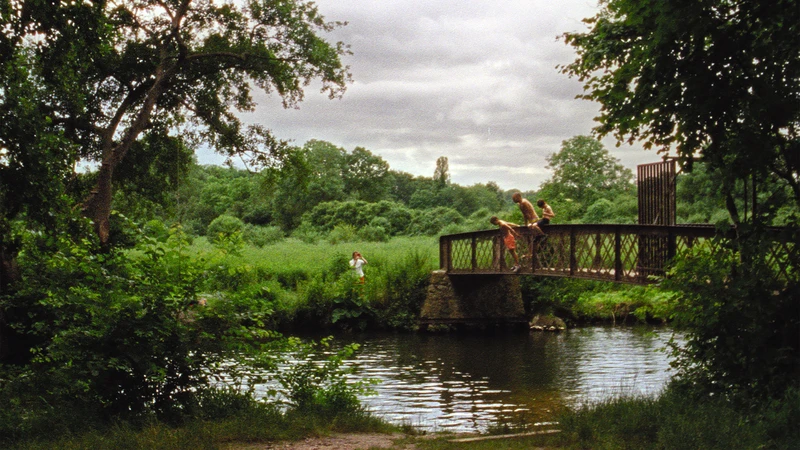
I was pleasantly surprised to see Les Inhabitants in Hot Docs’ programme this year, given that it had already premiered at Cinéma du Reel over a year ago. Maureen Fazendeiro’s other 2025 output, The Seasons, screened at TIFF last year, which is when she got on my radar. Unlike her partner, Miguel Gomes, who enjoys applying classic Hollywood artifice to his exotic travelogues about colonialism. Fazendeiro’s works have a more handcrafted quality. The documentation of history relies more on the syncretism of historical documents brought to the present tense. Les Inhabitant has two layers of form: diaristic writings from a group of women helping people living in a Roma camp that are about to be evicted by the town from their home, read by Valérie Fazendeiro, the director’s mother; and landscape shots of bucolic French farms, side trails, and neighbourhoods. The most common theme in those texts is the act of offering and receiving: the ladies bring food, household supplies, and necessities such as children’s diapers to the immigrant, and their offerings are returned with meal invitations and desserts.
The texts, like all diaries, are linked to time, yet the voice grants it a portal to be expressed in the present. Meanwhile, the landscapes with their timeless beauty – the various shades of green offered to the celluloid from the vegetations, whether glistening under the sun or washed over by the rain, – are open for extraneous history to be applied.
The two forms coexist in the house of cinema through their lowest common denominator: they are visual and auditory, two elements that must be present in a sound film. But the actual cadence of their mix plays out jarringly. Valérie Fazendeiro’s speech always moves faster than the tracking shots and the 360- and 270-degree camera pans. There is this illusion that the image of this bucolic small town, where you can barely find anybody, is still a life of pleasantry, while all the hurried actions are being taken off-screen, in a slightly more risky and emergent manner. Even the tracking shot that films the back of a garbage truck, where workers pick up furniture left at households’ curbs, gains a kind of ease due to its mechanical rhythm. The unspoken irony lies in how the “invisible” people living in these homes are dumping furniture while those living in the Roma camp are constantly on the verge of homelessness.
The dryness arises out of the absence of fiction. Or rather, the fiction already modulated to a point of invisibility. The letter being read dryly may or may not present absolute facts (they are probably entirely real), but they are all that’s left available to represent the occurrences at all, as Fazendeiro refuses to create a fictional stand-in for the refugees. The callous neighbours, who serve as the opposing majority to those benevolent villains, are also fictionally invisible; their inaction is the primary driving force pushing the narrative. The placements of Fazendeiro’s camera, which cannot quite be categorized as observational, since they don’t feel like they’re attempting to discover anything beyond their planned movements, present a series of rather mechanical beauties. The images are bursting with analogue textures, large swaths of lawn green from the agricultural land, a limpid pond with children cavorting, and willow branches hanging down. recordings with nice sound and rhythm. Having only attended two screenings at this year’s hot doc, I can still almost guarantee that Les Inhabitant is the best-looking one of everything; just an intuitive guess (prognostication) based on the types of programming being offered. The question is: how much does this pictorial beauty amount to?
When you compare this with Straub/Huillet: unlike in Too Early, Too Late, where Serge Daney mentions the pair placing the camera, like practicing acupuncture, to film the workers in the factory,1 there is surprisingly no tension about where to put the camera. Fazendeiro is, in fact, too late; her lack of timeliness corresponds to a film that can only function through the negatives – complacency and futility by absences – which make me question whether this whole apparatus of restraints is all too simple. Perhaps all of this is to signal that we can only identify with those of the “legal” inhabitants as tourists and can never truly be in the place of the “illegal”. The material remains for representation are those texts and the town’s visual sense of place. Fazendeiro embodies a handmade kind of cinema, where friction arises from the clash over the availability of epidemiological resources.
- Daney, Serge, “Cinemeteorology” (1982), e-flux Notes, translated by Jonathan Rosenbaum ↩︎



Leave a Reply