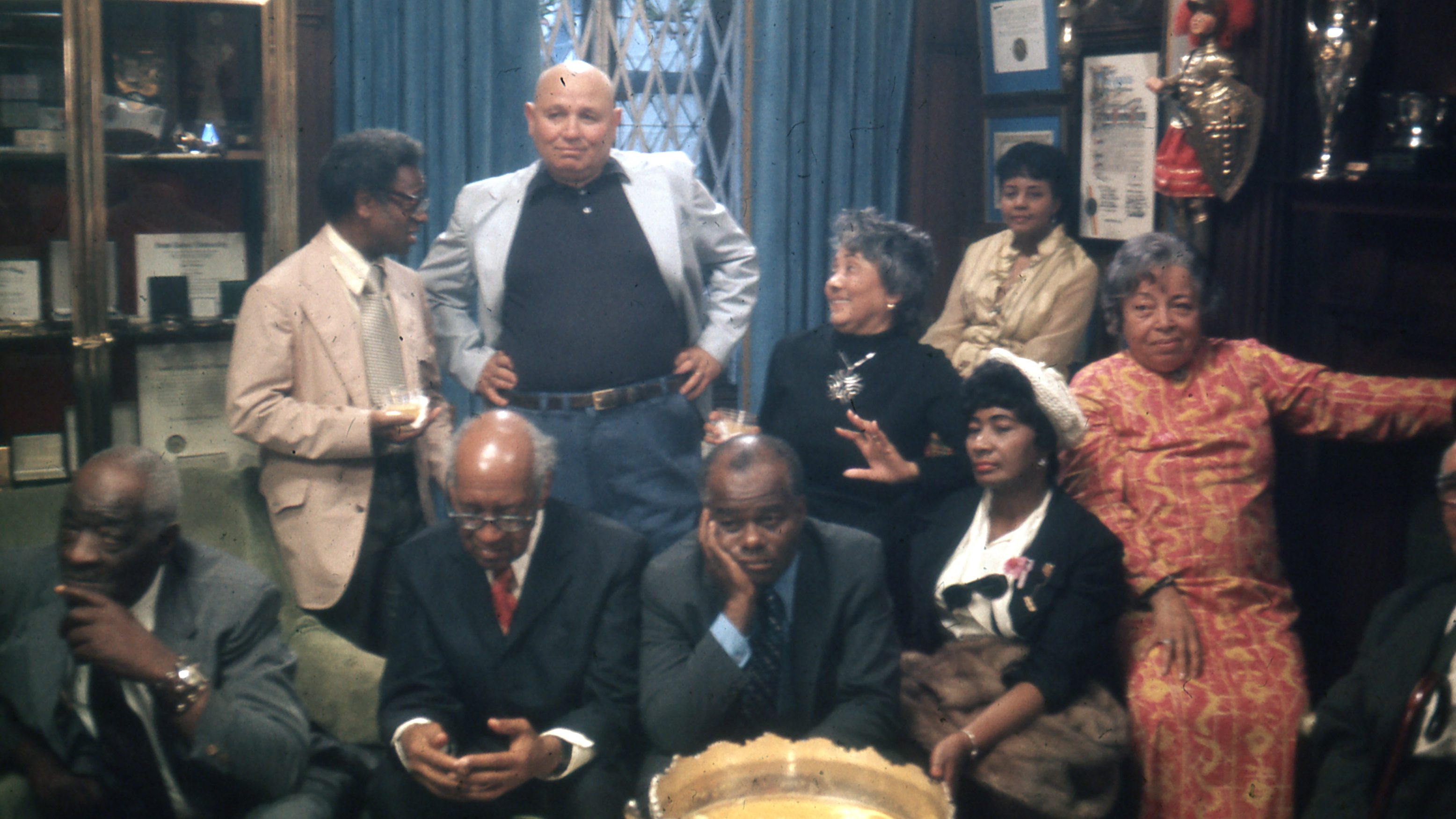
Legendary documentary filmmaker William Greaves conceived Once Upon a Time in Harlem decades ago – a literal assembly of legends. In the film’s opening, we see a typewriter typing out the letters Greaves sent to members of the Harlem Renaissance, inviting them to a party at Duke Ellington’s townhouse; it is an August afternoon in 1972, and following the letter, the invitees, who are now all senior citizens, some deceased and represented by their widows, walk up from the subway tunnel, or their automobiles pass the sidewalk, and enter the door of the townhouse – the party begins.
William Greaves couldn’t finish the film before he passed away in 2014; his son, David Greaves, who served as one of the camera operators on the film, took over and finished the editing. William thus acquires the “conceived by” title. When talking about Once Upon a Time in Harlem in the context of TIFF, I can’t help but first express my confusion about its inclusion in Wavelengths. The section has no shortage of films that heavily use archival footage in the past – the two films by Kamal Aljafari, With Hassan in Gaza and Masao Adachi Takes a Passport Photo, also have a “conceived by” title card for the filmmaker – but their uses tend to be more dialectical and confrontational. Once Upon a Time in Harlem, on the other hand, despite early reviews exclaiming “it makes you feel like you are in the party with those people,” is not presented in a cinema vérité style. It has many traits of a standard documentary: sit-down interviews, people’s faces labelled with accompanying texts, and old photos of what they looked like when they were younger. I have a quiet suspicion and unproven that Andréa and Jesse “saved” the film when TIFF Docs programmer Thom Powers, for whatever reason, failed to select it.
The primal formal conceit is this passing-the-torch sentiment around the film’s filmmaking. From that derives the biggest, perhaps only, formal thrill I got from watching the film – those that often excited me in films from Wavelengths – is a kind of double echoing of history, where we are not only watching footage from 1972, but the footage itself is already meant to evoke something from an even farther past. A kind of illusion still emerges when the interviewees begin to recite poetry or take up the piano once again – we are in 2026 watching footage from 1972 of someone reliving their artistic powers from the 20s and 30s.
The most disappointing part of the film is that William Greaves is someone who has made some fairly radical experiments with documentary form – Symbiopsychotaxiplasm Take One and Two are exemplars – but Harlem does not live up to his adventurous legacy. David Greaves not only inherits the footage from his father’s vision, but also some of William’s formal techniques. In both Harlem and Symbiopsychotaxiplasm, split screen presents footage shot from multiple camera angles during the same take in the frame at the same time. This technique is pertinent to Symbiopsychotaxiplasm, as the film’s premise derives its fascination from the porosity and obfuscation between what occurs in front of and behind the camera – camera A and B also represent reality A and B. So when footage of what the crew is filming is paired with the crew observing and filming the scenes taking place, the film is granted an illusion that the two cannot be demarcated and everything in the film exists within one large organism – two realities existing on the same plane. This technique has a more tepid effect in Harlem when it is used during conversations. We are already aware that the two people talking onscreen are occupying the same plane – as that is literally the whole conceit of the whole film – so the split screen here is now simply a substitution for a traditional shot-reverse-shot. In Symbiopsychotaxiplasm, the technique expands the scope of the film’s reality, whereas in Harlem it reduces it.
This idea of construction still surrounds the film. This is not just a normal party where all the legends tacitly decided to appear in the same room; William Greaves invited them all. During the party, they don’t talk about what they had for breakfast or what their grandchildren are doing, but instead about their legacies, and they argue and stand strong to defend their positions. Towards the end, when the conversation gets messy and hints at being out of control, William Greaves interjects himself into the film to facilitate the conversation. There is no doubt the film is another constructed artifact from William Greaves.
So, towards the end, when everyone departs the party through the same street they arrived from, and their images are accompanied by William Greaves’s “POEM/1965”, it becomes clear that the film is also a dedication to his father’s legacy. The particular light cast by the setting sun is particularly moving. “Must we die so soon? Must we sicken and suffer and cry for comfort”, asks William Greaves’s narration. Perhaps there is also a multi-textual layer: an ode to his father’s legacy, allowing his presence to shroud the legacies of legends that came before him – a double Mummy effect.



Leave a Reply