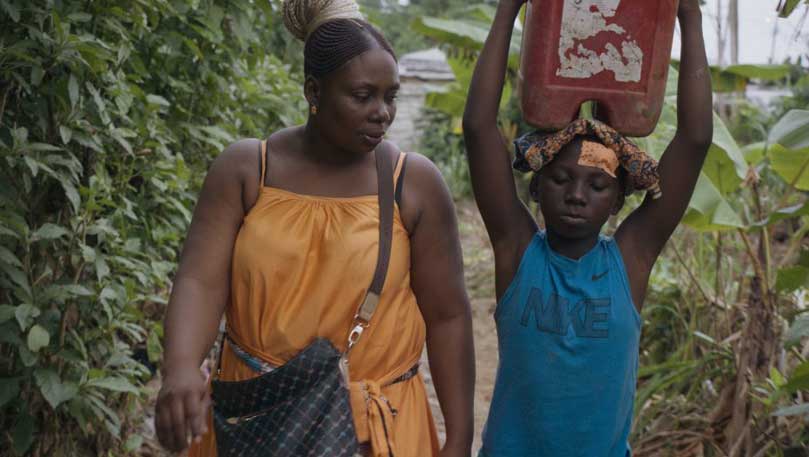
How may one regard the role of narrative? This question is a very important one to raise in the context of Rosine Mbakam’s Mambar Pierrette, an ostensibly cinema verité depiction of a Cameroon mother trying to take care of her mother and prepare her kids for the start of a new school year, while navigating through the aftermath of a large storm that hit the city. Especially, as a film that was part of TIFF Wavelengths in 2023, where films’ main attractions often lie in the challenges it imposes on the viewers – long duration, narrative abstraction, ellipsis, or a complete negation of narrative in favour of progression through arbitrary representations of colours and shapes – all things that seem extraneous or contradict narrative cinema. Mambar Pierrette is not a challenging film to watch, especially compared to other Wavelengths films programmed in the same year, Wang Bing’s Youth (Spring) and Angela Schanelec’s Music, for instance; its runtime is a friendly 93 minutes, and its central subject and narrative progression are rather easy to grasp. But it is in fact through its delicate modesty and a surprising slightness, along with a rather simple visual plan that does not immediately sound the alarm of dispositivism, that separates it greatly from today’s domineering trend of festival cinema.
The most unappreciated element that makes up its simplicity is the sound. It is pivotal to the construction of the scene, but can easily be neglected without exaggerated soundbites dominating the track. During the day, Mambar works as a seamstress. The film opens like it’s just another day for the protagonist, of her taking care of her mother and asking her younger son what treats he wants her to bring back after work. She has a sewing table set up in a room, and her clients enter and leave during the day, and casual conversations emerge. The sound of the sewing machine; you hear it, you understand it as the auditory rhythm of work and heartbeat of a mother taking care of a family. Similar sounds of the machine’s rapid pulsations can be found in Wang Bing’s Youth trilogy, but are less omnipresent here. Yet, when they disappear from the soundscape, you feel the insinuation that this mother’s livelihood, her weapon to protect the lives of those she cares about the most, is threatened. So when it reemerges in the end and carries into the credits, the lingering noise is a better anthem of “and life goes on” than Nina Simone at the end of Perfect Days.
There also the economical brilliance that environmental details do not need to be realized with cuts that disrupt the flow of a shot. First, the portentous sounds of a thunderstorm in the background of conversations hint at what is to come. Second, sounds delineate the aftermath. When Mambar wakes up at night to the sound of her son saying the storm has flooded the house, we see a shot of her getting out of bed and walking around the house. A typical film of this subject would cut to different shots of the water that got into the house, perhaps even linger on the household objects floating on top of it for a bit of artistic polish. But Mbakam does not make those cuts; through the sound, we can hear that Mambar is treading in water, and we realize the house is flooded through pure physical details. I am not arguing that long takes are better than cuts at all, as the refusal of découpage and one-perfect-shot-ism are also worrisome trends in today’s cinema; it’s just that in the case of this specific moment, Mbakam’s eloquence is far more effective.
Formerly a documentarian, it’s natural for Mbakam to carry over her observational instincts into her narrative debut. The film does not possess the structured intensity of a Dardenne brothers film – even though there are some behind-the-back tracking shots that briefly echo their films – and more than once allows Mambar to exist beyond typical miserablism plotting. Specifically, Mambar’s son’s money box is a plot device that would’ve been mined to further degrees in another film. This kind of denial makes the film feel quite Brechtian, particularly the use of the mannequin next to the shop’s front door. When Mambar goes back to her shop after the storm, she cannot find her sewing machine. She then delivers a small monologue on how her life is completely ruined (paraphrasing here). After the monologue, there is a moment of silence, accompanied by a cut to the mannequin. Another cut occurs, and two neighbours approach the shop to return the sewing machine, saying they hid it last night because of the storm. This deliberate rejection of a downward spiral feels like a sly hand that Mbakam has dealt with the narrative.
Through the mannequin that stands in front of Mambar’s workshop, Mbakam appears to be objectifying the Western gaze itself, which, ironically, with the film premiering at Cannes and subsequently touring the European and North American festival circuits, forms the majority of the film’s audience. We even get a perspective shot from the mannequin, but what can it give but a blank stare? The act of filming that constitutes the narrative we’re seeing thus becomes the central question. Towards the end of the film, a friend of Mambar, who paints his face white, dresses as a street clown singing with kids, comes to visit her, and declares, “there is no art in Cameroon”. If the social conditions of a place do not grant its inhabitants the freedom to express themselves through art, then what exactly is this exported project that remarks on this dearth? Similar to when critics questioned the role of the spectator when Wang Bing premiered his Youth trilogy at Cannes, Locarno, and Venice, Mambar Pierrette challenges the inherent implication of cinema verité by pointing out that what a camera captures is always a product of construction, which will inadvertently lead to indifferent consumption. The rhetorics of social consciousness becomes marginal compared to the formal construction of the film itself. So, during the film, there is a scene where Mambar is assaulted and robbed by a gang of men, and the film captures the entire event taking place in a small street corner through a distant, static take; is this an example of irony or callousness?




Leave a Reply