I attended a screening of Jodie Mack’s 2013 stroboscopic short Let Your Light Shine at Innis Town Hall last Friday, which included 8 other shorts made to produce rainbow 3D effects when viewed with diffraction glasses. The screening was part of UofT’s Cinema Studies Graduate Student Conference, with Mack delivering the keynote address. So it feels fitting to begin Wavelength Diaries with Jodie Mack and her longest work thus far, The Grand Bizarre, part of the Wavelengths programme in 2018.
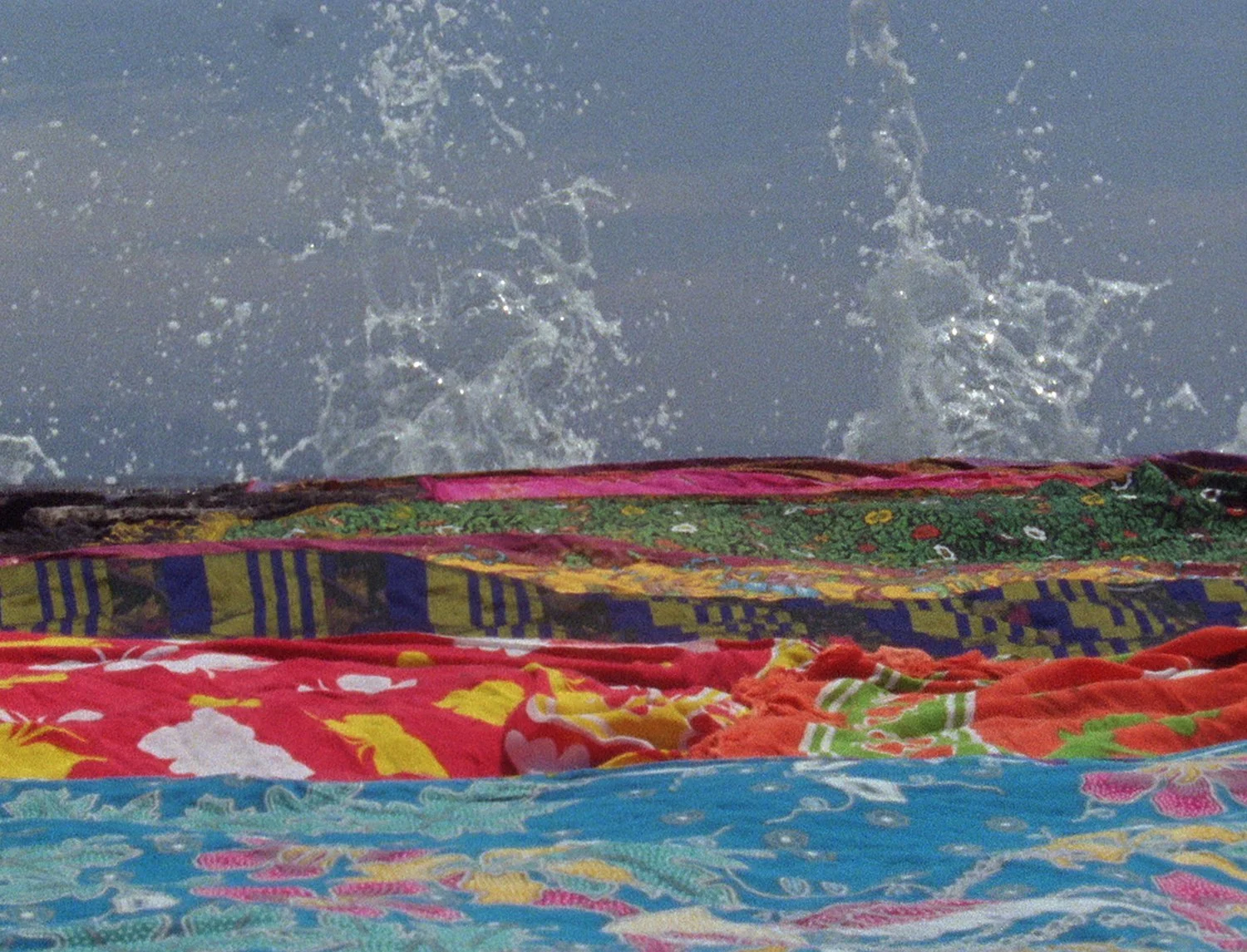
During her address, Jodie coined herself as a choreographer of time. Putting against words of an artist against her art, I’d say the description is very apt. The work is an arrangement of images and sounds. This description is vague, and one may argue that this is the case for every movie. But what makes Mack’s work so refreshing to watch is how playful and ferocious it manages to warp time while presenting the synthesis of textural patterns that outline the materialities of its subjects of interest. The Grand Bizarre is a travelogue, and the illusion of travelling is incited in multitudes of ways. First, by the objects of interest chosen by Mack – close-ups of suitcases, maps, international phonetic alphabet, and world globes – operating as promising symbols of exploration; second, the speed at which the images are delivered in the form of a Flicker – a form frequently employed by Mack in many of her shorts – to sustain a constant and exhilarating movement of image. Landscapes, views out of a train window, and the rearview mirror of a car are presented in sped-up footage that turn passing sights and pedestrians into ephemeral ghosts. The Flicker and the sped-up footage often overlap. For instance, during a sequence in which the Flicker presents an array of colourful textiles in close-ups, overlaid on sped-up footage filmed from the front passenger seat of a moving car, with the right rearview mirror positioned in the center of the frame. The flickering textiles directly block the rearview mirror in the sped-up footage, making this moment resemble a collage of two different modes of time.
The thematic meanings of individual images converge into a cohesive forward motion. During the keynote address, Mack also brought up the concept of “discontinuous continuity”. This idea is the basis of her Flickers and is predicated on the human eye’s ability to capture the similarities in the shapes and colours of disparate objects, as well as the human brain’s desire, upon processing these shapes and colours, to discover latent connectivities, all in the context of 24 frames per second. The most notable example appears during a segment, the disruption of a series of flickering textiles in fast transitions, each connecting to the next through the identical shape of a diamond at its centre, by a sudden cut to an exterior shot of a fence, containing a diamond at the centre of its framework and composed to match seamlessly with the diamonds shapes on the textiles. This transition is simultaneously abstract and concrete; the shape of a diamond being the only feature that connects two. an arbitrary linkage, yet a visceral one because it resembles the physical feature that more vividly represents how our eyes process both objects. It embodies an ecstatic surprise of seeing an object that reminds one of home when travelling in a foreign land; the textiles operating as a stream-of-consciousness impressions, and the fence as what the eye catches in real time. This sequence also creates a stimulating temporal contrast. The contingent of textiles is presented through the frantic pace of a Flicker, while the movement of the flowers behind the fence suggests that this image is at normal speed in real time. Mack’s choreography of time extends towards observing how discontinuous continuity can be retained with contrasting temporal modes. So the grandeur of the multi-national travelogue in The Grand Bizarre is really attributed to the collapses of colours and shapes constantly cycling between association and dissociation, similar to how globalization has introduced an overwhelming uniformity that surrounds the global population that creates the false conception of total free access to images around world, while circumventing a true feeling of belonging. The overall effect is derived not from the meaning of those individual objects Mack puts in the frame, but from the collisions themselves, which can only be achieved by time in a cinematic sense.
The presence of music or sound is also notable. Mack has mentioned the intention of making this a musical. A recurring anecdote she shared during the Q&As is that, during her travels, the music she’s heard most is from Drake, an obvious sign of globalization’s export of music. The opening sequence is driven by an energetic burst of music that Mack has said to be parodies of low-brow pop music. Its rhythmic nature matches the onslaught of movements onscreen as the title card emerges. Later in the film, diegetic sounds, such as bird chirping, a Skype ringtone, sewing machines, and, most notably, the shutter of an animation bench towards the end that seem to influence the montage itself and provide the film with a calmer cadence.
The film specifically makes conspicuous the idea of what it means to animate something. When people demarcate the art of animation from the art of cinema, it feels like the line is drawn on the premise that animation, whether hand-drawn, stop-motion, or rotoscope, uses an intermediate form to create the illusion of reality – for instance, the clay dolls with eyes that move to resemble human liveliness – as opposed to a live-action film that simply captures realities through the eye of the camera without an additional medium. Simply put, live-action images resemble more what our eyes see and our brains process in real life than images from animations. In The Grand Bizarre, however, inanimate objects, prominently the textiles, are captured on camera and given the illusion of movement through successive frames. But this movement is not seamless; instead, its conspicuous discontinuity resembles that of clunky stop-motion works. Mack thus makes explicit that what constitutes movement in cinema, often taken for granted as reality, is actually no different than animation. The illusion of realistic movement is painted by the camera and animated at 24 frames per second; what’s different is only the tools used. Designating The Grand Bizarre to any specific mode of filmmaking feels wrong because it’s difficult to specify where one technique begins and the other ends, and how different those two are in the first place.
I would make an off-handed thematic pairing with Hong’s By the Stream, based on the handcrafted nature of textiles that is central to both films. But unlike films of Hong, The Grand Bizarre is an entirely speechless film, and the presence of humans is mainly the ephemeral appearances of pedestrians during the many time-lapse sequences and the textiles themselves, evidently a product of human creativity – there is even a segment where human hands are part of a superimposition. Mack’s position towards the idea of globalization and how labour is associated with the textiles themselves remains non-didactic and arguably quite elusive throughout. As the textiles traverse the world, the geography or anthropology of each region remains rather vague. In fact, there is a flatness to the film’s images. A recurring image motif is a group of textiles hanging from a thin clothes line across different locations. The immobility of the sped-up image resembles more of a photograph with an additional temporal dimension.
I much prefer the energy of this film to a sterile version one that laments its awareness of social conditions and forces those conditions as part of its form through didacticism. During a Q&A session at Film at Lincoln Centre (around 19:00), Mack knowingly acknowledged the complicity that experimental artists face in creating work in this current climate. The circumstances of experimental cinema being subsumed by the industry and filmmakers working in the experimental branch lecturing at expensive private institutes create a contradiction: one has to pretend to be against the system in the name of forming a new language of cinema, even though they are the system and embodiment of the systematic film languages themselves, and their works are the regurgitation of established languages opposite of experimental. The outcomes are usually self-serving cynicism and a metatextual acknowledgment that amounts to nothing more than complacency. What’s so dazzling about Mack, who is currently a professor at Dartmouth, and her cinema is how the interconnectivity of the images themselves, or the use of pop music, doesn’t become fodder for a cynical outlook; the hand-crafted nature of the objects and their assemblage returns the joy to the discovery of cinema itself, of putting ideas raised from various contexts together to try to discover their commonality. The film is ultimately an effort towards coexistence, and coexistence liberates meanings in the form of art.



Leave a Reply