Forming a rhetoric around Hong’s films is easy. The distinctive way they look and feel is in congruence with his self-sustaining, economical methods – doesn’t shoot on film, only works with a close group of actors, spends a day or two assembling the final cut, revolves around celibate artists that resemble auto-fiction – creating the notion that Hong is: a simple man making simple film celebrating simplicity. There is also the term “late-style,” which has been used increasingly in the discourse on Hong’s recent works to explain why their digital sheen has gotten blurrier: signifying a world seen through the temperament of content reclusiveness and rejection of material needs. So it becomes very difficult to talk about Hong’s films at all, because then we would be discussing cinema based on regression and negation. I have been struggling to discuss Hong’s cinema this way, both because it feels so minuscule compared to the feeling I actually felt while watching the films.
I also find the idea of “simplicity” too deterministic to capture living and insufficient to replace all its opulence. In cinema, a realist art, the most essential elements to me are the matters within the frames and the accompanying sounds – the shapes delineated by light resembling human bodies, as well as their movements – that generate the illusion of human liveliness and grant ideas their concrete form. Ideas only count after their physical essence is sensed by the eyes, not vice versa. I think about Wim Wenders’s Perfect Days, and how it ultimately resorts to an ad for Tokyo toilet and UNIQLO (like, literally), because of how desperate it tries to sell an idea of a living by a simple ideal to a point that it effaces all human traces.
Hong’s cinema is not the amicable and benign kind that can be summed up by the way he and we discuss the way he makes them. His early works often tend to a kind of mean-spiritedness, structurally and narratively, that imposes a reality based on the many ugly truths of gender dynamics pertinent in Korean society. As he gets older, the misogynistic men migrate to the peripheries as his eternally lovely muse, Kim Min-hee, takes the stage. But the Hong that constantly plays with structure and visual forms to always contend with his characters’ quotidian beings never left. In his earlier student days, Hong wanted to be a painter, and he should still be perceived as one who uses cinema as the canvas and employs elements dearest to himself to delineate the most striking of human essence by discovering not just reality, but the many phenomenons that distance ourselves from reality; the outcomes are labyrinths of fiction built out of table conversations, soju, makgeoli, etc,. I would love to discuss What Does That Nature Say To You based on that.
Nature has a simple premise and a clear temporal framework that can fit into one sentence: 35-year-old Donghwa meets his girlfriend Junhee’s family over the course of one day. Donghwa – an unsuccessful poet with a part-time job on the weekend that he claims to be enough to sustain his lifestyle, who is also the son of a very respectable attorney that he seems eager to write off whenever mentioned – impersonates the platonic ideal of Hong’s film. He speaks and moves like a Hong character: inspired by the trees, launches into a monologue on the beauty of the world’s unknown, and seems assured of his purpose during moments of solitude. The clarity of the film’s premise and setting is obfuscated by how it gradually and simultaneously becomes an extension of Donghwa’s ideology while scrutinizing it during its narrational flow – the conversations he has that draw out unavoidable contradictions between himself and his purported simple way of living. Hong’s fiction draws a series of daggers that strikes at the minute moments of awkward pauses or brief hesitations when a conversation has gone slightly awry beyond the polite exchange of words on the surface.
The “meet the parents” esque synopsis conveniently serves Hong’s most alluring talent: shaping conversations specific to the character dynamics; how people interact, what they say versus what they mean, words put against intentions, honesty against concealment. In Nature, politeness, formalities, squareness, and awkwardness dictate the physical gestures in how everyone presents themselves. Conversations are the essence of the film’s ebb and flow of tension and shape. Scenes between Donghwa and Junhee, Donghwa and Junhee’s father, Junhee and her sister, and meal-table scenes featuring Donghwa and every member of the family, flow together as a consistently shifting current built upon juxtapositions of individuals’ rhetorics with underlying intentions – how Donghwa presents himself to the parents, the version of Donghwa Junhee wants to present to her family, and what the parents say to each other. Everyone safeguards themselves with language that can never reveal their true selves. This gamesmanship is evident twice when Donghwa asks Junhee’s parents to drop their formal speech when speaking to him. The mise-en-scène is thus the product of those invisible spaces between themselves derived from the flowing conversations, a result of Hong’s keen intuition for character psychology. Yet what appears onscreen is not abstract, nor psychological, but rather the concrete physical presence of every character’s vivid beings.

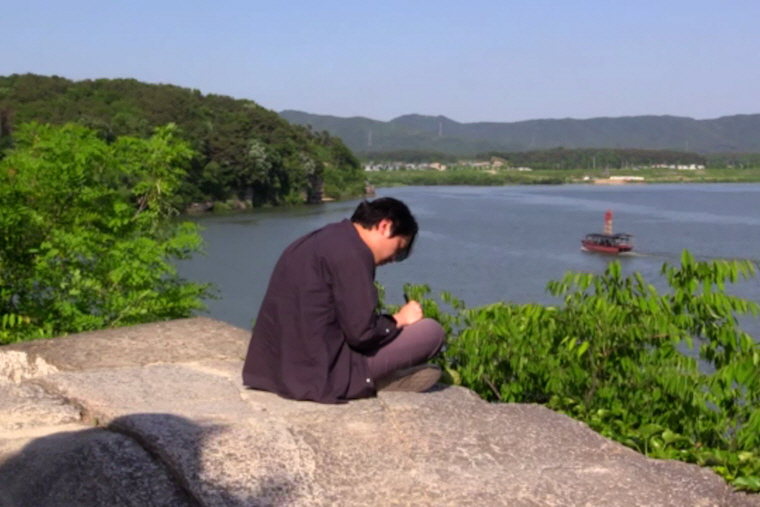
Hong’s pet theme of drinking, through which characters expose their most intimate selves, is subverted in Nature. Junhee’s family being strangers to Donghwa and the generational divide between young people and parents disrupt the narrative flow, because certain things can never be said during a single drinking session and certain physical gestures can never be performed, thereby circumventing true connections or confessions. The setting is also important; in one scene, Junhee’s father invites Donghwa to go on a hike up the hill, ending with the two sitting on a bench, both facing their backs to the camera, drinking. Distance is everything here: being outdoors and in bright daylight limits the secrecy of what is typically an action performed in a confined space between close friends; the camera only capturing half of their faces also blocks the audience from accessing part of their physicality.
Ruptures appear within Hong’s rudimentary compositions by the way they connect. Abrupt crash zooms are frequently employed by Hong to reframe a scene, and they tend to break the immersion of the conversation at hand by the sudden acknowledgment of the camera’s ontological presence, setting our attention adrift. In Nature, the rupture also exists in a larger structural sense in the way scenes, even individual compositions, connect. The film opens with a shot of a woman facing her back to the camera, cooking, a very common image in film. But as we gradually realize in the first half of the film, this image has no narrative or sequential connection with the following scenes. In the next scene, we transition to a completely different location, inside Donghwa’s car parked outside Junhee’s house. From the backseat, the camera observes the couple in the front seats, witnessing a black car exiting the house’s front gate; Junhee informs Donghwa that it is her mother, Sunhee, leaving for work. Only later in the film, when Donghwa officially meets Sunhee at the meal table and she makes a brief remark that a dish she made usually takes a day, does the first frame of the film begin to establish a narrative connection with the rest. But in a film where the time moves forward linearly, this image sticks out. What time does this image take place? Is it showing an alternative timeline in which Sunhee spends the whole day making the dish? Or is the shot showing her making a different dish at a completely different time? No matter the answer, this “out-of-place” image cannot be seamlessly fit into the rest of the film’s narrative and formal logic. The point being, we can easily be disoriented by how a single “common” image can completely break the illusion of a narrative and temporality that flow seamlessly through time.
Repetition exists to make us second-guess what we are seeing onscreen. It is a pet theme of Hong’s since his early works. Whether to complicate the narrative structure, as in Virgin Stripped Bare by Bachelor, where a scene is played multiple times from an alternative perspective to introduce instability by challenging the typical way the audience follows the narrative with a main character. Or, as Lawrence Garcia argued in his review of By the Stream for In Review Online, uses the same table arrangement in two separate compositions to underscore how a typical table conversation is shaped in Hong films. In Garcia’s words, the repetition “exemplifies aspects of Bazin’s metaphysical thesis, then, by showing how our grasp of the overall narrative is always unstable, how it can be potentially re-described by the emergent salience of a heretofore unnoticed event.” In Nature, repetitions take the form of character speeches. Junhee’s sister Neunghee repeatedly mentions Ha’s father’s status as a respected attorney. Neunghee’s words feel conspicuous because she is actively challenging the unity of the mise-en-scene upheld by social politeness to avoid asking a stranger the most trenchant questions. From Donghwa’s denials of linkage with his family and discourse to prove his self-sufficiency. Neunghee’s presence also seems to be Hong’s way of refuting the negation by continuously reintroducing the very fact that Donghwa most wants to hide. All three family members also remarked on Donghwa’s beard on different occasions, which one could argue is another facade Donghwa puts on. Repetition also occurs during a pivotal dinner table scene in which Donghwa recites one of his poems to Junhee’s entire family, and the repeated use of words and phrases offsets the image we imagined of Donghwa as a poet.
In earlier works like Night and Day and Woman is the Future of Man, dreams reveal the main character’s secret impulses, which he is ultimately exonerated from by the clean distinction between the two planes; only the film itself and the audience that witnessed it all are stained by the accumulated traces left behind. The shift in Nature is that no counter exists to the series of coincidences and repetitions we are witnessing. So, when Donghwa’s decision to take a closer look at the ornate architecture of Junhee’s parents’ house leads him to accidentally meet Junhee’s father standing at the driveway, it feels like the narrative itself is chasing Donghwa down instead of his own psyche. This incidental detail triggers an entire chain of narrative events that follow it, in which the meeting with the family is the film’s universe’s way of exposing Donghwa’s self-sustaining way of living to external convictions. We, the audience, are confronted with how his rhetoric, which is so similar to that surrounding Hong, is being invited to contradiction and ridicule by the author himself.
Culturally, meeting someone’s family is an invitation to demonstrate reliability and responsibility, two traits associated with an adult ready to enter their next stage of life: marriage (especially how Junhee’s dad is described as a filial son by Junhee near the beginning). In Donghwa’s case, the hilarious, cringey moments are associated with the gradual revelation of how he’s dispossessed of both; the careful arrangement of words when he tells Junhee’s parents that he works part-time on the weekend is a synecdoche for his whole day. There lies a contradiction between living according to senile wisdom while being perceived by others as a refusal to grow up. Presenting oneself to others leads to the destruction of one’s self-illusion, because a self-image is destroyed when we speak it aloud and see through its falsity internally. The nightmare presented by Nature is the perpetual conviction created by myriad fractures on that mirror of self-image when one invites others to look at it.

We reflect upon our own psychology through its infinite refraction in our daily activities: how, every time we meet someone and talk to them, we reveal and conceal something about ourselves, and our use of language is constantly aiming for the recourse of self that’s constantly fading during conversations. When we see a beautiful flower, the understanding of its beauty is immediate and pure, but when we try to express what we see to others, our words are always insufficient, limiting, and exist only to pollute that beauty. So the conviction is not there to condemn Donghwa, but a precise delineation of how difficult it is to recreate beauty, how it’s easy to understand what nature is saying to you, but so difficult to repeat it to others; one can even say that is the struggle of cinema itself.
The film leaves space for Donghwa’s ideals and half-wisdom. Scenes often end on a shot that lingers a few seconds too long on “unnecessary” elements extraneous to the narrative: Junhee’s father feeding the chickens, or a tree that Donghwa remarks is beautiful. And the ending shows optimism for time; maybe if a shot lingers long enough, we can observe a modest miracle: someone gaining clarity and obtaining an epiphany in real time, even a minor one. Every question and dictum uttered will eventually get carried away by the stream of time, no matter how drastic the moment feels. When the talent granted at birth is too deterministic to define how one chooses to live, maybe we can hope that time, through old age, will grant us wisdom. Hong’s generosity lies in his perspicacity for the moment while embracing the contradictions that allow us to live beyond it.
What Does That Nature Say To You coming near you in Canada:



Leave a Reply