When discussing Jean-Claude Rousseau and his body of work, solitude is the word that appears most often. As his own producer, cinematographer, editor, and often actor, this one-man crew is deeply engaged in crafting fiction as self-portraiture that concerns the spiritual confinement of how the artist is bound by the materiality of the world around him. But surprisingly, the results are never works of solipsism, and I think that is due to a kind of matter-of-factness in his cinema that precisely acknowledges what goes on in front and behind the camera. One may recall Venise n’existe pas, when Rousseau opens up the curtains in his room, the shot abruptly ends, and we are confronted with the film leader – the material within the film is inseparable from the materiality of the film. His films feel like a purer indication of how he relates to the world and contain a purer beauty without a pre-determined schema.
Rousseau jettisoned Super 8mm film stock after The Enclosed Valley and began working with a digital camera, giving himself the ability to see what he filmed immediately. Similar to James Benning (who switched to digital in the 2000s), this switch also makes the need for a cut arbitrary. Last Stop for the Circular Ticket is shot on a digital camera with a not-so-optimal resolution; the aspect ratio looks closer to a 4:3, but slightly wider. The question of the cut is ingrained in the rhythm Rousseau builds and shifts throughout the film. As one of his greatest virtues, his films are never deterministic or fall into dispositivism. Shot lengths are highly varied, unpredictable, and not fixated on any preconceived ideas about what it attempts to capture.
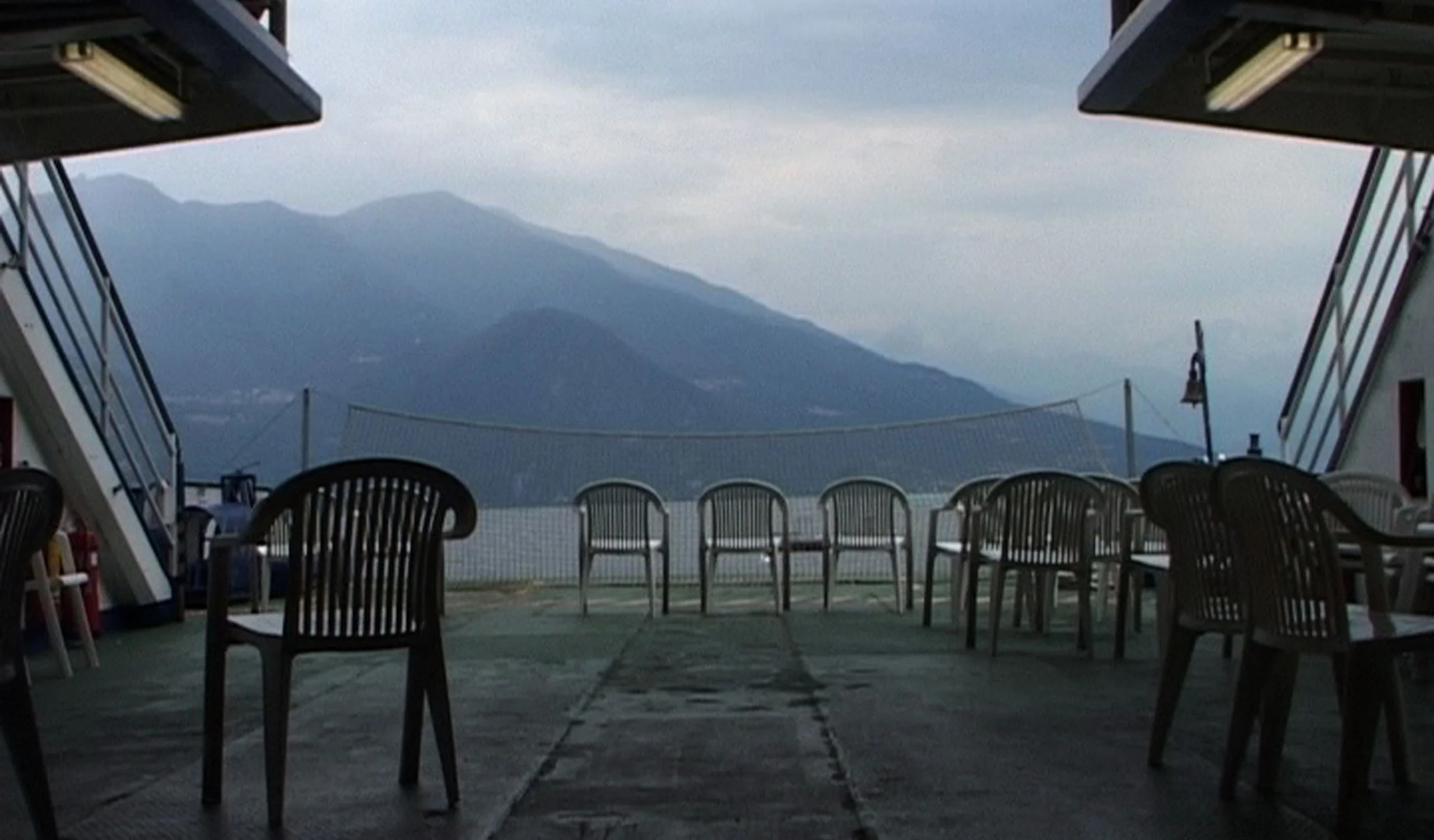
The majority of the film takes place outdoors. Rousseau sets his eyes on a round-trip ferry ride that circles around Lake Como, Italy. He is no longer the man in a hotel room observing the chanting boats passing by in Venise n’est pas (I swear I’ve seen more than this one); he is a passenger on the ferry himself. His usual visual motif, an image of him standing inside a room looking out from the window, does not appear in the film. While that motif announces the author’s loneliness and need to connect with the rest of the world, Rousseau’s physical presence in this film feels closer to an anonymous figure that rarely dominates the images he occupies. At times, we see him inside a phone booth, sitting on a bench, or looking into the distance with a telescope, but he is usually in the corner of a wider image and blends into his surroundings like the countless other nameless individuals being filmed, rather than straying apart from them.
The outdoor setting does not lead to a film of openness. As the title suggests, a circularity is in place to form a hermetic cycle. By depicting a central subject, a ferry ride around the lake, Rousseau observes the confluence of geography, nature – the lake, the mountains, the rain – and the tourists and locals who travel in between. Like Un Monde Flottant, Last Stop for the Circular Ticket is formulated around a series of places that we’ll get increasingly more familiar with through duration and repetition. The compositions are by-and-large static, but Rousseau often leaves in zooms or camera wobbles that seem like mistakes at the beginning or end of shots, never abiding by the passivity of a false tradition of “slow cinema”.
The locations, forming a cinematic equivalent of stops along a circular trip, include a dock where people wait or exit from the ferry in front of a black gate that opens in the morning and closes at night, another smaller dock that is adjacent to a phone booth, a fountain with a statue of cupid in its center, several places around the pier that look out to the water, different angles from the moving ferry, etc.. In a sense, they are organized by their own natural orders. Like travellers featured in those compositions who turn their heads to look at the view of mountains, the camera invariably faces towards the water instead of pointing inland when it is fixed at shore. Divisions between concrete and fluid is formed upon the planar compostions – ledges, arches, and bars of humanly constructed architecture use lines, circles, squares, and rectangles to break up the water and the faraway mountains.
Rousseau’s structuralism is particularly fitting within the subject here because a trip itself contains a fixed number of stops for the ferry to constantly travel between. Although Rousseau doesn’t particularly emphasize the number of stops or establish their sequential order during the trip, the oscillation between the locations – the moving ferry and the unmoving shore, forming a reciprocal relationship, with the body of lake as mediator, and both setting eyes on the unmissable distant mountain range – accompanied by the frequent returns to the same place captured with the same camera angles develop the mental shape of a circle because the structure grants us some sort of promise that we will return to where we began.
The images have us drifting between states of waiting, departing, and arriving. From the shore, views of mountains and lakes are captured, and we expect a ferry to arrive and take us on a journey; on the ferry, we look back at the shore, same locations from a different angle, and we wait for the ferry to dock so we exit. Through slight variations – night and day, rain and shine- Mother Earth delineates the landscapes differently and dictates human behaviours. In early mornings, the mountains seem to blend in with the clouds, and present themselves as soft shades. But after the afternoon rain, like how in Enclosed Valley the dark void on the flat surface of the screen representing the valley itself seems to form a wormhole-like entity that threatens to swallow any visitors whole, the mountains acquire a sort of density in contrast with the lightness of their surrounding clouds and flowing water, and take over the center of gravity of those compositions. The mountains’ monumentality seems to have all the passengers practicing directional looking, like the films of Ozu, by always turning their faces toward the wonder. The people are mostly filmed from behind. On rainy days, the people move inside, so the deck we see of them sitting in chairs observing becomes empty. The purported subdued naturalism in the images are filled with underlying logic and laws that stage where people should be, and perhaps plan where the camera should point to as well.
The shots capture ferries leaving and entering the port, but sometimes we arrive too early or too late, and the ferry has already departed or is minutes away from entering the frame. Once, a shot is set on the shore; a ferry exits the frame and a burst of music is accompanied by a group of ducks entering. We suspect they are why the shot lingers beyond the departure of the ferry, but they soon move across the frame and leave it, yet the shot still lingers. At times, the shot appears and disappears rapidly by fading in and out of the dark.
Temporality becomes simultaneously clear and unclear. During a long take, we can actively feel everything that is occuring in front of us – the trajectory of the boat, the gestures of people, even the minutes movements occurring in nature – but a cut disorients both time and geography as Rousseau never settles the film into a finite rhythm or pattern to say where he is going next, so we are never sure if the next shot take place will take place during night or time, or if the next shot will see the boat arriving at the location promised by the previous one, but somehow we still expect we will return in one way or another
Rousseau often captures sporadic but stunning beauty – things that definitely occurred by chance that his camera was in the right place at the right time to film. Like a bolt of thunder that pierces through the clouds and strikes the mountain for a split second on a rather stormy day, or a boy walking past the pier, whose head just happens to overlap with the trajectory of the rainbow for a few moments. When discussing the images he captures with Cinema Scope, Rousseau states:
As you can imagine, most of the time that I saw my Super 8 footage I was disappointed, because what the camera recorded wasn’t what I had in mind. This is wrong, though. I was looking for what I thought I wanted, and you can’t get the image you want. This especially happens when you make a film that was written as a screenplay. If you try to catch an image that you wrote down, when you see the shot you aren’t seeing an image at all; they are just signs. That’s why in most films there are no images, only signs. And there are many reasons why I may feel that the image I shot doesn’t fit what I wanted. Maybe there is some technical problem, it’s out of focus or the lighting is wrong, but this doesn’t mean anything! A technically “bad” image doesn’t have to be a bad image, which is why I never throw away these shots, and also why it takes me a very long time to include a shot in a film. Sometimes I have to wait five years or more before a shot finds its place. I have to first forget the film I had in mind when I was shooting, and then I can move behind the veil of my mental image and see the image for what it is.1
Similar to Pedro Costa, the need to see and understand what he films is essential to Rousseau. So, like all of his works, the origins of his images and music here are acknowledged. Interstitially, the film includes interior shots – which I think are the only ones set inside a room – of a small opera concerto, for which the piano serves as the soundtrack that occasionally accompanies images of the film. There are also shots where we see Rousseau pointing his camera at a mirror and revealing himself and his camera through the reflection. The sporadic cuts to blurry handheld footage confess the film’s singular perspective and also serve as breaks to the film’s usual, steady rhythm. When taking the awareness of the camera, a psychological factor invades certain images: by identifying the ontology of the camera with a pair of lonely eyes, what does it mean that the gestures of those people sitting on the boat or waiting by the dock are being watched, or, in a sense, surveilled? Those pedestrians – the man wearing a cowboy hat with his son, the lady pushing a stroller around the dock, a solo traveller with her backpack – may be too compelled by the natural landscape to care, but we, the ones sitting in a dark room observing them, must reconsider our perspectives as ones who are peeping into glimpses of other people’s lives.
Towards the end, the film feels briefly psychological, with a blurry image of an old sailor’s photograph. Who does it belong to? We see a car passing by one of the ports, now filmed from a different angle: the camera is no longer facing towards the lake, but towards some buildings. Are we finally breaking out of the circular trip? But we then return to a familiar angle on a boat once again, but it’s nighttime, and there is no one there. With Rousseau, images are formed by the geometric lines. But we always mentally turn the images inwards and expect an explanation and some sort of greater connective tie-ins that will ease our psyches. Similar to how his character (himself) yearns to be with the world but always gets blocked by a physical barrier in front of him, when viewing a film by Rousseau, one has to constantly reconcile with the intimacies brought by the camera and the contradiction that everything it films is just images distant from ourselves, eagerly waiting to complicate our preconceived notion of its “themes”, instead of lived experiences. This gulf, born of that reconciliation, may reveal his most truthful qualities.
- Williams, Blake, “Depth is Real. A Conversation with Jean-Claude Rousseau” (2021). https://blakewilliams.net/Depth-Is-Real.pdf ↩︎



Leave a Reply