Image Credit: Ritual Films
The two subjects in the title of Sho Miyake’s latest, Two Seasons, Two Strangers, reveal the foremost pleasures of watching the film. The enveloping of seasonality can be found clearly through the evidence onscreen: the summery rainstorm, the rustling leaves in a passageway that leads up to the shore and the undulation of waves, the forward motion of a train passing through tunnel the tracks into the frosty scenery up ahead, steps in deep in snow leading up a lodge that exists beyond a map. These elemental treats exist there to slow down your pulse with their movements. And the strangers are called strangers because they are travelling, a constant act of displacing themselves from familiarity and opting for a chance to encounter the unknown and spontaneity that, at certain moments, offers the film a high of drift.
Two Seasons, Two Strangers follows a Korean screenwriter, Lee. She is often timid and self-doubting. The film’s first half does not revolve around her, but around a story she is penning. In the beginning, we see her sitting at a desk, thinking, stuck, trying to jot down words. Suddenly, inspiration strikes, and a smile break out on her face. We get to see what she’s written down: “Scene 1: Summer, Seasside a woman sitting in a car”. As sounds of waves intrude the shot of Lee’s notebook, the film cuts and everything written on that page – the summery, seaside scenery, the woman, whose name is Nagisa – materializes in front of our eyes. As described in the text, Nagisa’s sitting bored stiff in a car, waiting for a man who appears to be her partner. Through this mise-en-abyme, we are displaced from the artist to her imagination, a fictional world, and transported to this remote, resplendent town with exquisite beauty plucked straight out of a manga (film is actually adapted from the manga short series “A View of the Seaside” and “Mr. Ben and His Igloot by Yoshiharu Tsuge) accompany a story of a young woman meeting and forming a connection with a local boy.
Seperated from her partner, the story follows Nagisa to a museum. Miyake captures the wonder of travelling when you enter a beautiful place for the first time and become struck by the newness around you. This scene not only recalls the opening scene of Asako I & II by Miyake’s contemporary Ryusuke Hamaguchi, but also Rossellini’s Journey to Italy. It’s the way in which the histories of this small town, the infinite possibilities of fiction, formerly unknown and alien to the visitor, finally open up to the visitors as they enter the space. But different from Rosseillini, whose camera goes beyond tracking the movement of Ingrid Bergman, but is also navigated by the curiosity of Rosseillini as a traveller and his fervour to see Italy for himself, Miyake’s plan is more strict, following the movements of Nagisa and cutting to static shots of individual photos exhibited to involve the viewer in encountering the museum for the first time as well.
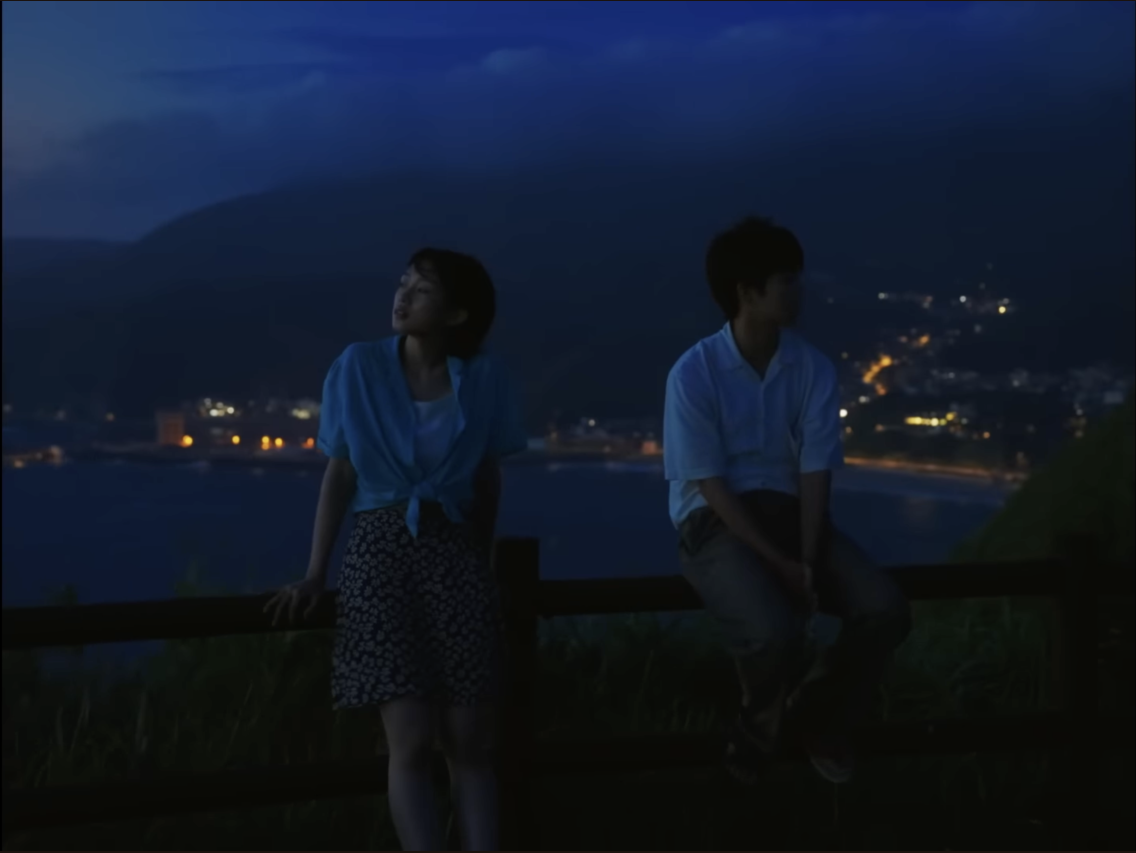
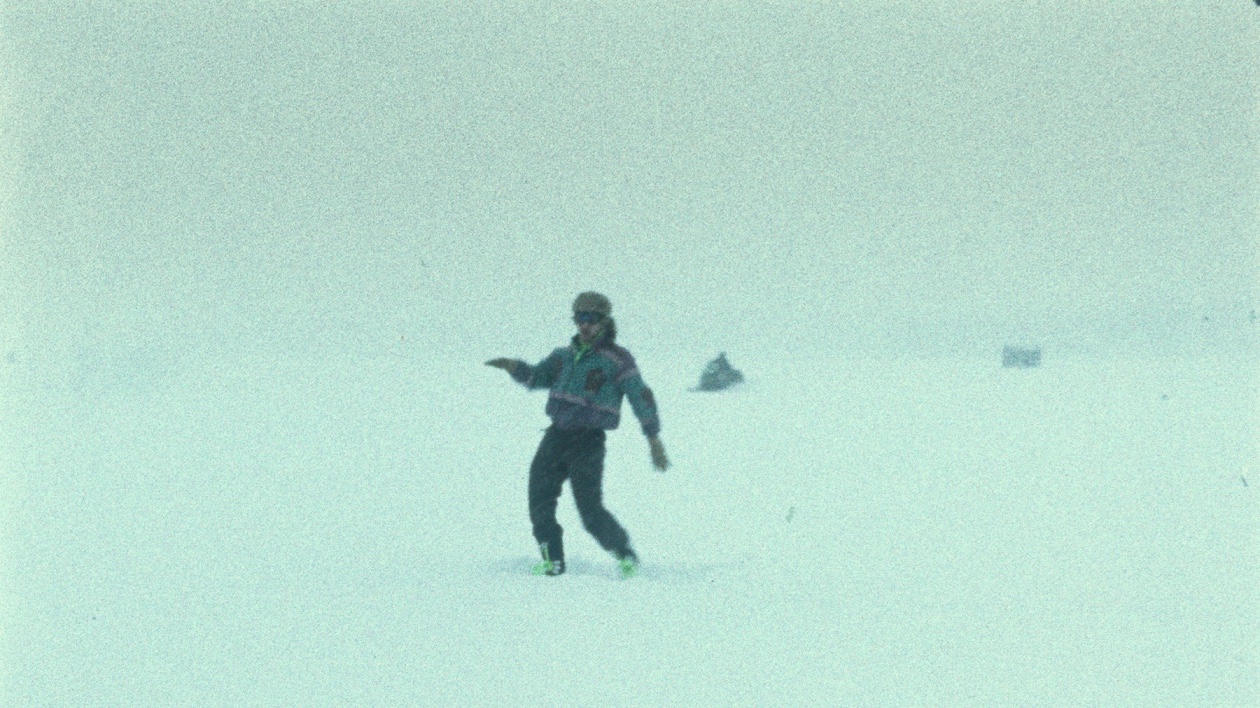
Exiting the museum, Nagisa wanders through a hidden trail in the woods and finally reaches the beach where she meets Natsuo, a local boy sitting alone by the shore. The two struck up conversations, along with plenty of silence breaks in between, from day to dawn. A clear echoing exists between Lee and Nagisa in this layered diptych. Both women – one in winter, one in summer – are displeased with their self-image; Nagisa talks about wanting to become someone else, and Lee often seems to be uncomfortable in her own skin during her daily interactions. In her narration, she describes herself as trapped in “a cage of words” and sees travel to be “about getting away from words”. So in the second half of the film, after attending a screening of the film made from her screenplay (which is clearly signaled to also be the first half of film that we’ve seen as the audience), it is Lee who embarks on the same journey just like her main character. And just like Nagisa, trying to find a place to stay for the night, she arrives at a desolate guesthouse that exists beyond the borders of the village’s map. The stranger waiting for her there is a lonesome middle-aged innkeeper. Beneath his scruffy face and ostensible gaucheness lies a man who’s quite malign with a murky personal history. A similar story unfolds with a different permutations of weather, location, and people, but it does not feel the same, as they never do.
The film’s clear formal break, which demarcates between the two stories, is rather clinical. There is even a Q&A session for the mise-en-abyme that directly demands Lee for her perspective on her work. When exiting the fiction, Lee has no more safeguards around herself. Part of the reason for this structure, as Miyake explains, is to be able to capture winter and summer in the film. Yet there is also this sense of inevitability that comes from Miyake’s hand, the film’s author, puppeteering the “fictional” and the “real” in his project and having them. This is perhaps why the film has been compared to Hong’s, where the jouissance of witnessing coincidence onscreen is actually part of a larger, constructed, labyrinthine fiction.
Miyake’s frames often feel quite rigorous. Often, hermeticism is created by doors or poles placed in the foreground of a statically composed frame to obstruct direct visual contact with the characters’ movements. The 4:3 aspect ratio transforms moments into pictorial vignettes. Silent pauses in the conversation between Lee and Benzo are often met with cuts to exterior landscape shots. The emergence of establishing shots – what’s commonly used to set up a scene in a new location – during the middle of conversations meets the characters in their constant act of displacement, where the yearning for a sense of place always lingers in the back of their minds.
The most alluring feature of the film may indeed be its casualness. And I think it may also be passed over for being too slight. But it’s this lightness in its story’s brevity that obtains the most charm. A woman has a bit of a crisis, so she leaves town to remove herself from her troubles. Nothing in the story directly answers her inner turmoil, yet it feels like everything’s answered solely because of the freshness of new encounters. After meeting some interesting people, having some conversations, and seeing some beautiful rivers and trees, she returns to writing, somewhat changed, but also somewhat not. I guess this cycle is also reminiscent of Hong and Hamaguchi (I apologize for the limited references): the alluring paradox of treating moments in everyday life with the intensity of a crisis while passing through them without too much lingering sentiment. The conversations that Miyake formulates do not compare to the intricacies of those of Hong’s, but it’s the curiosity for the spontaneous things we find in life, how shots in Two Seasons, Two Strangers linger on specific natural landscapes, like how Hong would zoom into the leaves of a tree, that serves the common lesson. The beauty of the undulating waves in a river is universal for the eyes.
Screening at Toronto Japanese Film Festival June 15, 2026



Leave a Reply