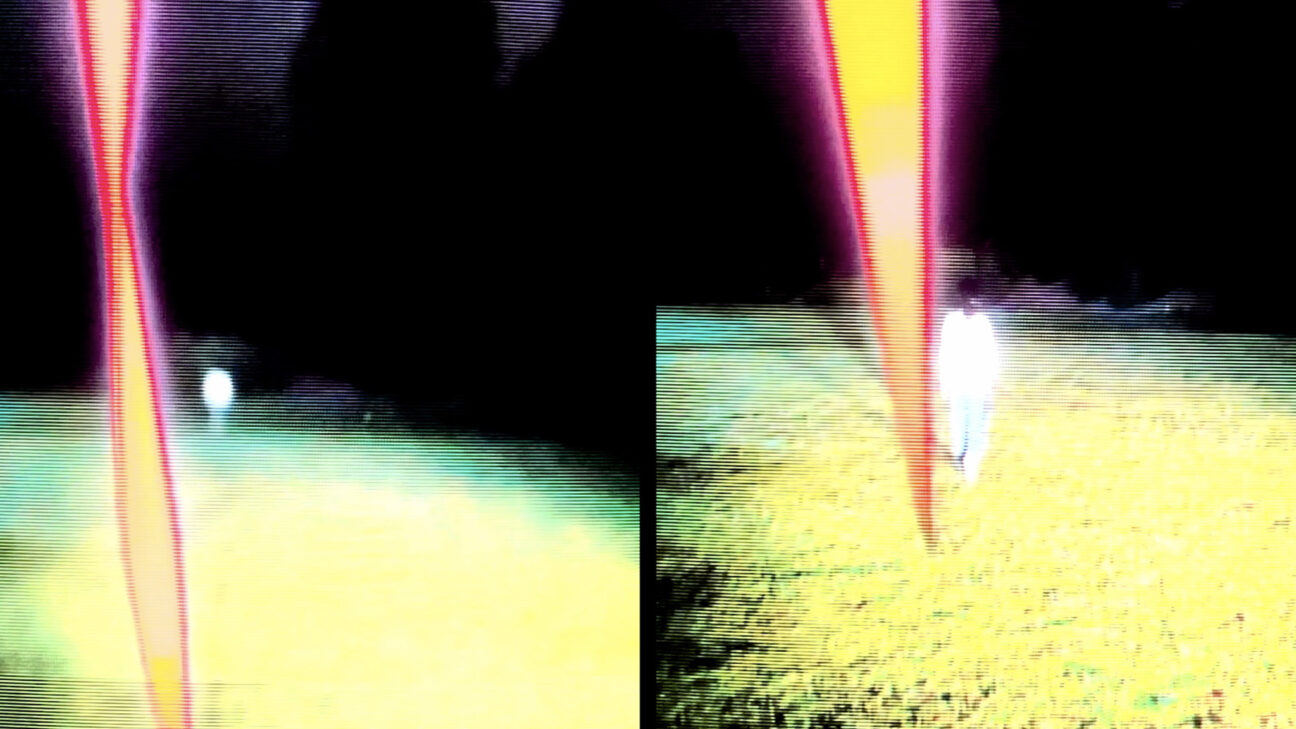
Julian Castronovo’s Debut, Or, Objects of the Field of Debris Currently Documented, lives inside one of those deep Internet rabbit holes, where the abundance of information reaches a level of infinitude that, when one stares into the abyss, their image becomes absorbed, and their reflection can no longer be seen. It works fascinatingly as a 2020s noir. Why? The absence of space, something once pivotal to the construction of the Hollywood classics, is now obscured by a digitally flat, two-dimensional representation. The character does not frantically enter or exit rooms as dictated by the narrative; in fact, the detective work is done remotely via the internet in the rooms of Castronovo, who is the director and the lead of the film. His physical presence is his appearance on a webcam with a resolution similar to those early 2010s YouTube videos. We can identify his face and his voice, but there is a barrier surrounding his presence, something personal, intimate, but ultimately unreachable.
Castronovo is the film’s sole onscreen character, but the film is distinguished from the strand of found footage films predicated on Internet lure by having the narrative presented through a third-party narrator, whose feminine, robotic voice insinuates that we are watching events that have already occurred; a fact true to all movies, but the delivery here makes it more conspicuous. It is sometimes used like narrations in John Smith’s films: autonomous, diaristically listing quotidian activities that accompany a structuralist flow of images onscreen. The narration is written in an objective manner that disguises the diegesis as deliberation of a series of physical evidence and documented facts. The story thus becomes a patchwork assembled from recorded calls, letters, video diaries, archival newspapers, and email correspondence that coheres into a diegesis through this mysterious entity behind the narration. So the reality in front of us, this running array of images, really exists within a cinematic vacuum form where its only constraint is the finite time that bounds every film.
The mystery begins when one day Castronovo finds a letter with no return address in his apartment that’s addressed to a figure named “F”. Upon further investigation, he discovers that the owner of his apartment once ran a forgery business and “F” is likely one of the forgers, a Chinese woman named “Fawn”, who has disappeared once the business seized. The core mystery here remains the investigation of an unknown identity. The similarities with the classic Noirs lie in the feeling that our existence is intertwined with larger conspiracies, and that untangling this web of mystery and obstacles in front of us would somehow transcend us beyond our own mundanity. In Lynch’s Blue Velvet, the underbelly of America unfolds in Dorothy’s room from the perspective of Jeffrey, who hides in her closet. Debut feels rather Lynchian, but the subjective eye of Jeffrey is supplanted by our shared experience with Castronovo, who encounters a series of newfound information and acts, and tries to make sense of our own fascination with fictions, which will only plunge us deeper into the fracture of the unexplanables. The most fascinating friction of film arises out of how two pieces of fictional storytelling flow in tandem: Castronovo uncovering the mystery of Fawn, and the other of the film disguising itself as an archive piecing together the character of Julian Castronovo in the film.
As Castronovo described himself, the film is constructed from material evidence and functions as an overlap of different epistemological frameworks. In other words, it was pieced together from concrete, physical things that are often rare in films centred on the subjective effort of a single person. The film does not make any clear social commentaries on contemporary society. But as Bertolt Brecht once said, “Truth is concrete”, and what resembles our society more is the paradox of the internet providing us with more access to documents of things that allow us to bridge any connections between anything, yet this abundance also pulls us further away from concrete connections and truth.
The film’s central force that unites the two central figures, amid the chaos, lies in both characters’ desire for creation. This brings back what I said a few paragraphs ago about the film existing in a vacuum; the desire to fill it, even in unconventional ways, is what connected Castronovo and Fawn, and what ultimately launches the former onto a quest to uncover the identity of the latter. Earlier in the film, the narrator brings up that Castronovo is a prodigious notetaker and diary writer. This is a kind of skill that may not be closely related to the art of filmmaking due to its enclosed nature, but it’s the film’s documentation of the process that establishes a distinct narrative style that lends it its own universe and reality. Fawn, who grew up in the forgery business in Shenzhen, had only the opportunity to express her artistry by replicating others’ works. As we discover later in the film, she would find a voice through conceptual photography. One may argue that a photograph is like a forgery of reality, but due to the fact that the two would never truly be identical, the artist invariably exerts her voice.
The unconventional aspects of art creation should always be taken into consideration because they reveal the personal and production conditions that artists work with. This can explain why the great masters of cinema can also be found under the hood of the classic Hollywood system, making westerns that follow a certain narrative formula. How can one diminish their artistry because of the story’s lack of originality, when we understand the context of their obligation to follow the industry’s rules of commerce, which were the only means they had to open the door to creating at all? But this is the year 2026. In the age of digital and the Internet, infinite information becomes infinite possibilities; one no longer has to conform to an industrial process to climb their way upwards; one room, one camera, a laptop, a stable internet connection, and a few close collaborators, as seen in Debut, give one the opportunity to create a reality and a world attuned to their personal experiences. Unconventionality lies in the method itself and in the way one sees reality moving forward. During one of their correspondence, the wannabe producer in the film asks Castronovo to “focus on what happened and less about her art and stuff”. It’s great that we don’t have to listen to that today.




Leave a Reply