The eye-catching title of Virgil Vernier’s Cent mille Millards is a number that the main character, Afine (Zakaria Bouti), a sex worker living in Monaco, counts to when he lies in bed at night. I find it pertinent that during his counting, the frame is fixated on a shot of construction sites – the promise of a place that our protagonist could never afford to live in. This cartoonishly large number, basically useless for representing anything in regular people’s daily lives, perfectly captures the margins between the disparate groups living in the city: the worry-free rich and the workers trying to claim a home. Like many cities inhabited by wealthy people, Monaco is a sleepless city, and many times during the film, Vernier would cut to shots of his camera surveying the coastal landscape and streets of the city, both appearing glistening by artificial lights; bright but grim, as there is no place for shadows to rest, busy and lonely.
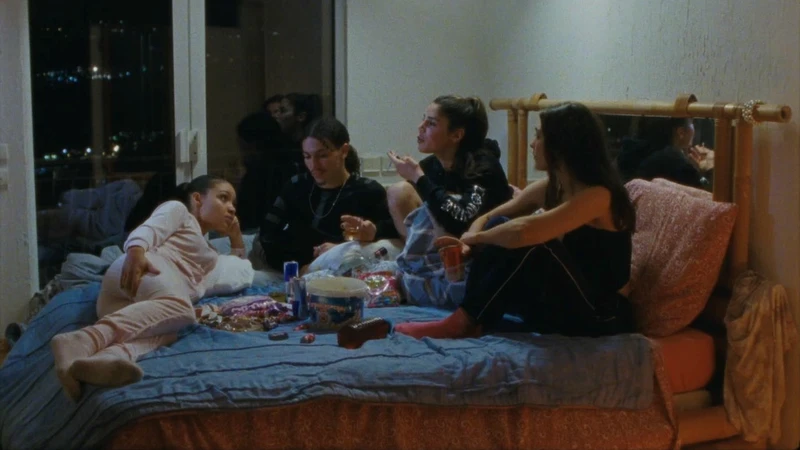
So here’s another contrast running throughout the entire film: how its documentary observational form – meaning real people hanging out with each other (none of the main actors seem to have any other acting credits) under a meanderous structure that does not follow any familiar story beats – comes into contact with a city that feels like a fictional paradise made of fancy restaurants, luxurious mansions, and high-end shops that exists above normal life. Time seems to be eerily frozen there. The mansion that Afine is invited to by his friend Vesna (Mina Gajovic) is owned by the parents of Julia, the 12-year-old she is babysitting, who are construction tycoons we never see onscreen; their omnipresent status is affirmed by the architectural design of the place itself.
Set around Christmas time, the film is somewhat about found family. During his stay, Afine hangs out with Vesna and Julia a lot – performing Christmas rituals, dancing, walking through underground passages that lead to a small beach – and he eventually strikes a friendship with Julia, and becomes someone she can confess her feelings to. A secret dialogue develops between the two, in which the film would be reinforced by lending both a brief chapter in which their interior voices narrate. They’re like reciprocating letters that the two never addressed to each other in real life.
However, Vernier is also acutely aware of the social disparity between Afine and Julia. Their roles in Monaco and perspectives toward it as a place are fundamentally different. Julia seems to see her home as a refuge from her monotonous boarding school, where there are unique people whom she can talk to and have fun with. In Afine’s eye, the city appears more melancholic and lonely, a place where he aimlessly wanders without a way out. At one point, a progressive friend of Afine’s yells at him for doing nothing all day, but the question is, what can he actually do besides this life he leads? Some of the film’s fantastical allusions have led many to comment that it feels like a fairy tale. In this sense, Julia seems like the prince who has the opportunity for adventure while yearning for home, while Afine is the princess trapped in the castle, defined by his social condition. As winter vacation ends and Vernier has to see Julia depart by private helicopter, this farewell scene set around dawn is plagued by the bitterness of unreachability.
Because Cent mille millards is also a film revolving around sex work. As a film that premiered in the same year as Anora, a social realist/fairytale hybrid film revolved around a sex worker from a different sleepless city, the difference between the two makes it understandable how one won the big prize at Cannes and the Oscars, while the other still has not gotten any distribution in North America. Other than a few scenes with his top off, Afine is barely sexualized for the camera. The film even seems to deliberately elude sex scenes – the first scene of the film ends with Afine shutting the door in front of the camera. Afine is stripped of the tag of a sex worker, and resembles a drifter in Monaco, constantly in displacement, an actual person granted with enough screen time to show his social life and his rather muted personality outside of work. Whereas in Anora, Annie’s performance, combined with the deterministic plot mechanics that purportedly follow the tragic neorealist tradition, only reinforces the audience’s pre-existing values about her line of work. This is not to say Cent mille millards does not show Afine in rather awkward situations, but those situations are not punctuated by genre classifications, so those scenes are allowed to breathe a little more. It’s astounding how the film manages to achieve much more with over an hour less of screen time.






Leave a Reply