Little Poems in Prose – Radu Jude, Andrei Rus:
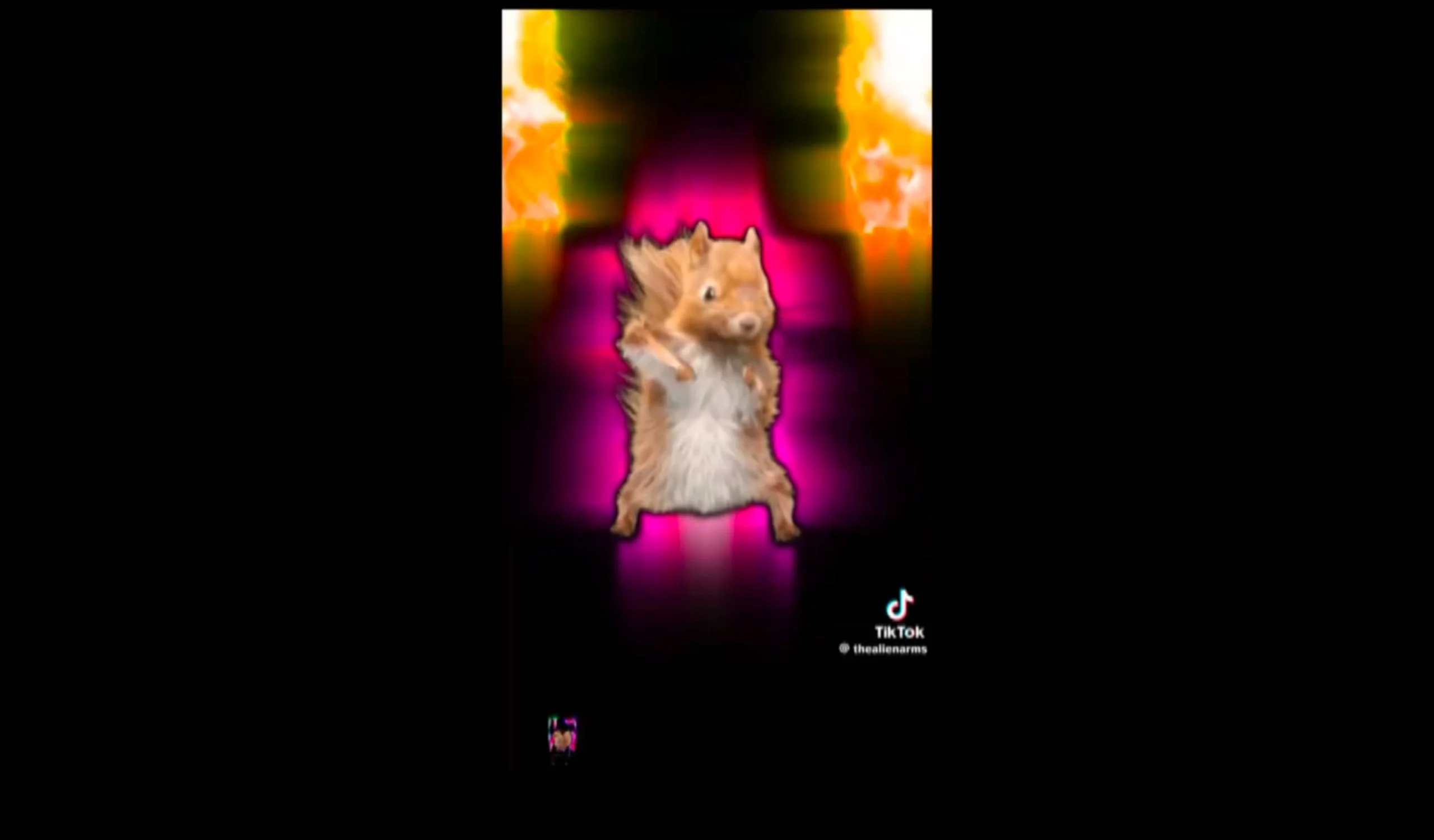
Radu Jude is by far the biggest name in the Flash Competition this year, yet somehow his co-directing effort with Andrei Rus also feels like the freest amongst the line-up. As described at the beginning of the film, this is a collage of TikTok videos assembled by Jude and Rus. The film is divided into 7 chapters. How the chapters are grouped and organized remains arbitrary. The penultimate chapter seems like an energetic musical, while the final chapter consists mostly of TikToks with A.I. visual effects. The individual videos often contain vulgar language, sexually explicit, and some delve into the uncanny imagination of the human brain. But despite the subject being how the TikTok world can easily seem as a bottomless pit, the film is, in fact, very geographically specific. The videos all feature personalities and regular people from rural Romania, embodying Romanian lives in the digital era that the Romanian New Waves from the aughts seem no longer have the formal means of capturing. The videos range from a man screaming revolution directly at the camera, to a group of hospital workers singing, to families costuming as minions, or a man reenacting Titanic with ice cubes in a tall glass and a muddy puddle.
What makes watching the film a different experience than actually scrolling on TikTok for 30 minutes is that one can no longer self-determine how long each video is going to play by scrolling away when it stops appealing to the attention span. Instead, the selection and editing process are done by Jude and Rus, who assembled the films into a fixed and connected experience despite its arbitrariness. It’s also noticeable that some videos are are not played in full as some don’t end with the trademark TikTok soundbite. The flow of the film gives the impression of contemporary life in Romania. There’s a certain joy in watching the unfiltered personas through the iPhone aspect ratio. Jude and Rus are not being derisive or treating the people in the videos as subjects for ridicule. In fact, they have repeatedly emphasized how this new era of TikToks echoes the cinema of spectacle when it was first invented. There’s no doubt that people put on facades when they performing in front the camera, yet the authenticity lies in how the camera has been democratized so anyone with a cellphone and the internet is granted creative control for self-expression. This mixture of collectivism (how everyone can create) and individualism (how this new freedom introduces an inifinite amount of possibilities that make shared experiences almost impossible) turns a new chapter for the idea of spectacles on screens. As A.I.-generated content dominates the final chapter, the film ends abruptly, without a farewell note; a new era quietly awaits.
My Little Nothing – Lucy Kerr
A dialogue between a nineteen-year-old girl and the devil, inspired by the texts in Mary Maclane’s book I Await the Devil’s Coming. The girl speaking as typed words on a black screen, and the devil is a static shot of a forest voiced by a synthesized male voice. The still image of the forest changes throughout the conversation: at times it seems sped up, at times shadows and darkness overtake the greens as the dialogue goes on, and at times infrared fills the frame.
I wasn’t a fan of Lucy Kerr’s Family Portrait, and this short reveals a similar issue: she seems to be very interested in crafting an ominous atmosphere, but beneath the looming ambient soundscape, the film seems to be very dry and bereft of any emotional content that can serve as the base of the formal ambition.
Chronicles of Tiredness – Natalia Marín
Horror of the ownership of life. The film consists of five shots in total: four tracking shots – all moving from left to right at a constant pace – and a static low-angle composition of a woman opening and shutting a kitchen drawer over and over again. This latter sequence invokes the unsettling feeling one would often feel watching a Kiyoshi Kurosawa film – the horrid dread of monotonous life. The first two tracking shots are accompanied by interrogations, in which an interviewer asks a woman questions about her application to live and work on a piece of land. The most memorable moment is when the first interviewer asks if the woman can read and write. The woman answered yes; the interviewer immediately said she would be given three years to learn if she couldn’t, and repeated the question. After a brief moment of silence, the woman answered no. The second conversation seems to be a follow-up interview in which the woman has learnt to read. The film derives most of its effects from repetition, in both how sound and images are incorporated. Its formal intention is very clear, almost to a point of dogmatism; in each shot, the viewer will understand what’s being attempted after a few seconds. But it still provokes an unsettling feeling, because just like life itself, what’s scary is not the immediate answers, but what then and how long will this go on? What about this house? What about this pavement? What about this land? In Marín’s work, we never see a human face, only their hands, the sound of their breathing, of them labouring with shovels, of countless names lined up on a shelf as folders of paperwork, yet there is this horror of a trajectory of life that keeps pulsating and haunting through its inevitability.
Love Would Have Sufficed Even for Nietzsche – Pierre Creton
Brings to mind a scene close to the opening of A Prince, where a woman sits next to a large window and reads a book; her voice explains the images preceding the shot and carries into the rest of the film as a power of fiction. The entirety of Love Would Have Sufficed Even for Nietzsche is built around Michel Surya’s The Eternal Returns, and Creton adopts the text in a very understated manner: he lends the power of the text to the simplicity of the human presence that reads it. A woman repeats the same text in front of the camera over and over again; what of this repetition? A majority of the film is a fixed shot of a window facing outdoors where we can see the waves crashing onto the shore. There’s also the burst of music, done in the way of many late Godards. Many of the compositions – the cat and dog, the man playing tennis – await the promises of salvation and return mentioned in the text.
Gestures to Break an Image – Gestos Para Romper Una Imagen
The lyrical nostalgia we find in the pixelated image of films such as Dry Leaf and In Water is reclaimed by Imagen for the politically fuelled implication of the tools that create them – the surveillance camera. The film uses a mixture of Google Street View and Surveillance footage, accompanied by subtitles where the director inserts their personal reflection on the images. At one point, surveillance footage directly transitions to Google Street View over a bridge. The acts of reclaiming and reconciliation are already present in the title, freely zooming and scrolling in Google Street View, contemplating those blurred-out faces, or using editing technologies to remove the police force captured in the surveillance footage, rendering them invisible, almost like the machine in Terminator 2.
The use of Google Street View reminds me a lot of the first half of Maps of Traces by Chan Hau Chun. But Chan’s film seems to have a better mixture of nostalgia, humour, and politically pointed moments, while Gestures to Break an Image is more fuelled by despair and anger. Towards the end, Imagen looks up at the stars in the galaxy through Google Street View, searching for answers, but her contemplation feels more like a message to me.
The Prehensible (The Text is Thunder) – Assia Tarquier-Zauberman
Diaristic journey of wandering and philosophizing through the city into the night. Misarrangements of subtitles on screen. Love and companionship as shadows on the ground. Occasional thunder without sound emerges like footage of Derrida. Very messy and disorganized. Funky town and horse mask.
I Couldn’t Draw You a Map – Yaela Gottlieb
Another diary entry into this year’s Flash Competition programme. Through his travelogue, Gottlieb seeks to draw the audience a map of Mitrovica, Kosovo and provide a picture of the city’s divided politics. Onscreen text accompanies footage shot by Gottlieb as he travels across different quadrants of the city – from South to North. The images seem to be haphazardly assembled, like someone dumped all the videos from their iPhone’s video gallery taken during a trip, arbitrarily edited them into a film, and wrote some text to recall what they did. Having others understand, and more importantly feel, the thoughts flowing in your stream of consciousness requires more consideration in the image and assemblage.
Dentro de lo Azul (in of the blue) – Racornelia
Its formal moves – superimposition of action converging past and present, the same conversation looping throughout the film – are used to service a vacant idea of heartbreak – a symbolic gesture rather than something that arises out of form. When someone like Hollis Frampton plays with sound and images, the project is not built to serve an overarching sentiment but to play with cinema itself. This is the exact opposite. Closer to a Pinterest moodboard than a film. I’d bet they will link up with A24 within 5 years.
Boyuna – Guillermo Quintero
Guillermo Quintero’s Boyuna, along with Racornelia’s Dentro de lo Azul, are the two shorts with the most mainstream appeal in the line-up, in a pejorative sense. The film is a sci-fi film constructed with limited means and sets within liminal, hermetic spaces. In the year 2135, most species we’re familiar with now are extinct, and the titular corporation, Bayuna, is offering excursions that let its customers experience sensorial contact with natural environments of their choosing, whether it is fighting with a spider in the forest or fishing next to a bay at dusk. Its compositions mostly rely on the current film industry norms of symmetry and intense close-up with shallow focus. Its music, while acting as proper ambience, merely serves as sonic bridges that connect the unrelated compositions together. It creates an atmosphere that’s quite stale because the film sustains at a level that’s difficult for any surprise to break in.
The film also purportedly serves as an actor’s workshop for a group of trainee inmates at the Baumettes prison, but the compositions are far too rigorous for their presences to breathe. The sensorial experiences are uniformly filmed with shadowy silhouettes of bodies performing gestures in front of a three-panel panoramic screen. The simplicity of the setup is somewhat of interest, as it does manage to communicate its concept through a simple visual idea. But the overall moment just feels so detached. As the film shifts into more abstract territory, it does not carry reality with it.



Leave a Reply