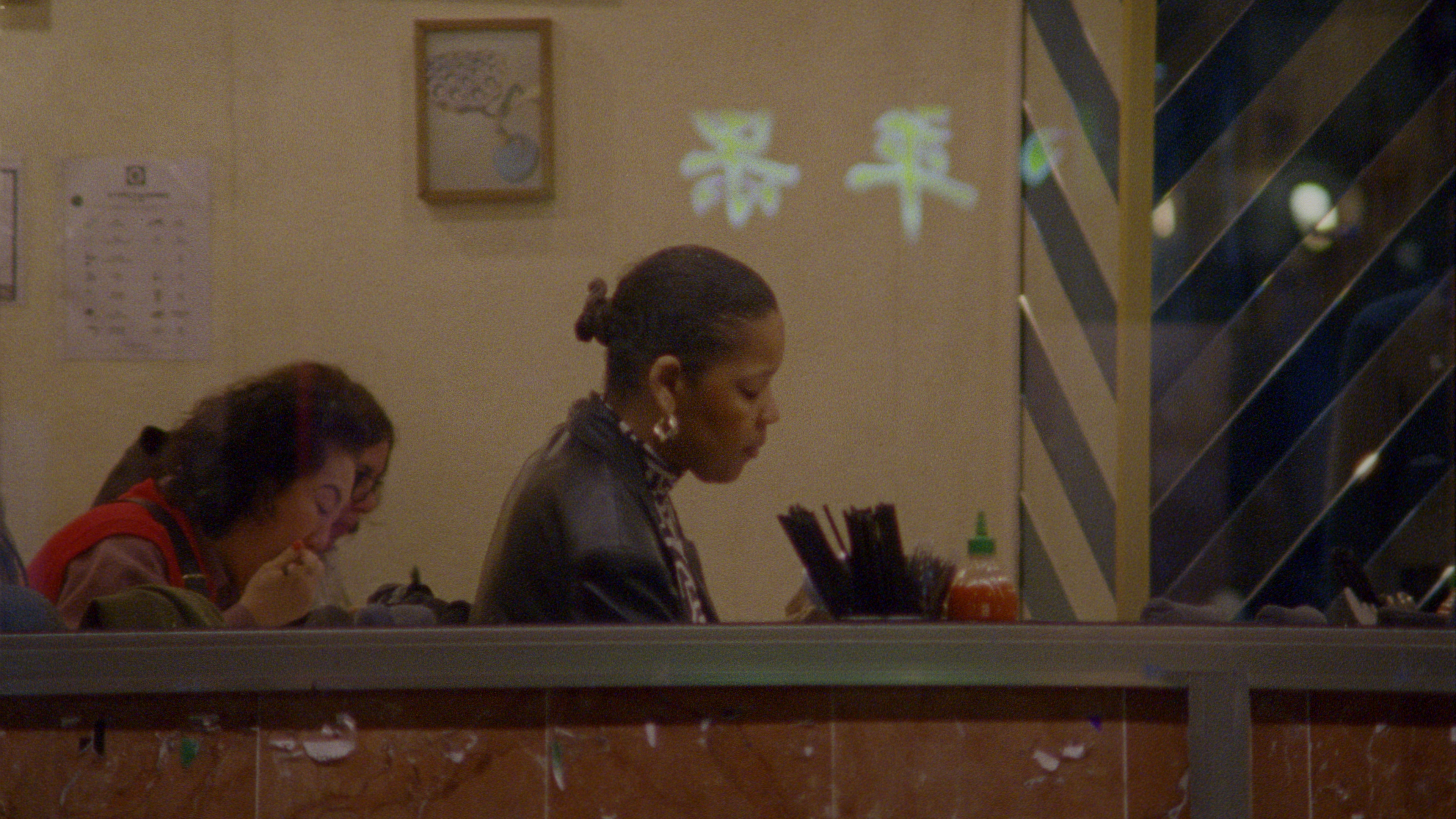
Beatrice Gibson’s debut feature, At Night, after a dozen or so short films, seems to stem from an imagination of the subway as a collective space and infinite fiction. It’s like taking the subway, briefly glancing at others around you, and managing to create a narrative from a few minutes of their presence. But the filmmaking process contradicts that, as it is a work of autofiction, one shared by the six women onscreen – Gibson herself being one of them and a prominent player – that was formed through a process of screenwriting workshops that made each woman their own screenwriter – an interwoven tale of collective monologues made of the imagination of selves.
The film opens with a quote from Alice Notley that begins with “I am a tone of voice.” This “I” is pertinent: we first hear Gibson’s voice and see her presence in the film. She is the point of dispersion for everything else in the film; a director standing on the platform of a subway station, imagining others would join her. She leaves a voice message to a woman named Didi, with whom she seems to have a falling-out after they last worked on a film, asking to talk it out in person. In a film with many face-to-face conversations in shared spaces, the voice message stands out, opening up the ambiguity of whether the person on the other end receives and acknowledges it. We, as the audience, also feel a kind of insecurity when someone onscreen takes a call, as we cannot hear the voices from the other side; it is the insecurity of whether one’s talking into a void or not – the desperation for constant connection and the illusion of such in the digital age that leads to total alienation. In At Night, Gibson seems to be mitigating this sense of alienation by consistently preserving a connectivity in her form – whether through sombre musical acting as connective tissue for different visual and aural elements or montages that bind women moving in disparate spaces together.
At Night and Gibson’s earlier short, I Hope I’m Loud When I’m Dead, share many thematic overlaps: the communal experience of women, the catharsis brought forward by dances, and concern about motherhood and the future for the children. However, Gibson handed the cinematography and editing duties to Ben Rivers and Liyo Gong, respectively, and with money from the BBC, the results seem to be a more polished investigation of those themes – the rhythm is less raw and more pensive, hypnotic and, obviously, the length allows for more extensive segments dedicated to her studies of various topics such as privilege, motherhood, race, feminism, etc..
Reviews have compared it to Ackerman, which I suspect is mainly because of Tout Une Nuit. While there is a sequence that shows the parallel lives of various anonymous groups of people at nighttime – people closing shops and going home – Gibson’s project, to me, seems like the opposite of Ackerman’s closed-off, painstakingly constructed frames that yearn to be connected. Her frames seem more sentimental, drawn less to spaces that confine people within their own solitude, and more towards a kind of cohabitation. We see long conversations between women, sometimes around a table at a restaurant, sometimes inside a locked-up convenience store where they’re trapped after the electricity went out, or just outside at a bus stop after a soul musical performance has just shaken their souls. The sharing of extremely intimate personal details, like sex drives during pregnancy and abortion, is only possible in a communal environment when the people at the table feel comfortable in the presence of one another. Just as the découpage in the longest table conversation in the film would fixate on a single face listening or speaking, but suddenly incorporates rapid pans and zooms to alternate focus between multiple people, the overall lack of rigour acknowledges the feeling of a sudden awareness that the people besides you share or contradicts a sentiment.
Gibson does not intend to craft an eternal Pleasantville. Like the screenwriting process, collaboration and mutual ground also include friction. In a scene between Gibson and Didi, one of the two Black women in the cast, after Gibson shares her troubles, Didi directly says she can’t relate to her privilege – “inequality is toxic” – and the scene takes on an unshakable tension that disrupts the tranquil niceness of 16mm photography and nocturnal scenery.
Subways and dining tables are not the only communal spaces. Through a musical performance scene near the end of the film, Gibson also proposes the question of whether the act of perceiving art in a shared room, even if two people do not acknowledge the presence of each other, initiates an act of connection as well. Of course, the proposal is metatextual, as we, the viewers, are watching the film in a packed theatre together, looking at the nocturnal London subway entering and departing the stations, passing by the tunnel lit by hues of light, as well as the strangers who share their intimate feelings and listen to others as well.



Leave a Reply